
Quick Summary
Trading card storage is all about protecting cards from humidity, heat, sunlight, dust, pressure, and everyday handling. Store valuable cards in penny sleeves, then top loaders and team bags, using acid-free boxes with enough room to keep cards upright without forcing them together. Keep the collection in a dark, temperature-stable interior closet, and store graded slabs vertically with protective sleeves. For larger collections, climate-controlled storage can provide the consistent temperature and humidity your cards need.
Look, I’m gonna be straight with you. I’ve been collecting cards since I was a kid ripping packs of 1999 Base Set. And I’ve made every stupid mistake you can possibly make with storage. I left cards in my car during summer. I stacked heavy boxes on top of binders. I even stored some in my mom’s damp basement.
I learned the hard way so you don’t have to.
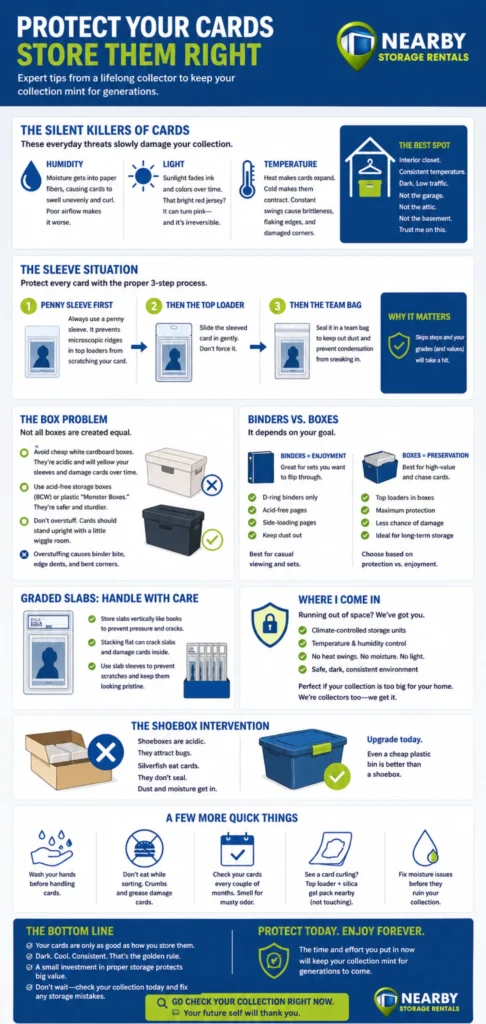
Let’s start with the stuff that actually kills cards. And I’m not talking about rare floods or house fires. I’m talking about the slow, quiet killers that creep in while you’re not paying attention. Poor Trading Card Storage is often the biggest culprit, exposing your collection to humidity, heat, sunlight, dust, and everyday wear that can slowly damage even your most valuable cards.
Humidity is public enemy number one
You know how your cards start to curl up like a Pringle after a while? That’s moisture. It gets into the paper fibers and makes them expand. The front of the card and the back of the card absorb moisture at different rates because the coating is different. So one side swells, the other doesn’t, and bam – you’ve got a bent card.
I cannot tell you how many collections I’ve seen ruined just because someone kept their box in a room without good airflow.
Then you’ve got light
We all want to show off our stuff. I get it. I’ve got a few display pieces myself. But sunlight is brutal. It fades ink like you wouldn’t believe. That bright red jersey on your rookie card? Leave it in the sun for a few months and it’s gonna look pink. It’s irreversible.
And then there’s temperature
Heat makes cards expand. Cold makes them contract. Do that back and forth enough times and the cardboard gets brittle. The edges start flaking. The corners look like someone took sandpaper to them.
So where do you keep them? Not the garage. Not the attic. Not the basement. Trust me on this.
The best spot in your house is an interior closet. Somewhere the temperature stays consistent. Somewhere dark. Somewhere you’re not walking past and bumping into the box every day.
The Sleeve Situation
Alright, let’s talk about sleeves because I see people messing this up constantly.
You need a penny sleeve. Every single card. Even the junk ones.
Why? Because the hard plastic cases – the top loaders – they have microscopic ridges inside. You slide a raw card in there, and those ridges scratch the surface. You might not see it with your naked eye. But if you ever send that card to PSA or BGC, they’ll see it under magnification and your grade drops like a rock.
So here’s what you do:
- Penny sleeve first. Slide the card in gently. Don’t force it.
- Then the top loader. Press it in carefully.
- Then – and this is a pro move – put the whole thing in a “team bag.”
Team bags are those thin plastic sleeves that seal at the top. They keep dust out. But more importantly, they keep condensation from sneaking in through the top of the top loader. If you live somewhere humid, this is non-negotiable.
The Box Problem
So you’ve got your cards sleeved and loaded. Now you need a box.
Most people grab those cheap white cardboard boxes from their local shop. You know the ones. They’re like two bucks.
Here’s the thing about those boxes – they’re acidic. Over time, that acid leaches into your sleeves and turns them yellow. I’ve opened boxes from the early 2000s and the cards looked like someone had been smoking around them for twenty years. The paper was brittle and stained.
Spend a few extra bucks on acid-free boxes. BCW makes good ones. Or get the plastic “Monster Boxes.” They’re sturdier anyway.
And please, for the love of everything, don’t overstuff your boxes.
I know you want to fit just one more row. But if you’re forcing cards in, you’re pressing on the edges. That causes “binder bite” – those little dents along the side. Or worse, it bends the corners.
You want your cards standing upright with a little wiggle room. Not flopping around, not jammed in tight. Just comfortable.
Binders Versus Boxes
This is a debate that’s been going on forever. Which is better?
Honestly? It depends on why you’re collecting.
If you have a complete set and you want to flip through it and admire it, binders are great. I have a few binders myself for my favorite sets.
But you gotta be picky about the binder
- D-ring only. Those O-ring binders pinch the pages and leave indentations on your cards.
- Acid-free pages. Cheap pages have PVC and they’ll ruin your cards over time. They get sticky and the card gets stuck to the plastic. You peel it off and the surface rips.
- Side-loading pages. Dust falls into top-loading pages. Side-loading keeps the dust out.
If you’re storing high-value cards – like chase cards worth hundreds – I’d keep them in top loaders in a box. Binders just don’t offer the same level of protection. They get dropped. Cards slide out. Pages get bent.
Boxes are for preservation. Binders are for enjoyment. Choose accordingly.
Graded Slabs
With all the grading craze these days, a lot of you are sending cards to PSA and BGC. Once they come back in those plastic slabs, you think they’re invincible.
They’re not.
Here’s the thing nobody tells you – those slabs are heavy. If you stack them flat on top of each other, the bottom ones are bearing the weight of all the ones above. That pressure can crack the slab. Or worse, over time it can press down on the card inside.
Always store graded slabs vertically. Stand them up on a shelf like books. Takes the weight off.
Also, those slabs can get scratched. You’re paying good money to grade a card. Why would you let the slab get all scratched up? Get slab sleeves. They’re cheap and they keep the plastic looking fresh.
Where I Come In
Look, I’m a collector too. I’ve got boxes taking up half my closet. I’ve got binders on my bookshelf. And at some point, I ran out of room.
That’s why I started paying attention to storage units. Not the sketchy ones behind the gas station. I mean proper, climate-controlled units.
If your collection is getting too big for your living space – and let’s be honest, it happens to all of us – you’ve got options. You don’t have to shove your cards in a garage or a crawl space. We offer storage with temperature and humidity control. It’s the same environment you’d want in your own home. No heat swings. No moisture. No light. Just safe, dark, consistent.
I’m not saying you need to rent a unit tomorrow. But if you’re at that point where your collection is taking over your house, keep us in mind. We get it. We’re collectors too.
The Shoebox Intervention
I need to say something and I don’t want you to take it personally.
If you’re still storing your cards in a shoebox, we need to have an intervention.
Shoeboxes aren’t acid-free. They attract bugs. Silverfish love cardboard and glue. I’ve seen silverfish chew right through a 1st Edition Charizard like it was a snack. They don’t care about value.
Shoe boxes don’t seal properly either. Dust gets in. Moisture gets in.
I know it’s convenient. I know you’ve been doing it since you were a kid. But it’s time to upgrade. Even a cheap plastic bin from Walmart is better than a shoebox.
A Few More Quick Things
- Wash your hands before handling cards. The oils on your skin are acidic. Over time, they’ll degrade the surface.
- Don’t eat while sorting. Crumbs get in the sleeves. Grease from chips transfers to the cardboard.
- Check your cards every couple of months. Open the box. Smell it. Musty smell means moisture. Fix it before it’s a problem.
- If you see a card starting to curl, get it in a top loader with a silica gel pack nearby. Not touching the card – just nearby in the box.
Bottom Line
Your cards are only as good as how you store them.
A pack-fresh card is beautiful. But if you throw it in a drawer and forget about it, it’s not gonna stay pack-fresh. It’s gonna warp, fade, and degrade.
Take the time now. Get the right sleeves. Get the right boxes. Keep them in the right environment.
It’s not expensive. A pack of penny sleeves is a few bucks. A box is maybe ten or twenty. That’s nothing compared to the value of what you’re protecting.
And if you need more space, we’ve got you. Just remember – dark, cool, consistent. That’s the golden rule.
Now go check on your collection. I mean it. Go look at it right now and see if you’ve got cards in top loaders without penny sleeves. If you do, fix it.
Your future self will thank you.










0 Comments