
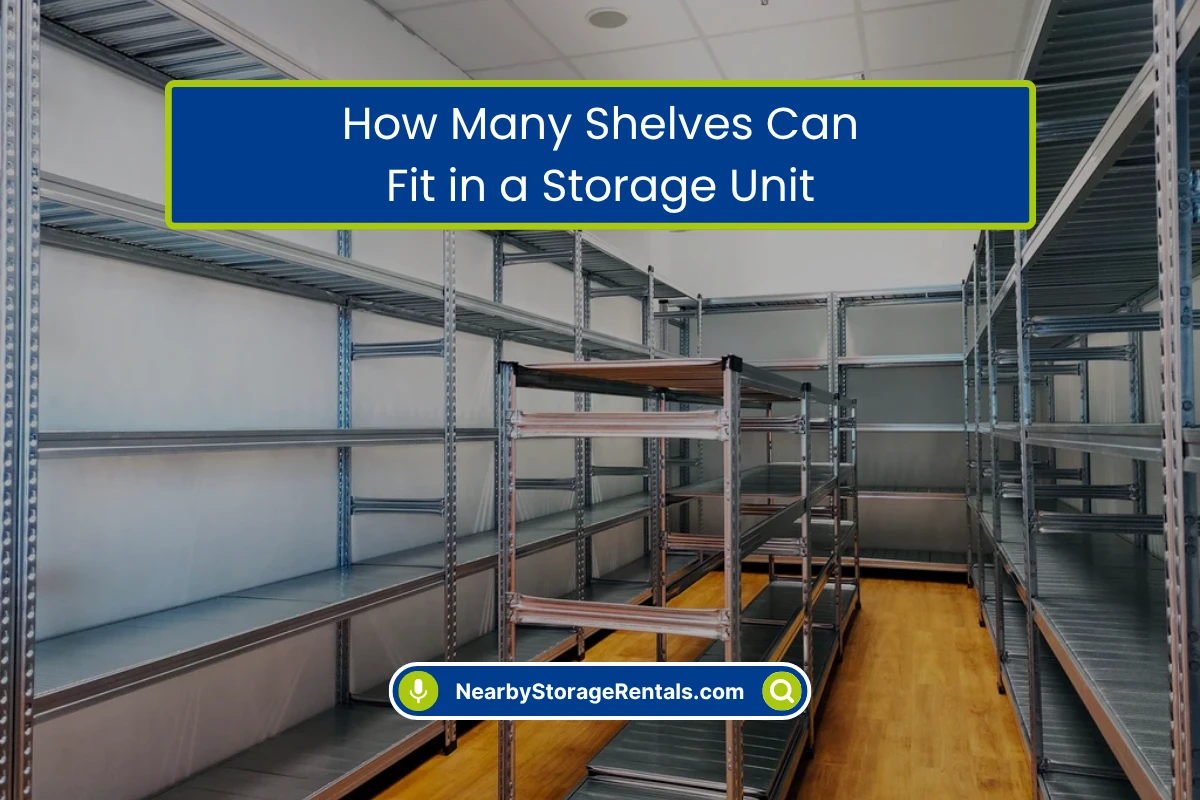
So you’re wondering how many shelves fit in a storage unit.
I get asked this all the time at our place. And I always kind of groan inside because it’s one of those questions that sounds simple but absolutely isn’t. But I also get why you’re asking. You’re trying to plan. You’re trying to figure out if you need the 10×10 or if you can squeeze into the 5×10. You don’t want to rent something too big and waste money, but you also don’t want to show up with a truck full of stuff and realize you’re screwed.
Let me just tell you straight up – anyone who gives you a firm number without knowing what kind of shelves you have is lying to you. They’re guessing. And they’re probably hoping you’ll rent a bigger unit than you actually need.
I had a guy named Tom come in last month. He’d already rented a unit somewhere else because the manager there told him “oh yeah, five shelves will fit easy in a 10×10.” Tom shows up with his five shelves and guess what? They were these massive, solid wood things from his grandfather’s house. Each one was like six feet tall and four feet wide. He got two of them in there and couldn’t even close the door. The other three sat in his truck while he called every storage place in town looking for something bigger.
That’s the kind of thing that makes me mad. Because Tom wasted a whole day and a bunch of money because someone gave him a number without asking the right questions.
So I’m going to ask you the right questions.
First thing – are your shelves assembled right now?
This is the biggest one. And I know what you’re thinking. “Of course they’re assembled, they’re shelves.” But what I mean is – are they put together and ready to use, or are they flat in a box somewhere?
Because here’s the reality. An assembled shelf is basically a piece of furniture. It takes up floor space. It has a footprint. You can’t put anything on top of it or in front of it without blocking access. It’s just… there.
But a disassembled shelf? That’s just a stack of wood. You lean it against the wall and it takes up maybe two inches of depth. You can fit ten disassembled shelves in the space of one assembled one.
I know you don’t want to take your shelves apart. Nobody does. It’s a pain in the ass and you already spent an afternoon putting them together. But if you’re storing them for more than a month or two, I promise you it’s worth the extra hour to break them down. You’ll save space, you’ll save money because you might need a smaller unit, and your shelves will actually be safer because they won’t get knocked around or warped while they’re standing up.
Second question – what kind of shelves are we talking about?
Because there’s a huge difference between a wire rack from Home Depot and a solid oak bookcase.
Wire racks are the MVP of storage units. They’re narrow, they’re lightweight, and you can see through them. That last one matters more than you’d think. When you can see through a shelf, you can access stuff from both sides. You can put a wire rack in the middle of your unit and use it as a divider. You can load stuff on it from the front and the back. You can fit way more of them in a space because they don’t have any bulk to them.
Wooden bookcases are the opposite. They’re heavy, they’re bulky, and you can only use them from one side. You put a wooden bookcase against a wall and that’s it – that’s where it lives for the next year. You can’t move it easily. You can’t rearrange it. And you definitely can’t put anything in front of it because then you can’t get to your stuff.
I had a woman last week who was moving her whole apartment into storage. She had six bookshelves. Six. They were all different sizes and colors and she was really attached to them. She wanted to keep them in her unit so she could move them straight into her new place when she found one.
We looked at her stuff and she really wanted a 10×15 unit. But the price difference between that and a 10×10 was like seventy bucks a month. Over a year, that’s almost a thousand dollars.
I suggested she break down four of them and keep two assembled. She resisted at first. But I walked her through the numbers – she’d save almost a thousand bucks and she’d still have all her shelves. She ended up doing it. She brought me coffee the next week to thank me.
That’s the stuff I love. Helping people save money without sacrificing what they need.
What Actually Fits: Real Numbers for Real Shelves
Let me give you some real numbers though. Because I know you want something to work with.
If you’re bringing wire shelves – the ones that are about two feet wide and eighteen inches deep – here’s what I’ve seen work at our facility:
- 5×5 unit: You can fit one. Maybe two if they’re really narrow and you put them back to back in the middle. But honestly, in a unit that small, you’re better off just stacking boxes. Use the floor as your shelf. Save the money and skip the shelving entirely.
- 5×10 unit: You can fit three or four along the long wall. Put them against the back wall, leave yourself walking space in the front. That’s the sweet spot for this size.
- 10×10 unit: This is where it gets fun. You can fit six to eight wire racks if you set them up right. Three along the back wall, three in a second row in the middle, leaving yourself an aisle between them. You can basically create a tiny store in there.
- 10×15 or bigger: Honestly, as many as you want. I had a guy who ran a small business and he had like fifteen wire racks in a 10×15. He had them organized by product category. It was beautiful.
Now if you’re bringing assembled wooden bookcases – the kind that weigh a ton and you need a friend to help you move – here’s the reality:
- 5×5 unit: Zero. Don’t even try. It’s not happening.
- 5×10 unit: Maybe one. And it better not be too deep or you won’t have any walking space.
- 10×10 unit: Two to four, depending on the size. But if they’re the big ones – six feet tall and four feet wide – you’re looking at maybe two, and you’re going to be squeezing around them.
- 10×15 unit: Maybe five or six. But again, it depends on the size.
Here’s something I wish more people understood about shelves and storage units.
The depth is what gets you
Everyone focuses on height and width. They’re standing in their living room looking at a shelf and they’re thinking “it’s six feet tall and three feet wide, so it should fit.”
But the depth is the killer. If your shelf is two feet deep, that means it sticks out two feet from the wall. In a ten-foot-wide unit, you’ve got ten feet of width, but you lose two feet right away if you put a shelf against each wall. Suddenly your ten feet of space becomes six feet of walking space. And if you’re trying to get past someone or move a box, six feet is nothing.
Wire racks are usually about eighteen inches deep. That extra half foot of space makes a huge difference.
The height matters less than you think
Here’s the thing – most storage units have eight to ten foot ceilings. But you can’t actually use all of that space. You need to leave a few inches at the top so you can actually see what’s on the top shelf without guessing. And if your shelf is too tall, you can’t fit it under the door track or the light fixture.
I saw a guy once bring a shelf that was exactly eight feet tall. The unit had a light fixture hanging down about a foot from the ceiling. He had seven feet of clearance. His shelf was eight feet tall. He had to lay it on its side and that meant he couldn’t use it at all because it wouldn’t stand up.
The door is smaller than you think
I keep saying this but people never listen. The door of a storage unit is usually about three feet wide. That’s it. If your shelf is wider than three feet, it’s not going in. You might be able to rotate it or tilt it, but you’re going to be cursing and sweating and probably scratching up your paint.
I had a couple bring a huge entertainment center last year. Beautiful piece. Solid wood. Must have weighed two hundred pounds. They measured the unit, they measured the space inside, everything looked great. But they didn’t measure the door. That thing sat in the parking lot for two hours while they figured out they had to take it apart. They were not happy.
Let me tell you about my favorite customer, though
Her name is Karen. Not the “I want to speak to your manager” kind of Karen. She was a teacher who was going overseas for a year and needed to store her classroom materials.
She brought in about twenty boxes of books, art supplies, teaching materials, everything. No shelves at all. Just boxes.
And she stacked them perfectly. Big boxes on the bottom, medium ones in the middle, small ones on top. She left a walking path down the middle so she could get to everything. She labeled every box on the side so she could read them without moving anything.
She fit all of her stuff in a 5×10 unit. No shelves needed. She saved herself money on shelving and on the unit itself.
That’s the thing, right? Sometimes the best shelf is no shelf at all. Just stack your boxes and call it a day.
Here’s what I’d tell you if you walked into our office right now
Bring your measurements. All of them. Height, width, depth. Whether the shelves are assembled or not. And if they’re assembled, whether you’re willing to break them down.
We’ll walk you through the unit. Show you where things could go. Give you honest advice on whether you need to go bigger or if you can stay smaller.
I’ve been doing this long enough that I can usually look at a list of stuff and tell you within a few feet whether it’s going to fit.
But I’ll never give you a number sight unseen. That’s how people end up like Tom, standing in a parking lot with a truck full of shelves that don’t fit.
One last thing
If you have to ask the question “will my shelves fit,” you’re already thinking about this the right way.
Most people don’t think about it at all. They just shove stuff in there and hope for the best. Then they come back a month later and everything’s a mess and they can’t find anything and they end up renting a bigger unit just so they can actually walk around.
You’re thinking ahead. You’re planning. That puts you ahead of about ninety percent of our customers.
So come in with your measurements. We’ll figure it out together. And if you want to store your shelves broken down and save yourself some money, I’ll even help you take them apart in the parking lot.
That’s what we’re here for.










0 Comments