
Quick Summary
Architectural drawings are easier to manage when you separate active, reference, and archive projects instead of cramming everything into your office. Use durable plastic tubes for active blueprints, flat files for drawings you check occasionally, and climate-controlled storage for older architectural drawings that no longer need daily access. Label every tube clearly, protect paper from moisture and sunlight, and keep digital backups without relying on them alone. Moving long-term archives into secure, clean storage can free office space while keeping important drawings accessible and protected.
You know what nobody tells you when you decide to become an architect? That half your job is wrestling with paper. Not designing. Not meeting with clients. Just… paper. Giant, unwieldy, impossible-to-fold paper that seems to multiply when you’re not looking.
I’ve been doing this for over a decade now and I still haven’t figured out the perfect storage system. And honestly? Neither has anyone else I know. We all just kind of cobble together whatever works and pray we don’t lose that one sheet that has the foundation details on it.
Let me walk you through what actually happens in a real architecture office, not what some magazine tells you should happen.
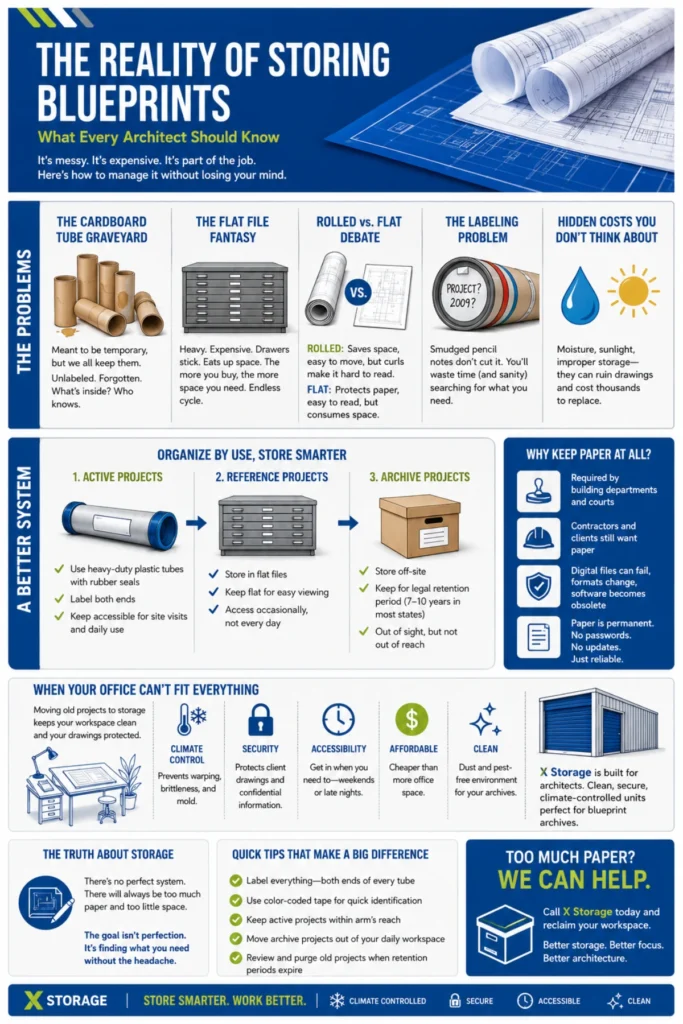
The Cardboard Tube Graveyard
Walk into any architecture firm and look at the corner of the main workspace. I guarantee you’ll see a pile of cardboard tubes. Some are standing up. Some are lying on their sides. Most are covered in coffee stains or have dented ends from being dropped one too many times.
You probably have this situation in your own office right now.
The thing about those cardboard tubes is that they’re supposed to be temporary. You’re supposed to transfer the contents to proper storage and recycle the tube. But nobody does that. We all think “I’ll just keep it in here until the project is done” and then the project finishes and you shove the whole tube in a closet because you’re too busy to deal with it.
Three years later you’re digging through that closet looking for something else and you find a tube with no label on it and you have absolutely no idea what’s inside. Could be a skyscraper. Could be a doghouse. Could be literally nothing because someone already pulled the plans out and threw the empty tube back in there.
This is the reality of blueprint storage. It’s messy and we all pretend it’s not.
The Flat File Fantasy
You’ve seen those giant metal cabinets with the shallow drawers. They call them flat files or map cases. They look incredibly professional. They cost a fortune. And everyone buys them thinking “this will solve all my organization problems.”
I bought one. Huge mistake.
- First of all, they weigh about four hundred pounds. You’re not moving that thing ever again. When you realize you placed it in the wrong spot in your office, you just have to accept that it lives there now. You work around it.
- Second, the drawers stick. All of them. Always. The nice ones have ball bearings but even those get sticky after a couple years of heavy use. You end up having to yank them open and they slam shut on your fingers. I’ve lost more fingernails to flat file drawers than I have to actual tools on a job site.
- Third, and this is the killer, you can only fit so many sheets in one drawer before they start overlapping and crinkling at the edges. So you buy more flat files. And then you need more space. And then you’re stuck in this endless cycle of buying heavier and heavier furniture for an office that is slowly turning into a storage warehouse instead of a place where actual work happens.
The Rolled vs. Flat Debate
Here’s where things get interesting. You have to decide whether you’re going to store your blueprints rolled or flat.
Rolled is easier. You put them in tubes, you label the outside, you stack them in a corner. Takes almost no floor space. You can fit hundreds of projects in a tiny area.
But the minute you roll a blueprint, you’re putting a permanent curl into that paper. That curl makes it hard to read. It makes it hard to lay flat on a table. You have to put weights on the corners or hold them down with your coffee mug and your phone and whatever else is within arm’s reach.
Flat storage keeps the paper in pristine condition. No curls. No weird waves. You slide the drawer open and everything is exactly as it should be.
But flat storage eats up square footage like nobody’s business. That cabinet is maybe four feet wide and three feet deep. That’s twelve square feet of floor space. In a downtown office where you’re paying fifty bucks a square foot, that cabinet is costing you six hundred dollars a year just to exist.
Most architects I know end up doing both. Current projects stay rolled because we need to grab them and go to site visits. Older stuff goes into flat files for long-term storage. And then we run out of room in both systems and start keeping stuff in our cars.
The Dreaded Labeling Problem
Let me ask you something. How many of your tubes actually have labels on them?
And I don’t mean labels that someone wrote in pencil three years ago that have since smudged off. I mean real, readable, current labels.
If you’re like most architects, the answer is “not enough.”
There’s a specific moment in every architect’s day where you’re standing in front of a stack of tubes and you know the one you need is in there somewhere but you’re going to have to pull out seventeen other tubes to find it. And then you put them back in the wrong order and you’ve just made the problem worse for next time.
I’ve started using color-coded tape on the ends of my tubes. Red tape means residential. Blue tape means commercial. Green tape means municipal. It’s not perfect but at least I can narrow it down before I start pulling tubes out and making a mess.
The Hidden Costs You Don’t Think About
Here’s something nobody mentions. Blueprints are expensive.
Not just to print. That’s bad enough. But to store them properly? You need acid-free paper. You need special folders. You need climate control. You need tubes that won’t degrade over time.
And the cost of not storing them properly is even higher. I’ve seen moisture get into a tube and ruin an entire set of structural drawings. That set cost nearly a thousand dollars to reprint. Plus the delay while you’re waiting for the new ones to show up. Plus the embarrassment of having to explain to the client why you don’t have the drawings ready for the meeting.
I’ve seen sunlight fade blueprints so badly that you couldn’t read the dimensions anymore. That project had to be redrawn from scratch because nobody had the original digital files. Weeks of work, gone because someone left the tube leaning against a window.
Where Does the Old Stuff Go?
This is the question nobody wants to answer. Eventually you have to retire old projects. You’re required by law to keep them for a certain number of years. In most states, it’s anywhere from seven to ten years for liability reasons. But after that? You can technically get rid of them.
But you won’t.
Architects are packrats. We keep everything. We have projects from fifteen years ago sitting in our offices. They’re not taking up much space. Just a tube here, a box there. But over time, it accumulates.
I spent three hours last month going through my archive closet. I found drawings for a house I designed in 2008. That house was demolished five years ago to make way for a condo. I had zero reason to keep those drawings. But there they were, taking up space in my office, costing me money to store.
I threw them away. It felt weird. But my office suddenly had more room.
What About the Digital Copy?
We’ve all got digital files now. PDFs, DWGs, all that stuff. So why are we still keeping paper?
Because you have to. The building department wants stamped paper. The contractor wants paper on site. The client wants something to hold in their hands. And at the end of the day, courts still treat paper documents differently than digital ones.
Plus digital files have their own storage problems. Hard drives fail. Cloud services change their pricing. File formats become obsolete. I’ve got CAD files from twenty years ago that I literally cannot open anymore because the software doesn’t exist.
Paper is permanent. It doesn’t need a password. It doesn’t need a software update. It just sits there, being paper, waiting for you to need it.
A Better Way to Think About It
After fighting this battle for years, I’ve arrived at a system that works okay. It’s not perfect. But it’s better than what I had before.
Active projects go in heavy-duty plastic tubes. Not cardboard. The plastic tubes have rubber seals and screw-on caps. They cost more but they actually protect the drawings. Each tube gets a label on both ends so I can read it no matter how they’re stacked.
Reference projects go in a flat file. This is stuff I need to look at occasionally but not every day. The flat file keeps them flat and I don’t have to unroll them to check something real quick.
Archive projects go somewhere else entirely. Somewhere I don’t have to look at them every day.
When Your Office Can’t Fit Everything Anymore
This is the point where you have to make a decision. You’ve got a stack of tubes in your workspace. You’ve got a flat file that’s completely full. And you still have more projects coming in.
At some point, you have to move the old stuff out.
This is why I started keeping my archive projects in storage. Not my office. Not my house. Just a clean, dry place where I can lock them away and forget about them until the statute of limitations runs out.
Here’s what I looked for when I was searching for storage:
- Climate control so the paper doesn’t warp or get brittle.
- Security so I don’t worry about someone walking off with client drawings.
- Accessibility so I can get in there on weekends or late nights if I need something urgently.
- Reasonable pricing because let’s be honest, architects aren’t exactly rolling in cash.
- Cleanliness. I don’t want dust or pests anywhere near my drawings.
It’s cheaper than buying more office space. It gets the clutter out of my daily workspace. And when I do need to access something from five years ago, I know exactly where it is and it’s still in decent condition.
I use Storage for this. They’ve got units that are just the right size for architectural archives. Climate controlled so the paper doesn’t warp. Secure so I don’t worry about anything walking off. And they’re open when I need to get in there at weird hours.
The Truth About Storage
Here’s the thing about storing blueprints that nobody wants to admit. It’s always going to be annoying. There’s no magic solution. You’re always going to have too much paper and too little space. That’s just the reality of this profession.
The goal isn’t to have a perfect system. The goal is to have a system that’s good enough that you don’t lose anything important and you can find what you need without spending an hour digging through tubes.
That’s it. That’s the whole game.
So stop stressing about the perfect storage solution for your Architectural Drawings. Pick a system that works for you right now. Label your tubes. Keep your active Architectural Drawings easily accessible. Move older drawings into long-term storage when you no longer need them for daily use.
And if you’re staring at a mountain of archive boxes right now wondering where you’re going to put them, give Storage a call. You’d be surprised how much better your office feels when half that paper isn’t staring at you every day.









0 Comments