
Quick Summary
Fountain pens need protection from more than scratches, especially heat, humidity, sunlight, and careless handling. For daily use, keep pens in a dedicated tray or holder, while larger collections benefit from a pen roll, case, or dark display box. Clean and dry fountain pens before storing them for more than a few weeks, particularly when using shimmer inks. For moving or long-term storage, choose a climate-controlled space with stable temperature and humidity, and keep valuable pens in their original boxes inside a cool, dark area.
So, you’ve got a fountain pen. Maybe you have one. Maybe you have twenty. I’m not here to judge.
But I am here to ask you a question that might sting a little.
Where are they right now?
Be honest. Are they in a mug on your desk? Are they shoved in that drawer with the rubber bands and dead batteries? Did you just toss one in your backpack this morning because you were running late?
Yeah. I thought so.
Look, I get it. We all do it. Pens are tools, right? We use them every day. Why would we treat them like fine china?
Here is the thing, though. A fountain pen isn’t a Bic. You know that. You bought it because you love the way it writes. You love the weight in your hand. You might have even spent a little more than you want to admit on that one with the gold nib.
And if you keep throwing it in your bag like a pack of gum, you are going to break it. It’s not a matter of if. It’s when.
I have been there. I bent a nib on a pen I saved up for months to buy. I almost cried. Okay, I did cry a little. It was dumb. I was rushing, I tossed the pen in my briefcase, and I sat down hard. That was the end of that nib.
So, let’s save you from that heartbreak. Let’s talk about storage. Not the boring, textbook kind. The real kind.
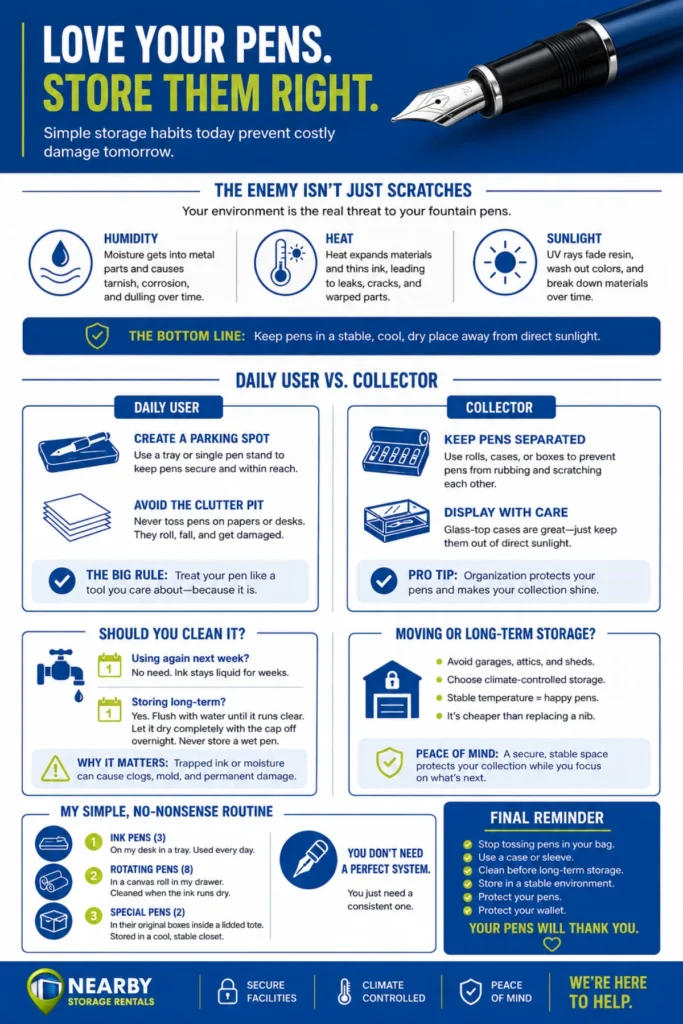
The Enemy Isn’t Just Scratches
Most people think storage is just about keeping your pen looking pretty. They worry about the shiny surface getting all scratched up.
That matters. But it’s not the biggest problem.
The real enemy is your environment. I’m talking about the air in your house. The temperature. The sunlight coming through that window.
- Do you live somewhere humid? Like, sticky, gross humidity? Because that moisture gets everywhere. It gets into the metal parts of your pen. The clip. The band around the cap. That little ring near the nib. Over time, that stuff tarnishes. It turns green or dull. It looks cheap.
- Do you live somewhere hot? Or maybe your apartment gets roasting in the summer when you’re at work and you don’t run the AC. Heat is a killer. It makes the plastic expand. It makes the ink inside thin out and leak. You’ll open your pen one day and find ink all over the grip section. Or worse, inside the cap. You’ll go to write and get a big blue blob on your white shirt.
And sunlight. God, sunlight. I know a sunny desk looks nice. I have a window in my office. But if you leave your pen sitting there day after day, that sunlight is going to fade the color. That deep burgundy resin? It’s going to turn pinkish. That nice black? It gets washed out.
I am not saying you need to lock your pens in a vault. But you do need to think about where you are putting them.
The Daily User vs. The Weekend Warrior
Here is the thing that drives me nuts about storage articles. They treat everyone the same.
They tell you to buy a $300 wooden box. But maybe you only have one pen. Or maybe you use three pens every single day and you don’t want to take them out of a box every morning.
So, let’s split this up.
If you are a daily user:
You need to think about your desk setup. You need a “parking spot” for your pens. I use a simple leather tray. It’s just a flat piece of leather with a slight lip. I drop my pens there when I come home. They don’t roll around. They don’t knock into each other.
If you want to get fancy, get a single pen holder. You know, the ones that look like a little stand? They hold one pen horizontally. It looks classy and it keeps the pen safe. Super cheap. Super effective.
The big rule for you? Don’t just toss it on a pile of papers. That is how it rolls off the desk. I have stepped on a pen before. It was not pretty.
If you are a collector (or you just have a lot of pens):
Okay, this is where you need to get organized. You can’t just “have a lot of pens” scattered around.
You need a case. Or a roll. Or a box.
I prefer rolls, honestly. They are portable. You can keep them in a drawer. They keep your pens separated so they don’t rub against each other. Because if you have two pens together and one has a metal grip and the other is resin? That metal grip is going to scratch the resin. It’s friction. It’s physics. It’s annoying.
If you have a lot of pens, think about a display case. The ones with glass tops are great because you can see your collection. But here is my one piece of advice about those: put them in a dark room. Or at least not in direct sunlight. That glass acts like a magnifying glass sometimes.
The “Should I Clean It?” Debate
Alright, let’s get into the weeds here.
You are going to put a pen away. Maybe you aren’t going to use it for a while. Do you clean it first?
Honestly? If you are going to use it again next week? No. Don’t bother. It’s fine. Ink stays liquid for weeks.
But if you are putting it away for the season? Or you are storing a pen you don’t use often? You need to clean it. And you need to be thorough.
I learned this the hard way. I had a pen with a shimmer ink in it. You know, the ones with the little glitter particles? I left it in the pen for like three months. When I finally picked it up to write, it was clogged. I mean fully clogged. I had to soak the nib for two days. I had to use a bulb syringe. It was a whole production.
Don’t be me.
If you are storing a pen, flush it out. Run water through the converter or the cartridge until it runs clear. Then let it dry completely. Leave the cap off overnight. Put it on a towel. If you put it away wet, you are going to trap moisture in the cap. That can cause mold. Yes, mold grows in fountain pens. It’s gross.
Moving or Long-Term?
This is where it gets tough.
Maybe you are moving. Maybe you are going overseas for six months. Maybe you just live in a tiny apartment and you don’t have a closet big enough for your pen case and your books and your guitar and all your other stuff.
If you are in this situation, you have to think about off-site storage. I don’t mean just tossing your pens in a box in a hot garage. That is a death sentence.
You need a climate-controlled space. Something that stays the same temperature year-round. Not too hot, not too cold, not too humid.
We actually run a storage facility, and we see people bring in the wildest stuff. But pens? Pens are common. People think they have to keep them at home. But if your home isn’t stable (like if you turn the heat off when you travel or you don’t have AC), you’re gambling with your pens.
A stable, secure unit can be a lifesaver. Especially if you are moving and you need a place to stash your collection for a few weeks while you get settled. It buys you time. And honestly, it’s cheaper than replacing a bent nib.
Here Is My Simple, No-Nonsense Routine
I am going to tell you what I do. Take it or leave it.
- Ink pens: I keep three pens inked at any time. They live on my desk in a simple tray. I use them every day.
- Rotating Pens: I have about eight pens that I rotate through. They live in a canvas roll in my drawer. I clean them when I empty the ink.
- Special Pens: I have two pens that are expensive and sentimental. They live in their original boxes. I put those boxes in a big plastic tote with a lid. And that tote goes in a closet that stays cool.
That’s it. That is the whole system.
You don’t need to overthink this. You just need to be consistent.
Stop throwing your pens in your bag. Get a cheap sleeve or a case. Clean them if you are going to ignore them for a while. And if you need to store a bunch of them long-term, find a place that is stable.
Your pens will thank you. And more importantly, your wallet will thank you when you aren’t dropping $200 on a nib repair.
So, go check your drawer. I dare you. Tell me I am wrong. Tell me there isn’t a pen rolling around in there with the paperclips.
I’ll wait.










0 Comments