

Okay, real talk. Moving is the worst. I do not care what anyone says. Those people who claim they “love the adventure of a new start” are lying through their teeth. They are not the ones carrying a seven-foot-tall particle board bookshelf down three flights of stairs in August.
I run a storage facility. I see people roll up here every single day with furniture that is already broken before it even makes it through our gate. And you know what the number one casualty is? Bookshelves. Not mattresses. Not couches. Bookshelves.
Why? Because people treat them like they are indestructible. They toss them in the truck, stack boxes on top of them, and act surprised when they open the unit three months later and the thing looks like a roller coaster track.
So let me save you some heartache. Here is how you actually do this.
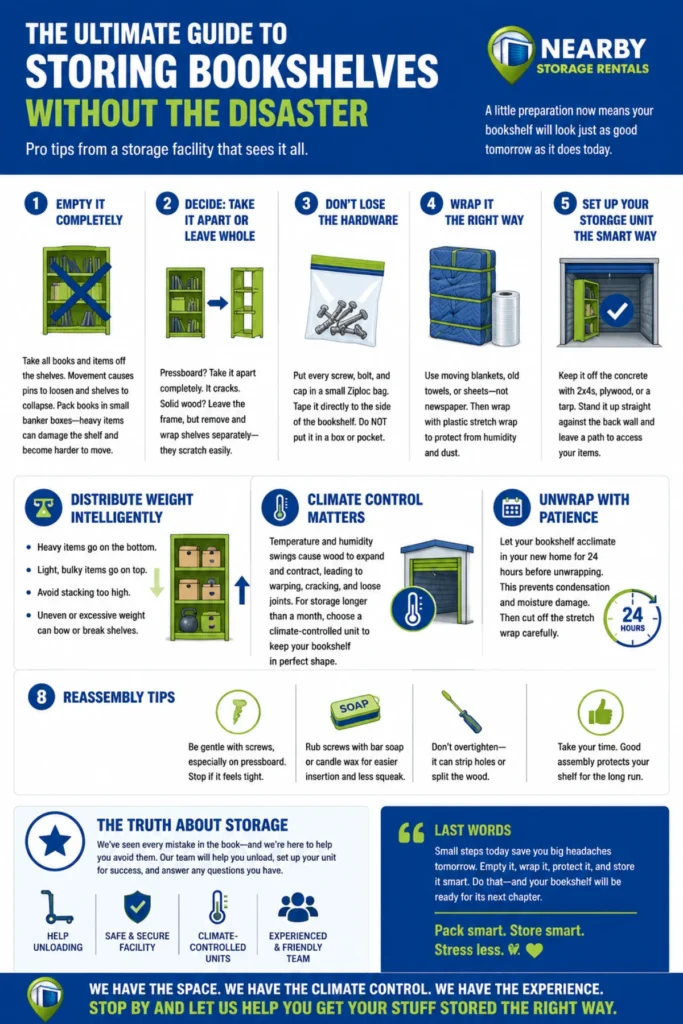
First things first – empty the dang thing
I know you want to leave the books on there. I get it. It saves time. It feels efficient.
But here is what happens when you do that.
Those little metal pins holding your shelves up? They are not designed for the jostling of a moving truck. Every bump, every pothole, every sudden stop puts stress on those joints. Eventually, something gives. And then you have a shelf full of heavy books crashing down inside your truck. Or worse, inside our storage unit.
Just last week, a guy came in with a bookshelf that had collapsed mid-transport. Books everywhere. The shelf split right down the middle. He looked at me and said “I should have listened to my wife.” Yeah. You should have.
So take the books off. Stack them in banker boxes. You can fit a surprising amount in those things if you pack them tight. Use small boxes though – large boxes get too heavy and then you are just trading one problem for another.
Now comes the decision – take it apart or leave it whole?
This depends entirely on what kind of shelf you are dealing with.
- If it is cheap pressboard – you know the one. It came from a big box store. It has that hollow sound when you knock on it. Maybe the back is just that thin cardboard material with little nails holding it in place. Take this thing apart. Completely. Down to every single piece. Why? Because pressboard does not flex. It cracks. If you try to move it in one piece, the joints will loosen and you will never get it tight again. Trust me on this. I have seen it happen a hundred times.
- If it is solid wood – oak, maple, something heavy that feels substantial. You can probably leave the frame intact. But still take the individual shelves out. Wrap those separately. They are the most likely to get scratched or dinged.
Here is the part people forget. The hardware.
You take out those screws and cam locks. You put them in your pocket. Then you forget about them and they end up in the washing machine. Or you throw them in a random drawer and spend four hours searching later.
This is my advice. Get a small Ziploc bag. Put every single screw, bolt, and little plastic cap in that bag. Then take a piece of masking tape and tape that bag directly to the side of the bookshelf frame. Do not put it in a box. Do not hand it to your friend. Tape it to the furniture.
When you reassemble, everything is right there. You are welcome.
The wrapping situation
I am going to tell you something that might sound weird.
Do not use newspaper.
I know people love newspaper. It is free. It seems like it protects things. But here is the problem – the ink transfers. Especially if the shelf gets even slightly damp. That newsprint will bleed right into the wood and you will have gray smudges all over your beautiful shelf. It does not come off.
Use moving blankets if you have them. If not, use old towels or sheets. Then wrap the whole thing in plastic stretch wrap. The kind you use for pallets. You can buy a roll at any hardware store for like fifteen bucks.
Why the plastic? Because wood breathes. It absorbs moisture from the air. And when it gets humid, wood expands. When it dries out, it contracts. That back-and-forth is what causes warping and cracking. The plastic acts like a shield. It keeps the humidity level stable around the wood.
But here is the catch. Do not seal it up tight if the wood is wet. If you just wiped it down with a damp cloth, let it dry completely before you wrap it. Otherwise you are trapping moisture inside and that is even worse. Mold city.
The storage unit setup
So you have your shelf wrapped. You have the hardware taped to the side. You are ready to bring it to storage.
Please do not just drop it on the concrete floor and walk away.
Concrete holds moisture. Even in a dry climate, there is moisture rising up from the ground. That moisture will find its way into the bottom of your bookshelf and start to rot or warp the legs.
Put something underneath it. A couple of two-by-fours. Some plywood sheets. Even just a tarp folded over a few times. Anything to create a barrier between the wood and the floor.
Now, where to position it inside the unit.
Put it against the back wall. If you have multiple large items, create a path so you can actually walk in and check on things. I cannot tell you how many people pack their unit like a game of Tetris and then cannot get to anything without unloading the whole thing.
Here is a tip nobody gives you. Do not lean the bookshelf against the wall at an angle. Stand it up straight. Leaning puts pressure on one corner and can cause the frame to shift out of square. I have seen shelves that looked like parallelograms because someone leaned them for six months.
The weight distribution thing
If you are going to store things on the shelves while they are in the unit – and I know some of you will – please be smart about it.
Do not put heavy toolboxes or boxes of canned food on the top shelf. That is just asking for trouble. Heavy items go on the bottom. Light, bulky things go on top.
And do not stack things too high. The beauty of a bookshelf is that it has multiple levels. Use them. Spread the weight out evenly.
One time a customer stored a bunch of cast iron pans on their bookshelf. The shelf bowed so badly in the middle that it was permanently ruined. It looked like a smiley face. Not a good look.
Climate control matters
This is where I am going to get a little salesy. But only because I genuinely believe it.
If you are storing your bookshelf for more than a month, you really should consider a climate-controlled unit.
I know. They cost a bit more. Nobody wants to spend extra money on storage. But here is the thing – a regular unit gets hot. It gets cold. It gets humid. All of that is terrible for wood.
Wood expands when it is humid. It contracts when it is dry. That constant movement loosens joints. It can cause the veneer to peel. It can make doors stick or not close properly.
We have climate-controlled units at our facility. They stay at a consistent temperature year-round. Your bookshelf will come out looking exactly the same as it did when you put it in. No warping. No cracking. No mold.
If you are storing a cheap pressboard shelf from Target, maybe you do not care as much. But if you have a nice piece of furniture – something with sentimental value or something you paid good money for – protect it. You will thank yourself later.
The unwrapping process
When you finally come back for your stuff, do not rush this.
Take the shelf out of the unit and let it sit in your new place for a day before you unwrap it. I know you want to see it. I know you want to set it up and put your books back. But patience pays off here.
If the shelf has been in a cold unit and you bring it into a warm house, condensation will form on the surface. And if you have it wrapped in plastic, that condensation gets trapped. Then you unwrap it and the wood is damp. Not good.
Let it acclimate. Give it 24 hours. Then unwrap it carefully.
If you used stretch wrap, just cut it off with scissors. Be careful not to scratch the wood with the blade.
Check the hardware bag. It should still be taped to the side. Assuming you followed my advice earlier.
Reassembly tips
When you put the shelf back together, take your time.
- If it is pressboard, be gentle with the screws. Pressboard strips out easily. If a screw feels tight, stop. Do not force it. You will strip the hole and then you are really in trouble.
- If you have solid wood, you can tighten things up a bit more. But still be careful. Overtightening can split the wood.
And here is a little trick. Rub a bit of bar soap or candle wax on the screws before you put them in. It acts as a lubricant and makes them go in smoother. It also helps prevent squeaking later.
The truth about storage
Look, storing furniture is never fun. But it is part of life sometimes. You are downsizing. You are in between houses. You are traveling for work. Whatever the reason, you need a place to keep your stuff safe.
That is what we are here for. We have been doing this a long time. We have seen every mistake in the book. And we genuinely want to help you avoid them.
When you bring your shelf to our facility, we will help you unload it. We have carts and dollies. We will show you how to position things inside the unit for maximum safety. If you are not sure about something, just ask. We are happy to share what we have learned from watching thousands of people move their stuff in and out.
Last words
Moving is chaotic. There is no getting around that. But how you store your furniture during that chaos makes a huge difference in how you feel when it is over.
Take the extra hour to empty the shelf. Take the extra fifteen minutes to tape the hardware to the side. Spend the few bucks on stretch wrap and a moving blanket. Put something under the legs.
These little things add up. They mean the difference between pulling out a beautiful piece of furniture that is ready to use and pulling out a broken piece of junk that makes you want to cry.
You have enough stress in your life. Do not let a bookshelf be one of them.
We have the space. We have the climate control. We have the experience. Stop by and let us help you get your stuff stored the right way. Your future self will be so grateful.
Now go pack those books. And for the love of everything good, do not put heavy stuff on the top shelf. You have been warned.










0 Comments