
Quick Summary
Before renting a storage unit, check the facility at night, ask specific questions about mice and pests, inspect the walls and floor for moisture, verify that advertised 24/7 access actually works, measure the real unit size, read the contract for rate increases and late fees, and talk to current tenants about their experience. These seven checks can help you avoid mold, pests, damaged belongings, lockouts, undersized units, and surprise charges. The biggest lesson is simple: slow down, inspect everything yourself, and don’t rely only on what the facility manager tells you.
I messed up once with a storage unit. Bad.
Rented a cheap place near my apartment. Looked fine during the day. The guy at the desk was nice. Signed the paper. Dumped all my stuff in there. Didn’t think twice.
Came back three months later.
Everything smelled like a wet basement. A box of old photos had this weird sticky feel to it. And something had definitely been chewing on my sleeping bag.
I was so mad. At myself mostly.
So now I want to save you from doing the same dumb stuff I did.
Here are seven things I personally check now before I give anyone my money. And yeah — we run a storage unit service ourselves. So some of this comes from fixing other people’s messes too.
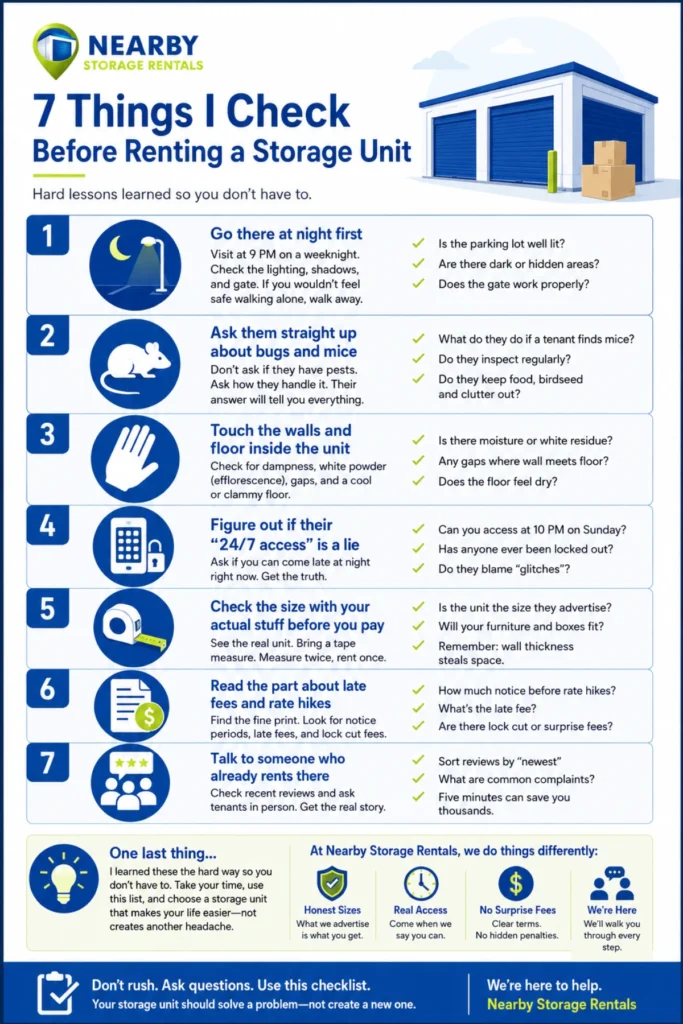
1. Go there at night first
Seriously. Don’t go during the day when the sun is out and the manager is smiling.
Go at 9 PM on a Tuesday.
Is the parking lot pitch black? Are there weird shadows between the buildings? Does the gate even work or is it just propped open?
You won’t know any of this until you see it in the dark.
I made this mistake. My first unit looked great at 2 PM. At night? Half the lights were burned out. I had to use my phone flashlight just to find my lock. Never again.
So before you rent anything, drive over after dinner. Sit in your car for five minutes. Watch. If you wouldn’t feel safe walking to your unit alone, cross that place off your list.
2. Ask them straight up about bugs and mice
Most small storage places will lie about this. Or they’ll say “we haven’t seen anything” which is manager-speak for “we don’t look.”
You have to ask differently.
Don’t say “do you have pests?” They’ll just say no.
Say this instead: “What do you do when a tenant finds mice in their unit?”
Watch their face. If they hesitate or give some corporate answer like “we follow standard protocols” — that means they have protocols because it happens.
A good answer sounds like this: “We have traps in the hallways, we inspect every month, and we don’t let people store food or birdseed.”
A bad answer is anything vague or defensive.
I learned this after finding mouse poop inside a box of sweaters. The manager acted surprised. He wasn’t surprised. He just didn’t want to lose my business.
Don’t let them do that to you.
3. Touch the walls and floor inside the unit
People forget this one.
You walk into an empty unit. Looks fine. White walls. Concrete floor. Clean enough.
But run your hand along the bottom of the wall. Feel for dampness. Look for powdery white stuff — that’s efflorescence. Means water has been coming through at some point.
Also check the corners. See any tiny gaps where the wall meets the floor? Mice can squeeze through a gap the size of a pencil. Not even kidding.
And stomp on the floor a little. Does it feel bone dry or kinda cool and clammy?
We had a woman rent from a place across town. Her unit looked perfect. But the floor was always slightly damp. Ruined the bottom of all her furniture. The legs on her oak dresser literally rotted.
She told me she wished she’d just touched the floor first. One minute would have saved her thousands.
4. Figure out if their “24/7 access” is a lie
This one makes me mad because so many facilities just straight up lie.
You see the sign: 24 Hour Access. Great. You work late nights. You want to grab your ski gear at 11 PM.
Then you show up at 11 PM and the keypad says access denied. Or the office number just rings forever. Or there’s a tiny line in the contract that says “access hours subject to change” which means nothing.
Ask them: “Can I come right now at 10 PM on a Sunday and get in? Has anyone ever been locked out?”
If they say “well technically you can but sometimes the system glitches” — that means it glitches all the time.
We had a guy who kept his work tools in a unit. Showed up at midnight for an emergency job. Gate wouldn’t open. Had to drive home. Lost the job. Lost a client.
All because someone didn’t want to fix their broken gate system.
At our storage unit service, we don’t play that game. If we say you can come, you can come. No glitches. No hidden rules. Just a working gate and a code that actually does what it’s supposed to.
5. Check the size with your actual stuff before you pay
Here’s where rental offices get you.
You tell them “I have a one bedroom apartment worth of stuff.” They say “oh easy, a 5×10 will be plenty.”
Maybe. But maybe not.
Because their idea of “plenty” means perfectly stacked Tetris-style boxes with no aisles. Your actual moving day? You’re tired. You’re throwing boxes in any which way. Nothing stacks right.
So ask to see the actual empty unit. Not a diagram. Not a “virtual tour.” The real thing.
Then imagine your couch in there. Your mattress. Those six plastic totes of Christmas decorations.
Better yet — bring a tape measure. Most units are smaller than they advertise. A 10×10 should be 100 square feet. But wall thickness, support beams, weird angles — you can lose 10 or 15 percent easy.
We had someone rent a “10×20” from a big national chain. Measured it later. 9×18. That’s almost 40 square feet gone. They just didn’t notice until their stuff didn’t fit.
Don’t let that be you. Measure it yourself.
6. Read the part about late fees and rate hikes
Nobody reads the fine print. I get it. It’s boring.
But storage facilities know this. So they hide the ugly stuff in paragraph 14.
Look for two things specifically.
- First: how much notice before a rate increase? Some places say 14 days. That’s nothing. They can raise your rent and you have two weeks to either pay it or move everything out. Good luck doing that on short notice.
- Second: what’s the late fee? I’ve seen places charge 25% of your monthly rent. So if you’re paying 200,yougethitwitha50 late fee because you forgot by two days. That’s robbery.
And here’s the sneakiest one — some contracts have a “lock cut fee.” If you’re late, they cut your lock, put their own on, and charge you $75 plus a new lock. Even if you pay the next day.
We don’t do any of that stuff. We think it’s wrong to trap people with surprise fees. You should know exactly what happens if you’re late. No hidden penalties. No nonsense.
But most places won’t tell you unless you ask. So ask. Point to the paragraph and say “explain this to me like I’m five.”
7. Talk to someone who already rents there
This is the secret weapon nobody uses.
Find the facility on Google Maps. Sort reviews by newest, not highest. Look for the three-star reviews — those are usually the honest ones.
Then go to the facility and just hang out for ten minutes. Wait for someone to walk out of their unit. Ask them “hey sorry, do you like this place? I’m thinking of renting here.”
Most people will tell you the truth. They’ll say “it’s fine but the gate breaks a lot” or “the manager is nice but good luck getting them on the phone.”
You won’t get that from a sales tour.
We actually encourage people to talk to our current tenants. Because if we’re doing a good job, they’ll tell you. And if we’re not, we want to know about it.
But most facilities will never suggest this. Because they know exactly what people would say.
Don’t be shy about this step. It takes five minutes and it tells you more than any contract ever will.
One last thing before you go
Look, I didn’t know any of this when I rented my first climate controlled storage unit. I learned by losing stuff. By finding mold. By getting locked out at midnight.
You don’t have to learn the hard way.
Take this list. Use it. And if you want to skip the headache entirely — come check out what we’re doing. We run our storage unit service the way I wished that first place had run theirs. Honest sizes. Real access. No surprise fees. And we’ll walk you through every single one of these seven checks ourselves.
But either way, just don’t rush. Storage units are supposed to make your life easier, not give you another problem to deal with.
You’ve got enough of those already.







0 Comments