
Quick Summary
Every storage unit goes through four stages: the organized honeymoon, the pile-up, the out-of-sight abyss, and finally the purge or upgrade. The biggest problem usually isn’t needing a larger unit, but letting clutter destroy your usable space and make belongings impossible to reach. Regular visits, clear labels, shelves, and a walking path can keep storage functional. If your unit has already become a mess, reorganizing or purging unwanted items can restore space and help you stop paying to store things you no longer need.
You probably think a storage unit is just a metal box. You rent it, you fill it, you lock it. Done.
But that’s not really how it works.
If you’ve ever rented a storage facility before, you know that your relationship with that unit changes over time. It’s almost like watching a living thing grow, get messy, and eventually—if you’re not careful—become a problem.
We’ve been helping people find the right storage facilities for years, and trust us when we say: every single storage unit goes through four clear stages. Whether you’re storing old furniture, business inventory, or your college kid’s mountain of boxes, your unit will hit these phases.
Let’s walk through them together.
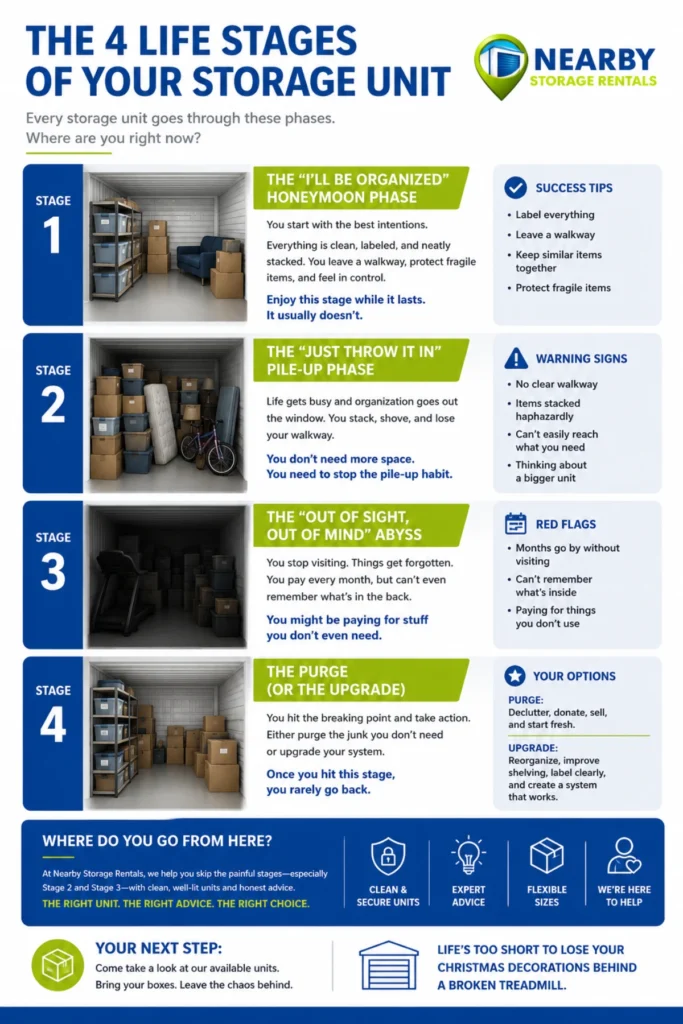
Stage 1: The “I’ll Be Organized” Honeymoon Phase
This is where you start with the best intentions.
You walk into your empty unit. It’s clean. It’s dry. The floor is spotless. You look around and think, “I’m going to label everything. I’ll leave a walkway down the middle. This is going to be beautiful.”
And for the first week or two? It actually is.
You stack your boxes neatly. You leave your old couch on the right side. You put your holiday decorations in clear plastic bins with lids. You might even buy a small shelf from a hardware store because you’re committed to “doing this right.”
But here’s what really happens during this stage: you avoid putting anything heavy on top of fragile stuff. You leave space between items “just in case you need to grab something later.”
We see this all the time at our facility. People come in during the first month with color-coded tape and sharpies. It feels good. It feels controlled.
Enjoy this stage while it lasts. It usually doesn’t.
Stage 2: The “Just Throw It In” Pile-Up Phase
This is where reality hits.
You’re busy. You’re tired. You don’t have time to fold that moving blanket perfectly or re-tape that torn box. So you start telling yourself a little lie: “I’ll fix it next time.”
Next thing you know, you’re sliding things in wherever they fit.
You shove that lamp behind the boxes of winter coats. You stack a plastic tote on top of an old mattress because “the mattress is soft anyway.” The walking path you left last month? Gone. Now you have to crawl over a kid’s bicycle to reach your camping gear.
During this stage, your storage unit stops looking like a system and starts looking like a pile.
And here’s the kicker—this is also when most people start renting a bigger unit. But that’s usually a mistake. You don’t need more space. You just need to stop the pile-up habit.
We’ve watched this happen hundreds of times. One customer came in saying his 5×5 was “impossibly small.” We helped him reorganize for twenty minutes, and suddenly he had an empty corner. It wasn’t the unit’s fault. It was the “just throw it in” stage.
Stage 3: The “Out of Sight, Out of Mind” Abyss
This is the dangerous one.
You stop visiting. Maybe a month passes. Then two. Then six. You’re still paying the bill every month, but you can’t even remember what’s in the back left corner anymore.
At this stage, your climate controlled storage unit becomes an abyss—a black hole where belongings go to be forgotten.
You start having conversations like:
- “Where’s my grandfather’s clock?”
“Oh, it’s in storage.” - “Can you grab the Christmas tree next week?”
“Uh… it’s all the way in the back behind the old treadmill.”
Nobody goes to get anything because it’s too much work. So your unit just sits there, collecting mental dust.
This is also when you start paying for things you don’t need. We’ve seen people rent a unit for two years just to store a broken treadmill and three boxes of high school yearbooks. That’s real money. That’s your money.
If you’re in this stage right now, you’re not alone. But you need to get out.
Stage 4: The Purge (Or the Upgrade)
Eventually, every storage place reaches a breaking point.
You either:
- Purge: You spend a Saturday emptying the whole thing. You throw away the junk. You donate the stuff you forgot you had. You sell the old furniture. And you walk away feeling ten pounds lighter.
- Upgrade: You realize you actually use some of that stuff regularly. So you reorganize. You buy better shelves. You label everything clearly. You leave a real walking path. You turn your unit back into something functional.
Most people go through the purge at least once. It’s emotional. You’ll say things like, “Why did I keep this broken fan?” and “I don’t even remember buying these curtains.”
But here’s the good news: once you hit the purge stage, you almost never go back to the pile-up stage again. You’ve learned your lesson.
Frequently Asked Questions
Q1. Are the four storage stages a fixed rule for every renter?
The four storage stages are an organizational illustration, not a fixed rule every renter follows.
Your routine and inventory determine what happens.
We recommend using the idea to spot practical problems rather than assuming a messy phase is inevitable or that every unit eventually requires an upgrade to a larger size.
Q2. How can I keep a new storage unit organized after move-in?
Keep the new unit organized by assigning locations, labeling contents and updating an inventory after changes.
Maintain the access route and return items consistently.
Nearby Storage Rentals suggests making these tasks part of each visit so the initial careful arrangement does not slowly disappear beneath unrecorded additions.
Q3. What is an early warning that storage is becoming a pile-up?
An early warning is when additions lack assigned locations or begin blocking labels and access.
Review the layout before the problem grows.
We suggest checking whether the contents still need storage rather than treating the first crowded corner as automatic proof that a larger rental is necessary.
Q4. Does losing track of belongings mean I must empty the whole unit?
Losing track does not always require emptying the entire unit at once.
Rebuild the inventory in safe sections and mark uncertain entries clearly.
Keep exits and stacks stable during sorting, rather than creating another chaotic temporary load while trying to restore order or assuming a single long session is essential.
Q5. Should I upgrade storage size before reviewing unused belongings?
Review unused belongings and the current layout before upgrading the unit.
A genuine space shortage may still exist, but poor organization can obscure the answer.
We recommend measuring the remaining planned inventory and checking transfer terms rather than paying for more room to continue the same unresolved packing habits.
Q6. Can a regular storage review prevent years of forgotten rent?
A regular review can make forgotten rental costs less likely by connecting the account with its current purpose.
It does not mean every long-term rental is wasteful.
Check inventory, access and budget together, then decide deliberately instead of letting automatic payments become the only continuing link to stored belongings.
Q7. How do I reorganize storage without losing track of removed items?
Record removed items and their destinations as you reorganize, updating labels and location notes at the same time.
Keep donation, disposal and retained groups distinct.
We suggest using verified entries rather than assumptions so a cleaner unit does not leave you unsure whether a particular belonging was moved, sold or discarded.
Q8. What should I do after finishing a major storage clear-out?
After a clear-out, update the inventory and reassess whether the remaining space suits your needs.
Check the rental's transfer or closing requirements before making changes.
We recommend recording final account arrangements as carefully as physical organization so removing belongings does not leave unnecessary billing or incomplete move-out tasks unresolved.
Where Do You Go From Here?
Look, storage units aren’t magic. They’re tools. But like any tool, they only work well if you use them right.
That’s where we come in.
At Nearby Storage Rentals, we don’t just give you a lock and a door and wave goodbye. We help you skip the painful stages—especially Stage 2 and Stage 3—by offering clean, well-lit units and honest advice on how to keep your space from turning into an abyss.
Whether you need a small 5×5 for a few boxes or a large 10×20 for business inventory, we’ve got you covered. And we won’t let you fall into the “just throw it in” trap without saying something first.
Your next step? Come take a look at our available units. Bring your boxes. Leave the chaos behind.
Because honestly? Life’s too short to lose your Christmas decorations behind a broken treadmill.









0 Comments