
Quick Summary
Countertops need protection from moisture, pressure, and uneven surfaces while they’re in storage. Clean and completely dry each piece, wrap it with moving blankets, corner protectors, and stretch wrap, then store it vertically on plywood or thick padding rather than directly on concrete. A climate-controlled storage unit helps prevent temperature and humidity problems, and countertops should have their own space with nothing leaning against them. Use two people to move them, inspect for damage before taking them home, and check the condition about once a month.
My neighbor Mark just learned this lesson the hard way last month. He’s got this beautiful kitchen, right? White quartz, waterfall edge, the whole nine yards. He’s doing a full gut renovation and needed somewhere to stash his new countertops while the cabinets got installed.
He put them in a small storage unit. Did he wrap them? Sort of. Did he think about the floor? Nope. Did he check on them for three months? You already know the answer to that.
When he finally pulled them out, the bottom edge looked like someone took a chisel to it. Just crumbled. The concrete floor had this tiny little bump he didn’t notice and that one spot took all the weight. His wife cried. I’m not kidding, she actually cried.
So here I am, writing this because I don’t want you to be Mark.
Let’s Start With The Obvious Thing Everyone Overlooks
You’re probably thinking about scratches. Everyone thinks about scratches. You’re imagining the countertop getting all marked up and that’s what’s keeping you up at night.
But scratches are actually the least of your problems.
The real enemy? Moisture. And pressure. And that weird combination of both that happens when you leave something heavy leaning against a wall for two months.
Here’s what I mean. Countertops aren’t like furniture. They don’t flex. They don’t give. They’re rigid and heavy and if you put them in the wrong position, they will absolutely break under their own weight.
I had a customer once who stored her granite slab flat on the floor. Just flat. She figured that was the safest way because it couldn’t fall over. But here’s what happened. She stacked boxes on top of it. Not heavy boxes, just random stuff. Over time, the weight created a pressure point right in the middle. She came back and there was a crack running from one end to the other.
She never even stacked anything heavy on it. It was just the constant pressure for weeks.
The Cleaning Thing Is Not A Joke
Okay I know this sounds like I’m nagging but I swear cleaning matters.
You know how when you leave a plate with food on it in the sink overnight and it gets all crusty and gross? Imagine that but on your countertop and it sits there for months. Now imagine you wrapped it up so it’s nice and dark and maybe a little humid in there.
You see where this is going.
Mold. Not like black toxic mold or anything dramatic. But that weird powdery stuff that grows on stone when it stays damp. It etches into the surface and you can’t always clean it off.
And don’t even get me started on grease splatters. If you stored your countertops after cooking near them and there’s any oil residue, that oil is going to oxidize and turn into this sticky yellow film that’s honestly disgusting.
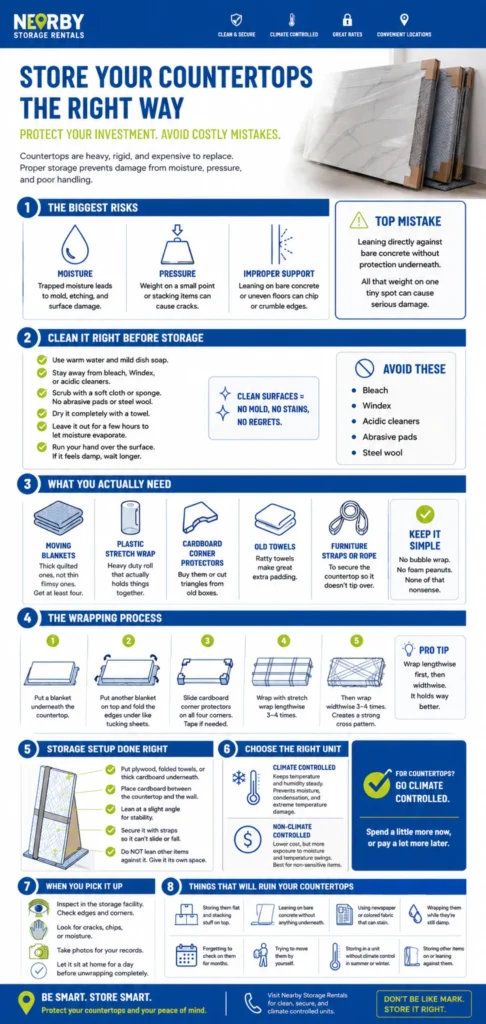
So here’s what you actually need to do:
- Use warm water and mild dish soap. Nothing fancy, nothing harsh.
- Stay far away from bleach, Windex, or any acidic cleaners. They’ll dull the finish.
- Scrub with a soft cloth or sponge. No abrasive pads, no steel wool.
- Dry it completely with a towel. And I mean completely.
- Leave it out for a few hours. Let any trapped moisture in the pores evaporate naturally.
- Run your hand over the surface. If it feels even slightly damp, wait longer.
Skip any of these steps and you’re basically inviting problems.
What I Actually Use When I Move This Stuff
My brother works for a moving company and he gave me the best advice. He said forget all the fancy packing materials. Here’s what actually works:
- Moving blankets – The thick quilted ones, not the thin flimsy garbage. You can grab these at Harbor Freight for like fifteen bucks each. Get at least four.
- Plastic stretch wrap – The big roll, not the little kitchen stuff. You want the heavy duty kind that actually holds things together.
- Cardboard corner protectors – You can buy them or just cut triangles from old boxes. Doesn’t matter as long as they cover the corners.
- Old towels – The ratty ones you were about to throw away anyway. Fold them up and use them as extra padding.
- Furniture straps or rope – Something to secure the countertop once it’s in the unit so it doesn’t tip over.
That’s literally all you need. No bubble wrap, no foam peanuts, none of that nonsense. Keep it simple.
The Actual Wrapping Process Without All The Fluff
Alright here’s what I do. I put the countertop on my driveway because that’s flat and I can work around it.
First, put a blanket underneath it. Then put another blanket on top.
Second, take the edges of the top blanket and fold them under the countertop. Like tucking bedsheets in. This makes it so the edges have double protection.
Third, slide those cardboard corner protectors over all four corners. If they don’t stay in place, just tape them.
Fourth, go crazy with the stretch wrap. Wrap it around three or four times in each direction. Not so tight that you’re crushing it, but tight enough that nothing moves.
And here’s a trick my brother taught me. Wrap it lengthwise first, then widthwise. Creates a cross pattern that holds everything way better than just wrapping in one direction.
Here’s Where Most People Screw Up
The biggest mistake I see is people not thinking about what happens when they actually move the thing.
You wrapped it up beautifully. It looks like a giant burrito. And then you try to pick it up and it’s awkward and heavy and you drop it or bang it against a doorframe.
So here’s my advice. Get someone to help you. This is not a one person job. Even if you think you can handle it, you’ll be surprised how heavy these things are once they’re all wrapped up.
And when you’re carrying it, keep it vertical. Don’t tilt it. Don’t try to carry it flat. The weight distribution is all wrong and you’ll end up straining your back or dropping it.
Picking The Right Unit
I’m just gonna say this straight up. Get climate control.
I know it costs more. I know you’re probably already spending a fortune on your renovation. But here’s the thing. If your countertop gets damaged, you’re not just out the cost of the countertop. You’re out the cost of having it delivered again. You’re out the time of waiting for a new one. You’re out the headache of dealing with it.
Climate control keeps everything at a steady temperature and humidity level. No wild swings. No moisture condensing on your stuff. No freezing temperatures making your stone brittle.
At our facility, we’ve got both options. The non-climate units are cheaper and some people use them for stuff like patio furniture or tires. But for countertops? Come on. Spend the extra twenty bucks a month.
The Floor Thing Is Actually A Big Deal
I already mentioned this but I want to hammer it home because I keep seeing people ignore it.
Concrete floors are never completely flat. They just aren’t. And they wick moisture from the ground. Even in a dry climate, there’s some moisture coming up through that concrete.
So when you lean your countertop against the wall, it’s touching the floor at a weird angle. All that weight is concentrated on one edge. That edge is pressing into whatever is on the floor, and if there’s a tiny pebble or a bump in the concrete, that’s where the pressure goes.
Here’s what you need to remember:
- Put something under the countertop. Plywood works great. Folded towels work too. Even thick cardboard is better than nothing.
- Put something behind it too. Cardboard against the wall protects from hidden screws or nails.
- Lean it at a slight angle against the wall, not straight up and down. Gives it more stability.
- Secure it so it can’t slide or fall. Use straps, rope, or even bungee cords.
And here’s something nobody thinks about. Don’t lean other stuff against the countertop. No boxes, no furniture, nothing. Give it its own space.
The Day You Pick It Up
When you come back to get your stuff, don’t just grab it and go.
Open the wrap and look at it. Right there in the storage unit hallway. Check the corners. Run your hand along the edges. Make sure nothing cracked or chipped while it was sitting there.
If something did happen, you want to catch it before you leave. Because once you take it home and start installing it, nobody is going to believe it happened in storage.
And when you get it home, let it sit for a day before you unwrap it completely. The temperature change from the storage unit to your house can be pretty significant and stone doesn’t like sudden changes.
A Quick List Of Things That Will Ruin Your Countertops
I’ve seen all of these happen. Please don’t let any of these be you.
- Storing them flat and stacking stuff on top.
- Leaning them directly against bare concrete without anything underneath.
- Using newspaper or colored fabric that can stain the surface.
- Wrapping them while they’re still damp.
- Forgetting to check on them for months.
- Trying to move them by yourself.
- Putting them in a unit without climate control during summer or winter.
- Storing other items on top of or leaning against them.
What I’d Do If I Were You
Honestly? I’d wrap it up like it’s a newborn baby. I’d put it in a good climate controlled unit. I’d check on it once a month just to make sure nothing weird is happening. And I’d take a picture of it when I put it in so I have proof of the condition.
This is one of those things where being extra is actually the smart move. Being lazy about countertops always ends badly.
We’ve got units available at Nearby Storage Rentals and I’d be happy to show you around. We’ve got plenty of space and we keep things clean and secure.
Just please don’t be like Mark. His wife still brings up that countertop every time they have guests over.










0 Comments