
Quick Summary
Interior doors can warp, swell, dent, or get damaged before installation if they are stored incorrectly, especially on concrete floors or in garages with changing temperature and humidity. Store Interior Doors flat and fully supported off the floor with spacers between stacked doors, or stand them at a slight angle with soft protection underneath. Keep them in a dry room with stable conditions, and give pre-hung doors extra support around the actual door rather than the frame. Moving blankets can prevent scratches, but avoid airtight plastic wrapping that traps moisture.
So you bought new interior doors. Congratulations. That is a solid chunk of change you just dropped, whether you went with the cheap hollow ones from the big box store or you splurged on those gorgeous solid wood slabs that cost more than your first car.
Now what?
You probably did what most of us do. You leaned them against the wall in the garage. Maybe you stacked them in the corner of the spare bedroom. And you told yourself, “It’s fine. They’re only gonna be here for a couple days until the guy shows up to install them.”
Yeah. I have been there. And let me tell you a quick story. A few years back, I bought six beautiful pre-hung doors for a rental property I was fixing up. Had them leaning against the living room wall for exactly one week while I waited for my carpenter to have an opening.
One week.
When he finally showed up, we grabbed the first Store Interior Doors, and it would not close. We fought with it for an hour. The thing had bowed so badly in the middle that the latch wouldn’t even catch the strike plate. The back of the door was touching the frame at the top, and there was a half-inch gap at the bottom. It was a frustrating reminder that even quality Store Interior Doors need to be stored properly to prevent warping before installation.
I was furious. I blamed the manufacturer. I called them up and gave them an earful.
Then the guy on the phone asked me, very calmly, “How did you store them?”
I told him. He went quiet for a second and then explained that I had basically done everything wrong. I had leaned them flat against a cold concrete floor in a damp basement. The moisture from the concrete wicked up into the bottom edge of the doors. The wood swelled on that side, stayed dry on the other, and physics did the rest.
I ate the cost. It was a $700 mistake.
I don’t want that to happen to you.
Here is why your garage is a trap
Look, garages are for cars and old lawn equipment and that exercise bike you swear you are going to use again someday. They are not built for protecting expensive building materials.
Think about what happens in a garage. It gets hot during the day and cold at night. Humidity goes up and down like a roller coaster. Concrete floors sweat.
Your interior doors are made of wood, or wood composites, or even MDF. All of those materials are porous. They soak up moisture from the air. They release it when things get dry.
When you lean a door against a wall, you are setting up a really unfair fight. The side facing the wall cannot breathe. The air cannot circulate around it. Meanwhile, the side facing the room is exposed to whatever humidity is floating around. One side expands, the other side stays put, and you end up with a door that looks like a potato chip.
And it is not just the moisture, either
This is the part people forget.
Your garage is also a disaster zone. People are walking through there carrying boxes. You are moving ladders around. Kids are playing.
One little bump. That is all it takes.
If you have a hollow-core door, even a light tap can dent the edges. Those things are basically cardboard on a wooden frame. The edges crush so easily. And once that happens, you have a problem because the door won’t sit flush in the frame. Your hardware won’t line up.
And if you have solid wood doors? Sure, they are tougher. But you know what happens when you drop a solid slab of oak onto a concrete floor? It chips. It gouges. You might get a split in the end grain that you can never fully hide with wood filler.
I am not trying to scare you. I am trying to save you the headache I went through.
So what actually works?
Let me walk you through the right way to do this.
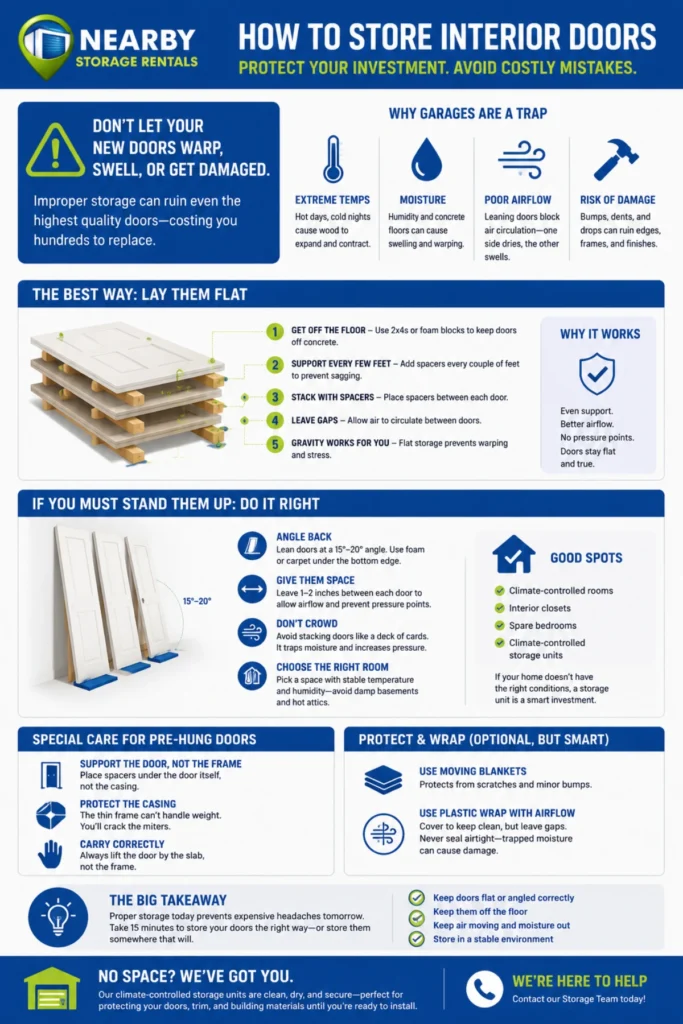
If you have the floor space, lay them flat. I cannot stress this enough. Flat is your best friend.
Here is the setup:
- Get the doors off the floor. Do not let them touch concrete directly. Put down some 2x4s or some foam blocks.
- Every couple of feet, put another spacer underneath the door. This gives the door support along its whole length so it does not sag under its own weight.
- If you are stacking multiple doors, put spacers between each one.
- Leave a gap between the doors so air can circulate.
This method works because gravity is working with you instead of against you.
But I know what you are thinking. “I do not have room to lay six interior doors flat in my basement. I live in a townhouse. My living room is already full of boxes.”
I hear you. I have been in that exact spot.
If you have to stand them up, you can do that too. But you need to be careful.
The upright method done right
First off, you need to angle them. Do not stand them straight up and down against the wall. Tilt them back at a slight angle. Maybe fifteen to twenty degrees. And put something soft under the bottom edge. Foam is great. An old piece of carpet works too.
The angle is important because it takes the pressure off the bottom edge and distributes the weight more evenly across the body of the door.
Now, here is the other thing. If you have more than one door, do not crowd them together. I know it is tempting to just line them all up like a deck of cards because it saves space. Resist that urge.
When you pack them tight like that, you create pressure points. The doors in the back are bearing the weight of all the ones in front. Plus, if there is any moisture trapped between them, it cannot escape. You are basically creating a greenhouse effect right between the panels.
Spread them out. Put at least an inch or two of space between each door. Use more foam or cardboard pieces as separators if you have to.
What about the room itself?
This is where people get lazy.
You need to pick the right spot in your house. Do not put the doors in a damp basement that smells like mildew. Do not put them in a hot attic that turns into a sauna in the summer.
Find a room that has stable temperature and humidity. Somewhere that is close to the same conditions as the rest of your house.
If you do not have a spot like that in your home, you are probably looking at renting a storage space.
And look, I get it. Renting a unit just to store some doors seems like overkill at first. You think, “Why would I pay money to store something that I am going to install in a couple weeks?”
But flip that question around. How much did those doors cost? How much are you going to pay to replace them if they get damaged?
That storage unit suddenly looks like a pretty good deal when you think about it that way.
We have customers come in all the time with this exact problem. They are doing a whole house renovation. They have doors, trim, baseboards, all kinds of stuff that needs a safe spot to sit while the drywall gets finished or the flooring gets laid.
They stash everything in one of our climate-controlled spaces and they can just exhale. They know the materials are safe. They are not tripping over them in the hallway. They are not worried about the cat scratching them up. It is peace of mind.
One more thing about pre-hung doors
If your doors came already attached to the frame—that is what “pre-hung” means—you have to be even more careful.
Those frames are made of thin wood that warps really easily. And they are fragile.
If you lay a pre-hung door flat, make sure you put the weight on the door itself and not the frame. Put your spacers under the solid part of the door so the casing does not take any pressure. The casing is just decorative trim. It cannot hold a lot of weight. You will crack the miters at the corners and then you are in for a fun afternoon of wood glue and clamps.
And whatever you do, do not carry these by the frame. Grab the door itself. The frame is not meant to be a handle.
Wrapping them up
This is optional but honestly, it is smart.
You can wrap your doors in moving blankets. That protects them from scratches. It also gives a little bit of cushion in case something bumps into them.
If you use plastic wrap, leave some gaps. Do not seal it up airtight. You want a little bit of airflow. If you trap moisture inside the plastic, you are basically putting the door in a sauna bag. That is bad news.
The big takeaway
Here is the bottom line.
Your doors are not going to take care of themselves. You spent good money on them. You picked them out specifically for your home. You probably looked at a dozen different styles before you found the right one.
Do not ruin them because you got lazy about storage.
Take the extra fifteen minutes to set them up correctly. Find a good spot. Use the right supports. Keep them away from moisture.
And if you simply do not have the space to do it right, do not force it. Come talk to us. We have storage units that are clean, dry, and secure. You can drop off your doors, lock them up, and forget about them until you are actually ready to install.
It is better than finding out the hard way that your garage floor ruined everything. Trust me on that one. I learned that lesson the expensive way so you do not have to.










0 Comments