
Quick Summary
Store folding tables flat, dry, and off bare concrete whenever possible. Folding tables can develop rust, warped or bubbled tops, damaged hinges, and bent frames when exposed to moisture, humidity, or heavy weight. Before storing, clean the table with mild dish soap and water, dry it completely, release the locking mechanism, and use padding between stacked tables. For long-term storage, protect a completely dry table with a furniture pad or tarp, but avoid trapping moisture. A clean, dry, climate-controlled storage unit can also help protect tables and other event supplies from temperature and humidity swings.
Look, I’m just going to be straight with you.
Folding tables are a pain in the neck to store. We both know it.
You buy the thing because you’re hosting a barbecue or you’re doing a garage sale, and it’s perfect for that one day. But then the event ends, and you’re standing there holding this awkward, heavy, metal-legged monster going, “…Now what?”
You don’t want to leave it in the middle of the living room because it looks ridiculous. You try to shove it in the hall closet, but it doesn’t fit unless you tilt it at a weird angle. So, most people do what my dad did for years—they just lean it against the wall in the garage and hope for the best.
And you know what happens?
Six months later, you go to grab it for a birthday party, and the thing is wrecked. The top is bubbled up like it has a rash, the legs are rusted at the bottom, and it wobbles so badly you’re scared to put a plate of food on it.
I run a storage facility, so I see this happen to people literally every single week. They bring their tables into our units, and they look rough. And nine times out of ten, they tell me, “I don’t know how this happened. I just put it away.”
So, let’s save you that frustration. Here is the real, unpolished truth about keeping these things safe.
Forget Everything You Know About “Just Leaning It”
Let’s get this out of the way first.
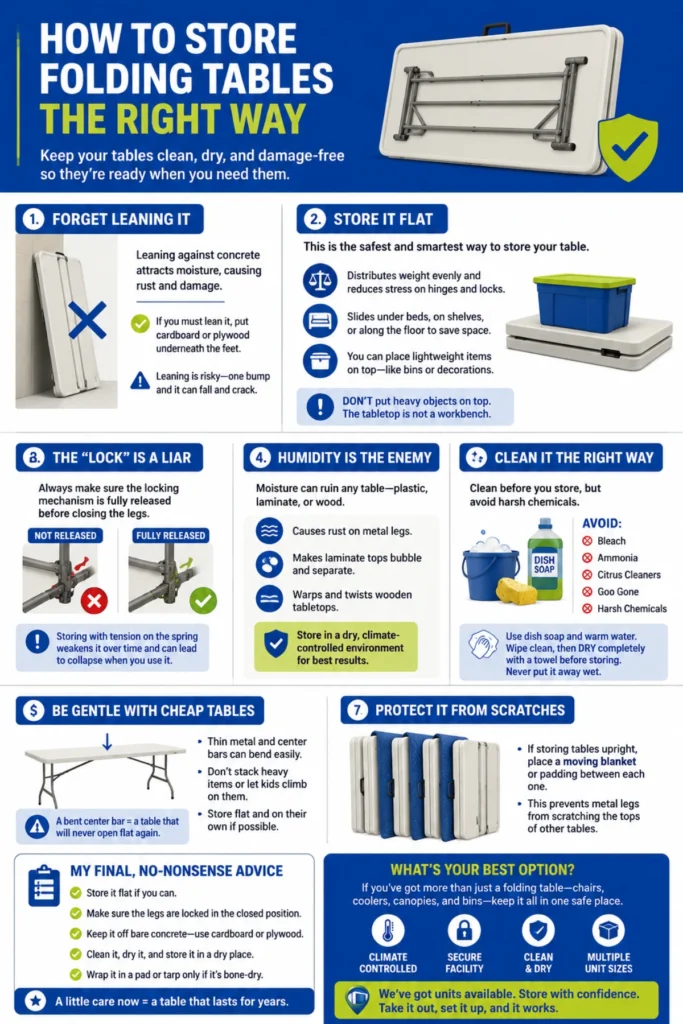
If you lean your folding table flat against a concrete wall in your basement or garage, you are basically asking for trouble. Concrete is cold, and cold attracts moisture. Even if the floor looks dry, that moisture wicks up through the concrete and hits the metal feet of your table.
I can’t tell you how many tables I’ve seen with legs that are just coated in orange rust because of this.
If you absolutely have to lean it, put a piece of cardboard or a scrap piece of plywood underneath the feet. Give it a barrier. But honestly? I hate the leaning method. It’s too risky. If someone bumps into it, that table is coming down like a tree, and the edge of that top is going to chip or crack when it hits the ground.
The “Flat” Method is Your Bet
If you have the space—and I know a lot of you don’t—store the table flat.
Lay it down on the ground with the legs folded completely inside. This takes all the pressure off the locking mechanisms and the hinges. It also means there is zero chance of it falling over.
Here is why flat storage works best:
- It distributes the weight evenly across the entire tabletop, so no single area is stressed.
- You can slide it under a bed, on top of a shelf, or along the floor of a storage unit without it taking up vertical space.
- You can store lightweight items on top of it. We have clients who lay their folding tables flat and then stack their plastic bins of Christmas decorations right on top. The table acts like a false floor.
Just don’t go putting your engine block or a stack of cinder blocks on it. Keep it light. The table top is not a workbench.
The “Lock” is a Liar
Okay, this is my biggest pet peeve.
When you fold up a table, there is usually that little metal bar or bracket that clicks to keep the legs locked in the open position. When you fold it closed, you have to make sure that bracket is fully released.
I see people shove the legs closed, but that metal bracket is still halfway engaged. They just jam it together and toss it in the corner.
You can’t do that.
If you store that table with tension still on that spring, the metal is under stress 24/7. Over a few months, that spring gets weak. Eventually, the next time you open that table, it’s not going to lock properly. You’ll set a bowl of potato salad on it, and boom—the leg folds up and you’ve got a mess on your hands.
Always, always push that locking mechanism all the way back to the “closed” position. Do it gently. If you have to force it, you’re doing it wrong.
The Humidity Problem (This is a Big One)
Listen, I don’t care if you buy the cheapest plastic table at Walmart or the most expensive commercial-grade wooden one. Humidity is the enemy.
If you store this thing in a shed where it gets hot and steamy in the summer, that laminate top is going to separate from the particleboard core. It’s going to bubble up. You can’t fix that. There is no glue in the world that will fix a bubbled tabletop.
If you have a solid wood folding table, humidity is even worse. It will warp. It will twist. You’ll set it up and it will rock back and forth because the wood decided to change shape while it was sitting in the heat.
This is actually why a lot of our clients end up renting units from us. We keep the air regulated. We don’t have those massive temperature swings. You don’t have to worry about the 100-degree summer heat ruining your stuff while it’s sitting in a metal box. We’ve got that steady climate so you don’t open up your table and find it looking like a potato chip.
Clean it, But Not with Weird Chemicals
This sounds basic, but you’d be surprised.
Before you put that table away, wipe it down. But please, please, do not use bleach, do not use ammonia, and do not use any kind of citrus-based cleaner that’s super acidic.
I had a guy tell me once that he used Goo Gone on his table to get tape residue off. It melted the finish. He had a permanent smudge mark on the table after that.
Just use dish soap and warm water on a sponge. Wipe off the ketchup, the juice stains, the dust from the garage sale. Then—and this is the step everyone forgets—dry it with a towel.
Do not put it away wet.
If you wipe it down and toss it in the corner while it’s still damp, you’re trapping moisture against the seams of the table. That moisture will get inside the tabletop and cause swelling. It takes two seconds to dry it off. Don’t skip it.
Think About the “Cheap” Tables
We all buy them. Those $30, 6-foot tables from the big box stores.
I want you to know that those tables are made of really thin metal. They’re not built like tanks. When you store them, you have to be extra gentle.
Do not stack heavy boxes on top of them. Do not lean heavy furniture against them. The center bar that runs down the middle is thin. If you put weight on it while it’s folded, you will bend that bar.
Once that bar is bent, the table will never, ever open flat again. It will always have a hump in the middle.
If you’ve got a cheap table, treat it like it’s fragile. Store it on its own. Don’t let your kids climb on it while it’s in the garage.
How We Handle This
When someone rents a unit from us and they tell me they are storing event supplies or extra furniture, I always ask them, “How are you storing the tables?”
We have some people who shove four or five tables into a 5×5 unit. That’s fine if they’re stored vertically, but we always tell them to put some padding between them. We sell cheap moving blankets here, and we tell people to throw one between each table. It stops the metal legs from scratching the top of the table next to it.
You don’t want to pull a table out of storage and realize the legs on Table A have gouged a massive scratch into the top of Table B. That’s just money wasted.
My Final, No-Nonsense Advice
Here is what I would do if I were you.
If you’re storing this table for the long haul—like you’re moving or you’re just not using it until next Thanksgiving—wrap it in a cheap furniture pad or a plastic tarp.
But, and this is a big “but,” make sure the table is bone-dry before you wrap it.
I’ve seen people wrap a table that was slightly damp, seal it tight with plastic wrap, and put it away for three months. When they came back, it was covered in black mold. You don’t want that. Mold ruins the table and it smells. Then you have to throw it away.
Just use common sense. Keep it dry. Keep it off the bare concrete. Make sure the legs are locked closed.
Honestly, these tables are tough, but they aren’t indestructible. They last a long time if you just show them a little bit of care when you put them away.
What’s Your top Option?
Look, if you have a spare room or a dry closet, use that. I’m not here to tell you to rent a unit just for one folding table.
But if you’re like most of the people I talk to, you probably have more than just a folding table. You’ve got chairs, you’ve got coolers, you’ve got canopies, and you’ve got bins of party supplies.
If that’s the case, you’re better off renting one of our units to keep it all in one place.
We have all different sizes. You can lay your table flat on the floor of the unit. You can stack your plastic chairs on top of it. We keep the facility clean, dry, and secure.
You don’t have to worry about raccoons getting in, you don’t have to worry about the roof leaking on your stuff, and you definitely don’t have to worry about the extreme heat or cold ruining your equipment. It’s just a safe place to put your things so that when you need them, they actually work.
So, before you shove that table into the corner of your garage behind the lawnmower, stop and think. Is it dry? Is it locked closed? Is it on cardboard?
If you can answer yes to those, you’re golden. If you can’t, fix it now while you’re thinking about it.
We’ve got units available if you need a clean slate. Just swing by, or give us a call. We’ll get you set up with the right size and you can get that stuff out of your living room.








0 Comments