
Quick Summary
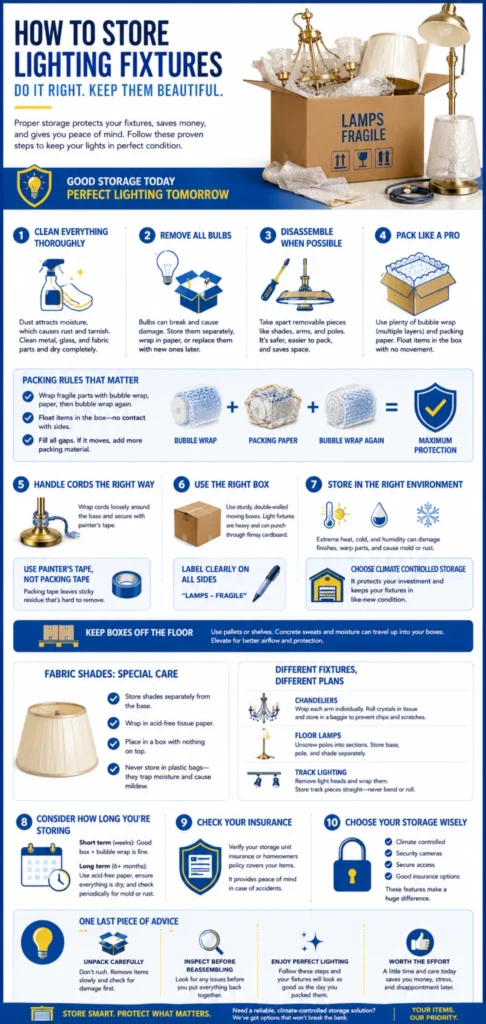
Storing lighting fixtures safely starts with cleaning and completely drying every piece, removing bulbs, and disassembling anything that can come apart. Wrap fragile parts in multiple layers, keep them from touching the box, eliminate empty space, and use sturdy labeled boxes. Store fabric shades separately with acid-free tissue, never plastic. For storage lasting more than a month, climate control helps protect metal, glass, wiring, and shades from humidity and temperature swings. Keep boxes off concrete floors, check insurance coverage, and inspect everything carefully before reassembly.
Look, I am going to be straight with you. The first time I had to store lighting fixtures, I had no clue what I was doing. I just shoved a floor lamp into a box with some old t-shirts and called it a day. Big mistake. When I pulled it out three months later, the shade was crushed, the metal had this weird tarnish on it, and I wanted to cry.
So trust me when I say this – I learned the hard way so you do not have to.
Whether you are remodeling your kitchen, moving to a smaller apartment temporarily, or you just bought way too many lamps at that estate sale (no judgment, we have all been there), storing these things properly is not optional. It is survival.
The First Thing Nobody Tells You
Here is something most blogs will not say. You cannot store a lamp dirty. I know you are thinking “it is just dust” but hear me out.
Dust is not just annoying. It attracts moisture. And when that moisture sits on metal finishes for weeks or months, you get rust. I am not talking about a little patina either. I am talking about actual pitting where the finish just flakes off. You take your lamp out and it looks like it has some kind of skin disease.
So before you even look at packing supplies, you need to clean everything thoroughly.
For metal parts, just use a soft cloth with some mild soap and water. Dry it completely. And I mean completely. Any leftover water droplets will cause spots. For glass, windex works fine but make sure you buff it dry. Fabric shades? Vacuum them gently with the brush attachment. Do not get them wet unless you want a nightmare situation with water stains.
I know it is an extra step. But you will thank yourself later.
Bulbs Are Not Your Friend Here
This is going to sound obvious but you would be surprised how many people skip it.
Take the bulbs out.
All of them.
I am not joking. I have seen people store lamps with bulbs still screwed in and when they moved the box, the bulb broke inside the socket. Now you have broken glass wedged in there and you cannot even get it out without risking cutting your fingers.
Plus, bulbs are fragile. They roll around in the box even if you think they are secure. Just pop them out, wrap them in some paper, and store them in a separate small box. Or honestly? Throw them away and buy new ones when you pull the lamp out. They are cheap. Your fixture is not.
Taking Things Apart Saves Headaches
If your lamp or chandelier has pieces that detach, take them apart.
I know it seems like more work but it actually makes everything safer. Those little glass shades that screw on? They are going to bounce around if you leave them attached. The arms on a chandelier? They can bend under pressure if the box gets jostled.
So break it down into smaller pieces. It packs easier. It takes up less space. And most importantly, it means you are not trying to wrap some giant awkward shape that does not fit in any standard box.
The Packing Part That Actually Matters
Okay so now your fixture is clean, disassembled, and bulb-free. Now we actually have to pack it.
Forget everything you think you know about packing delicate stuff.
- First rule. Bubble wrap is great but only if you use enough of it. I am talking multiple layers. I always wrap the fragile parts in bubble wrap first, then I put a layer of packing paper around that, then another layer of bubble wrap. It is overkill? Maybe. But I have never had anything break using this method.
- Second rule. Do not let the wrapped item touch the sides of the box. This is called floating. You want to put a bunch of crumpled packing paper or packing peanuts at the bottom of the box. Then you nestle your wrapped fixture in there. Then you fill all the gaps around it so it does not move. If you can shake the box and hear movement, you have failed. There should be zero movement. None.
- Third rule. Cords are annoying. I hate cords. But you need to deal with them. Wrap them loosely around the base of the lamp and tape them down with painter’s tape. Not packing tape. Packing tape leaves that sticky residue that is impossible to get off metal. Painter’s tape comes off clean.
The Box Itself
Do not use some flimsy box from the grocery store.
Spend the few dollars and get a proper sturdy moving box. Double-walled if you can find it. Light fixtures are heavy and pointy. They will poke through thin cardboard like it is butter.
Also, label the box clearly. I know this sounds basic but how many times have you stacked boxes and then spent an hour searching for one specific thing? Write “LAMPS – FRAGILE” in big letters on all sides. Use a marker that does not smudge.
Where You Store It Changes Everything
Here is where people really mess up.
They think “oh I will just toss this in the garage” or “the shed out back is fine.”
No. No it is not.
Temperature changes wreck lighting fixtures. Extreme heat can warp plastic parts and dry out wiring insulation. Extreme cold can make glass brittle. And humidity? Humidity is the absolute worst for metal finishes. That beautiful brass lamp? It will look green and sad after a few months in a damp environment.
If you are storing these fixtures for more than a month, you really need a climate controlled space. I know it costs a bit more but think about the value of what you are storing. A nice chandelier can cost hundreds or even thousands. Paying a little extra for a storage unit that controls temperature and humidity is cheaper than replacing everything.
And if you use a storage facility, do not put boxes directly on the floor. Concrete sweats. Even if it looks dry, moisture comes up through it. Use pallets or shelves to keep your boxes elevated. Airflow underneath makes a huge difference.
Fabric Shades Are Their Own Nightmare
Fabric lampshades are the worst to store. They are awkward shaped. They crush easily. And they stain if you look at them wrong.
My advice? Store them separately from the base. Do not leave them attached.
If the shade is small enough, wrap it in acid-free tissue paper and place it in a box with nothing on top of it. If you have to stack boxes, put the shade box on the very top so nothing crushes it.
And for goodness sake, do not store fabric shades in plastic bags. I know it seems like a good idea to protect them from dust but plastic traps moisture. That moisture causes mildew. And mildew on a lampshade? You might as well throw it away.
Different Fixtures Need Different Plans
Let me break this down because not all lighting is the same.
- For chandeliers, wrap each arm individually. I know it is tedious but those arms are fragile. If you have crystals on chains, roll them in tissue and put them in a baggie before putting them in the box. Otherwise they clink against each other and you end up with chips or scratches.
- For floor lamps, take the pole apart if you can. Most of them unscrew in sections. This makes them way easier to pack. Keep the base separate from the pole separate from the shade.
- For track lighting, these are actually easier to store. They are sturdy. Just remove the light heads, wrap them, and store the track piece straight. Do not bend or roll anything.
How Long Are You Storing This?
Short term versus long term is a real factor here.
If you are just storing for a few weeks while you paint or while you are between apartments, you can be a little less intense about it. A good box and some bubble wrap will probably be fine.
But if you are storing stuff for six months or more, you need to think long term. Use acid-free paper. Make sure everything is absolutely dry before packing. Check on your stuff occasionally if you can. Just open a box and make sure nothing is growing mold or rusting.
The Truth About Insurance
This might sound like I am trying to sell you something but I am not.
Check your storage unit insurance or your homeowners policy to see if your stuff is covered. Accidents happen. Boxes get dropped. Things fall over. Knowing that you are covered takes a lot of stress off your shoulders.
And if you are looking for a storage facility, ask about their policies. Do they offer climate control? Are there cameras? Is the place secure? These things matter more than you think.
One Last Piece of Advice
When you finally pull that fixture out of storage and unpack it, take your time. Do not rip the box open like it is Christmas morning. Carefully remove everything. Check for damage before you even try to reassemble.
And if you followed all this advice? Everything should look exactly as good as the day you packed it. Maybe better because you cleaned it first.
Look, storing lighting fixtures is annoying. I get it. It takes time and effort and honestly who has time for all this? But the alternative is pulling out a broken expensive lamp and regretting every decision you made. And nobody wants that.
So take the extra fifteen minutes. Wrap things properly. Pay attention to where you store them. Your future self will thank you when you are plugging in that beautiful lamp and it looks perfect.
And if you need a reliable place to keep all those boxes safe and climate controlled, we have got options that will not break the bank. Just saying. We know how important your stuff is because we have seen too many people lose things to bad storage conditions.
Now go clean that dusty lamp before you pack it. Seriously. Do it right now.










0 Comments