
Quick Summary
The safest way to store vintage clothing is to control moisture and temperature, not simply seal everything in an airtight box. Sealed cardboard boxes and plastic bins can trap humidity, leading to condensation, musty odors, mold, and permanent fabric damage. Let air circulate, make sure clothing is completely dry, use silica gel packs, keep containers off concrete floors, and consider freezing fabrics before long-term storage. For valuable vintage clothing, climate-controlled storage is the most reliable option because stable temperature and humidity reduce the risk of moisture-related damage.
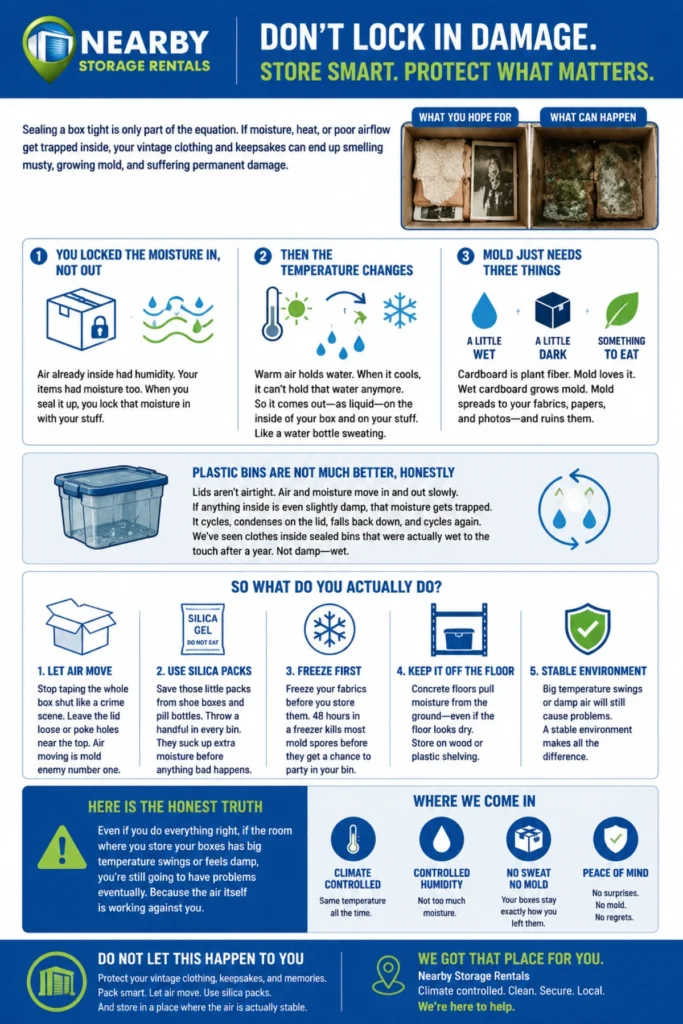
You pack up your stuff. You get the good tape. The wide one. You go around the whole box twice. Maybe three times on the bottom because you don’t trust it. And you think yeah. Nothing is getting in or out of this thing.
Then three months later you open it and it smells like a wet dog died inside a crawlspace.
What gives right?
I will tell you. And you are not gonna like it.
Because when it comes to the best ways to store vintage clothing properly, sealing a box tight is only part of the equation. If moisture, heat, or poor airflow get trapped inside, your prized pieces can end up smelling musty, developing mildew, or suffering permanent damage.
You Locked The Moisture In, Not Out
That box you sealed so nice? You locked the moisture in with your stuff. Not out. In.
Think about it this way. When you packed that box, there was air in there already. That air had humidity in it. Maybe not a lot. But some. And your stuff had moisture too. Even dry looking clothes have a little. Paper definitely has some.
So you seal it up. Okay fine.
Then The Temperature Changes
If you store that box somewhere that gets warm during the day and cool at night – which is basically everywhere except fancy climate controlled places – then the air inside that box is gonna sweat.
I am serious. The warm air holds water. Then it cools down and it cant hold that water anymore. So the water comes out. As actual liquid. On the inside of your box. On your stuff.
You ever see a water bottle sweat on a summer day? Same exact thing. But inside your sealed box where you cant see it.
Mold Just Needs Three Things
And that is all mold needs:
- A little wet.
- A little dark.
- Something to eat.
Guess what cardboard is made of. Plant fibers. Mold loves eating plants.
So now you got wet cardboard. Wet cardboard grows mold. Mold and mildew spreads to the fabric or the papers or the photos inside that box. And by the time you open it again, everything is ruined.
Plastic Bins Are Not Much Better Honestly
People bring us these nice clear totes. Snap the lid on real tight. They feel so proud. And I have to tell them sorry but that lid is not airtight. Air gets in and out slowly. Moisture gets in and out slowly.
And if you put something in there that was even slightly damp? That moisture is trapped. It cycles around. Condenses on the lid. Falls back down. Cycles again.
I have seen clothes inside sealed bins that were actually wet to the touch after a year. Not damp. Wet.
So What Do You Actually Do?
Few things.
- Stop taping the whole box shut like a crime scene. Leave the lid loose or poke some holes near the top. Air moving is mold enemy number one, especially when using prevent mould storage boxes to keep stored items fresh and dry.
- Get those little silica packs. The ones that come in shoe boxes and pill bottles. Save them. Throw a handful in every bin. They suck up the extra moisture before anything bad happens.
- Freeze your fabrics before you store them. I know that sounds weird. But 48 hours in a freezer kills most mold spores before they get a chance to party in your bin.
- Keep everything off the floor. Concrete floors pull moisture from the ground. Even if the floor looks dry. It is not. Put stuff on wood or plastic shelving.
Here Is The Honest Truth
Now look. You can do all that stuff. And it will help a lot. Really.
But here is the honest truth. If the room where you keep your boxes has big temperature swings or feels damp at all, you are still gonna have problems eventually. Because the air itself is working against you.
Where We Come In
That is why at Nearby Storage Rentals we run climate control. We keep the air boring. Same temperature all the time. Not too much humidity. Your boxes dont sweat at night because the air doesn’t change.
You bring your sealed bins here? They stay exactly how you left them. No surprises. No mold. No opening a box six months later and wanting to throw up from the smell.
Frequently Asked Questions
Q1. What causes mold in storage boxes most often?
Mold often follows moisture from damp items, humid air, leaks or packing materials that stay wet.
Poor airflow around dense stacks can contribute.
Nearby Storage Rentals recommends drying belongings completely before boxing them, rather than sealing damp contents and hoping a closed unit will keep mold from developing later.
Q2. How do I stop mold before packing boxes for storage?
Clean and fully dry items, choose sturdy dry boxes or bins, and avoid basement-damp cardboard.
Use moisture control suited to the unit conditions.
We recommend inspecting fabrics and wood carefully, because packing even slightly damp goods is one of the fastest ways to create mold problems after move-in.
Q3. Can climate-controlled storage reduce mold risk in boxes?
Climate-controlled storage can reduce humidity and temperature swings that encourage mold, but it does not fix items packed wet.
Packing quality still matters.
Nearby Storage Rentals suggests combining appropriate climate options with dry packing practices instead of treating the unit type as a cure for moisture already sealed inside boxes.
Q4. Should I leave air gaps between storage boxes?
Leaving modest gaps and avoiding tight contact with exterior walls can support better air movement around stacks when the facility design allows it.
Do not block corridors.
We recommend stable, accessible arrangements rather than compressing every box tightly against surfaces where condensation or cooler wall temperatures may concentrate.
Q5. Do plastic bins prevent mold better than cardboard?
Plastic bins can resist absorbing moisture better than cardboard, but mold can still form if contents are damp or lids trap humidity.
Dry items first.
Nearby Storage Rentals recommends judging the whole packing system, not only the container material, when protecting papers, textiles or other mold-sensitive belongings.
Q6. What should I do if I find mold on stored boxes?
Avoid spreading spores unnecessarily, isolate affected items if safe, and seek appropriate cleaning or disposal guidance for the materials involved.
Notify the facility about unit conditions if relevant.
We recommend acting promptly rather than resealing moldy boxes, which can worsen damage and contaminate neighboring contents over time.
Q7. Can silica packs alone stop mold in a storage unit?
Small desiccant packs may help inside sealed containers but cannot control humidity for an entire unit alone.
They are not a substitute for dry packing and suitable climate conditions.
Nearby Storage Rentals suggests using them as a limited aid, not as the primary mold-prevention strategy for a full storage space.
Q8. How often should I check boxes for moisture during storage?
Check on a schedule you can keep, especially after weather extremes or if you notice odors or warping.
Inspect without leaving the unit disordered.
We recommend planned visits rather than waiting until retrieval day, when mold may already have damaged papers, fabrics or wooden items beyond easy recovery.
Do Not Let This Happen To You
I have seen that look on peoples faces too many times. When they open a box that had their kids baby clothes or their wedding dress or old photos and everything is covered in that fuzzy green gray mess.
It sucks.
Dont let it happen to you.
Pack smart. Let air move. Use those silica packs. And if you really care about your stuff, put it somewhere the air is actually stable.
We got that place for you.







0 Comments