
I’ll be honest with you. I learned this lesson the expensive way.
A couple years back, I found a killer deal online. Buy two water filters, get one free. I thought I was being so smart. I tossed the extras in the basement, right next to the water heater. Fast forward about fourteen months. I pop one in, run the water, and I swear it tasted like I was drinking out of a garden hose that had been sitting in the sun. Just… plasticky and wrong.
I wasted my money. And I learned that you can’t just chuck these things anywhere and expect them to work.
Here’s the thing that nobody tells you. Your water filter is basically a hungry little sponge. That’s all it is. It’s designed to pull stuff out of your water. So what happens when you store it in a place that has stuff floating around in the air? You guessed it. It starts pulling that in too.
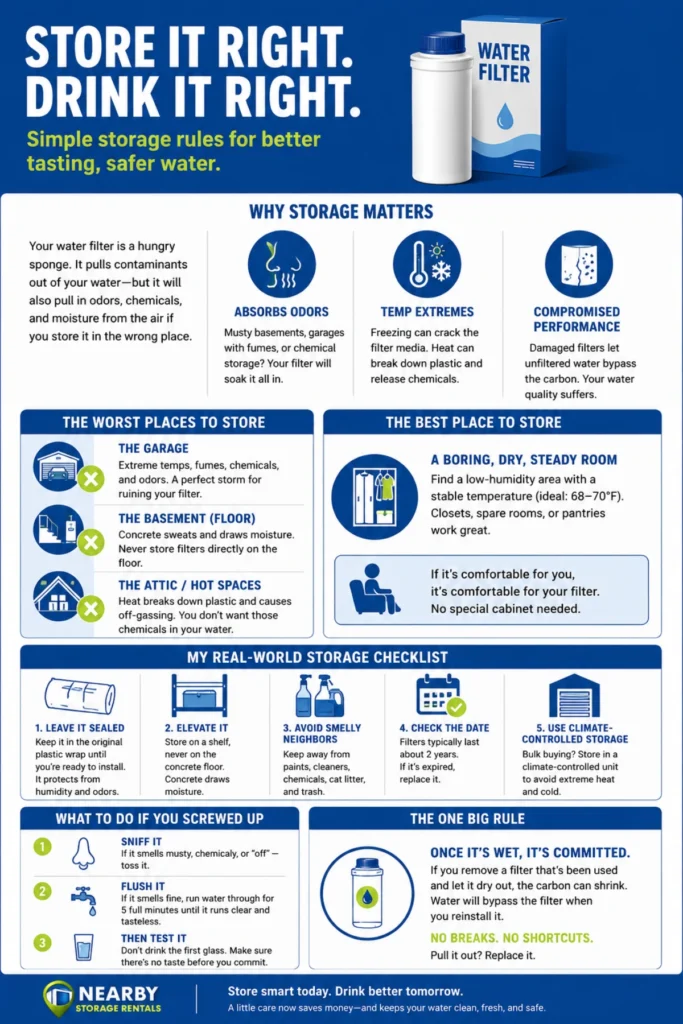
So if your basement smells musty, guess what your water filter is going to taste like? Musty. If your garage smells like gasoline or paint thinner, your filter is going to be more than happy to absorb those fumes. That’s why it’s important to store water filters in a clean, dry, odor-free environment. Otherwise, those unwanted smells can end up in your drinking water. Not ideal, right?
The Temperature Thing Is a Bigger Deal Than You Think
I’m in the storage business, and I can’t tell you how many people shrug off temperature. They think, “It’s just plastic and carbon, what’s the big deal?”
The big deal is expansion and contraction. Let me break it down in plain English.
When that filter gets really cold, like below freezing cold, the tiny little bits of moisture inside the filter expand. We’re talking microscopic levels here. But that expansion is enough to crack the internal structure of the carbon block. You won’t see a crack on the outside. It’ll look brand new. But on the inside? You’ve just created a highway for unfiltered water. The water will find that path of least resistance and just bypass the filter media entirely.
On the flip side, heat is just as bad. If you leave that box in an attic or a hot storage unit without climate control, the plastic starts breaking down. I’m not talking about it melting. I’m talking about off-gassing. The plastic releases chemicals into the filter media. And then you drink those chemicals. I don’t know about you, but I didn’t buy a water filter to add extra chemicals to my water.
The Garage Is a Death Trap
Look, I get it. The garage is where we store everything. Old paint cans, holiday decorations, tools, and that extra water filter you bought.
Don’t do it.
Garages are the worst. They are freezing in winter, roasting in summer, and they collect every nasty smell from your car, your lawn chemicals, and your trash cans. Your filter is sitting there, breathing all of that in. Because yes, filters breathe. That carbon is activated, which means it is actively looking for stuff to trap.
If you have yours in the garage right now, go get it. Seriously. Go grab it and move it inside. I’ll wait.
So Where Do I Actually Put It?
This is where I had to get creative myself. I live in a small house, so I don’t have endless closets. But here is the rule I live by now.
Find the most boring room in your house. You know the one. The one that doesn’t have a bathroom (so no steam), doesn’t have a kitchen sink (so no humidity), and stays roughly the same temperature year-round.
For me, that ended up being the back corner of my bedroom closet. It’s boring, it’s dry, and the temperature stays around 68-70 degrees no matter what is happening outside.
You don’t need a special “filter storage cabinet.” You just need a place that feels comfortable for you to sit in. If the room is comfortable for a human, it is comfortable for a filter. That’s the test.
A Couple of Real-World Rules I Follow Now
I’m not a scientist. I’m just a guy who has learned a few things. Here is my personal checklist that has kept me from ruining anymore filters.
- Leave It Sealed. Seriously, do not open the packaging just to “check it out.” That plastic wrap is protecting it from humidity and odors. Keep it on until you are ready to install it. I know you want to look at it. Resist the urge.
- Elevate It. If you have to store it in the basement because you have zero closet space, at least put it on a shelf. Never put it on the concrete floor. Concrete sweats. It draws moisture up from the ground. Even if the floor looks dry, it isn’t.
- No Smelly Neighbors. Keep it away from cleaning supplies. Keep it away from where you store your paints. Keep it away from the cat litter. I know that sounds obvious, but you would be surprised.
- Check the Date. Manufacturers put expiration dates on these things for a reason. Usually it’s about two years. The carbon loses its kick over time. If you are past that date, just toss it and buy a fresh one. It’s not worth the gamble.
What About a Storage Unit?
A lot of people ask me this. They buy in bulk to save money, but their house is overflowing. They think, “I’ll just throw it in a storage unit.”
And I tell them, “Sure, but pick the right one.”
If you are using a storage unit that isn’t climate controlled, you are basically putting your filters in a giant metal box that turns into an oven in July and a freezer in January. You’re better off leaving them in your car trunk. At least the car has some ventilation.
We offer climate-controlled units specifically for stuff like this. We keep the temperature steady so your filters don’t cook or freeze. It’s not flashy, but it works. If you are serious about buying filters in bulk and storing them properly, it’s the only way to go.
What to Do If You Screwed Up
Let’s say you pulled out a filter that has been sitting in your garage for a year. You’re already committed. What do you do?
First, smell it. I know, weird. But take the plastic off and give it a sniff. Does it smell like anything other than plastic or a slight medical smell? If you smell chemicals, grass, or mustiness, do not use it. I mean it. Toss it.
If it smells fine, you need to flush it. Don’t just pop it in and drink the first glass of water. Run water through it for a good five minutes. Not two minutes. Five. Let all that initial carbon dust and anything that settled in there wash down the drain.
Sometimes the water comes out grey. That’s normal. That’s just activated carbon dust. Wait until it runs totally clear and there is zero taste before you drink it.
The One Thing I Wish Someone Told Me
Here is the biggest mistake people make. They treat a used filter like a spare.
If you take a filter out of your fridge because you are going on vacation, do not save it. I know it feels wasteful. But once that filter is wet, the clock is ticking. The inside is moist. If you let it dry out, the carbon shrinks. And when you put it back in, the water just slips around the sides instead of through the filter.
Once it gets wet, it’s committed. There are no “breaks.” So if you pull it out, just throw it away and start fresh when you get home.
The Bottom Line
Look, water filters aren’t that expensive. But they also aren’t free. It stings to drop forty bucks on a filter, install it, and realize you just drank a glass of “basement flavored” water.
Just give your filter a boring, dry, temperate place to live while it waits. Keep the plastic on. Keep it off the floor. And if you don’t have that space in your house, use a climate-controlled storage spot.
It takes zero effort once you know the rules. And the payoff is water that actually tastes like water, not like whatever is festering in your garage. That’s the whole point of buying the filter in the first place, isn’t it?










0 Comments