
Quick Summary
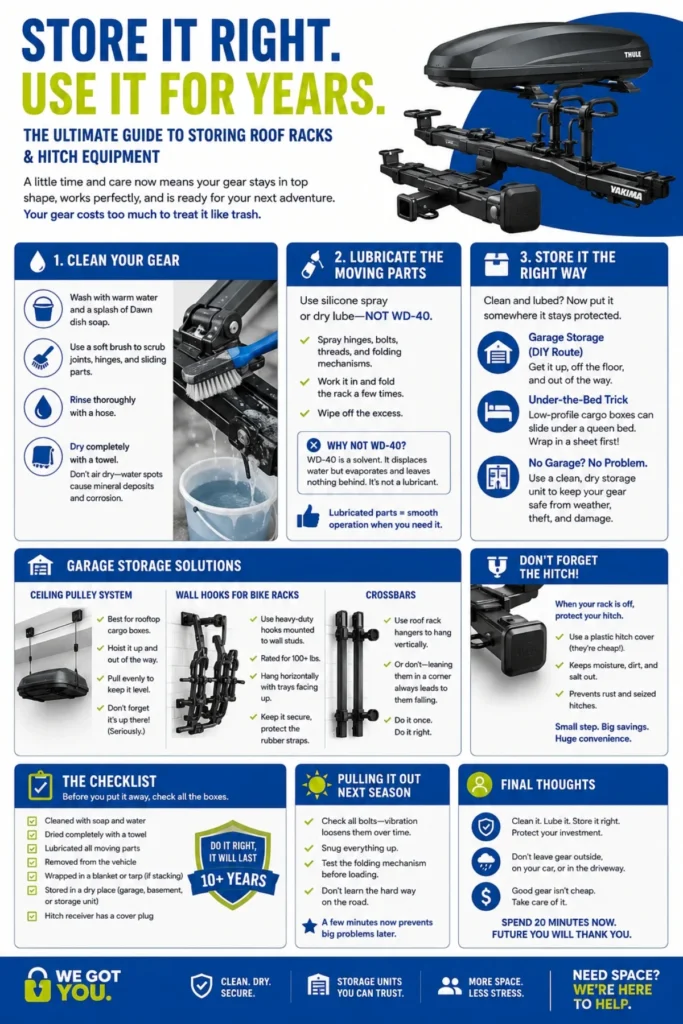
Roof racks and hitch equipment should be cleaned, dried, lubricated, and stored somewhere dry rather than left outside or on your vehicle all winter. For garage storage, a ceiling pulley works well for cargo boxes, heavy-duty wall hooks handle bike racks, and roof rack hangers keep crossbars organized. Low-profile cargo boxes can even fit under a bed. If garage space is limited, a storage unit can protect expensive gear from weather and theft. Before using everything again, check the bolts and test the folding mechanisms for safe, secure operation.
Okay, real talk. You know that feeling when you pull into your driveway after a killer weekend camping trip, you are exhausted, your back hurts, and you look up at that massive cargo box strapped to your roof and think, “Yeah… that is a problem for Future Me.”
Well, Future Me is here. And Future Me is annoyed.
Because here is the thing about roof racks and hitch equipment – they are amazing when you need them and an absolute nightmare when you don’t. They are bulky, they are awkward, they have weird pointy bits that scratch your car if you look at them wrong, and they take up space that you simply do not have.
I have personally punched a hole in my drywall trying to maneuver a bike rack off my hitch. I have also watched my neighbor leave his Yakima box outside for two winters and then act shocked when the lid cracked like an egg. Don’t be that neighbor.
We run a storage facility, sure. But before I even suggest you rent a unit from us, let me tell you what I tell my own brother who refuses to pay for storage because he is “cheap” (his words, not mine). You have options. Some are good. Some are bad. Let’s walk through them.
First Things First – Clean Your Crap
I know you don’t want to hear this. You just got home. The cooler needs to be emptied, the kids need to be fed, and the dog is tracking mud through the house. The last thing you want to do is scrub a roof rack.
But listen to me. Please.
If you put that rack away dirty, you are basically inviting rust and corrosion to have a party on your expensive gear. Think about all the road grime, the bug guts, the tree sap, the salt if you drove near the coast. That stuff is acidic. It eats paint. It seizes up bolts.
Here is what I actually do, and it takes maybe ten minutes:
- Grab a bucket of warm water with a splash of Dawn dish soap. Nothing fancy.
- Use a soft brush – I use an old tire brush – and scrub every joint and hinge. Pay attention to where the metal pieces slide into each other.
- Rinse it with the hose.
- Dry it with a towel. Do not skip this step. If you let it air dry, you will get water spots, and if you live in a hard water area, those spots are basically mineral deposits that etch into the finish.
I am not trying to sound like your dad, but seriously, do this. Your wallet will thank you later.
Lubricate the Moving Bits
Once it is clean and bone dry, grab some lubricant.
Quick side note – DO NOT use WD-40 for this. I see people do this all the time and it drives me insane. WD-40 is a solvent. It displaces water, sure, but it evaporates and leaves nothing behind. It is not a lubricant. It is a temporary fix.
Get yourself a can of silicone spray or a dry lube. I use the same stuff I put on my garage door tracks. Spray it on the hinges, the folding mechanisms, the bolts, the threads. Work it in. Fold the rack a few times. Then wipe off the excess with a rag.
Why? Because the next time you go to use it, you want it to fold smoothly. You do not want to be standing in a parking lot at 6 AM, wrestling with a stuck folding mechanism, while your friends are already loading their bikes onto their cars. Trust me, I have been that guy.
Okay, Now Actually Store It
So now your gear is clean and lubed. Now we gotta figure out where to put it.
Garage Storage – The DIY Route
If you are keeping this stuff in your garage, you have two options. You can be organized, or you can be chaotic. I have been both. Organized is better.
The Ceiling Pulley System
If you have a rooftop cargo box, this is your best friend. You can buy a pulley hoist kit on Amazon for like forty bucks. You screw it into your ceiling joists, run the straps under the box, and crank it up to the ceiling.
This gets it completely out of your way. You can still park your car under it (as long as you remember it is there – I may have forgotten once and nearly crushed my box). Just make sure you pull it up evenly so it doesn’t tilt and slide off the straps.
Wall Hooks for Bike Racks
Hitch bike racks are heavy. Like, deceptively heavy. You think they are just metal tubes, but then you try to lift one and your back immediately regrets it.
Use heavy-duty wall hooks. You want the ones that screw directly into the wall studs – not the flimsy drywall anchors. These hooks are usually rated for like 100 pounds. Hang the rack horizontally. I hang mine with the bike trays facing up so they don’t put pressure on the rubber wheel straps.
For Crossbars
If you have roof crossbars, you can hang them vertically on a wall using specific roof rack hangers. Or, if you are lazy like me, you can just lean them in the corner behind your tool bench. But they will fall over. They always fall over. Save yourself the headache and get the hangers.
The Under-the-Bed Trick
Here is a hack that a customer actually taught me years ago. If you have a low-profile cargo box – the slim ones that are designed for skis – it can slide right under a queen-sized bed. Just wrap it in an old bedsheet first so it doesn’t scuff your floor. This is perfect for apartment dwellers who don’t have a garage.
What About the Hitch Itself?
One thing nobody talks about? The actual hitch receiver on your car. When you take the bike rack off, that hole is just sitting there, exposed to rain, dirt, and salt.
Here is what you should do. Go buy a plastic hitch cover. They cost like eight bucks. Pop it into the receiver. It keeps moisture out, which means your hitch won’t rust from the inside out, which means you will actually be able to get your rack back in next season without using a hammer.
I cannot tell you how many customers I have seen come in with seized hitches because they left the receiver open to the elements. Do not be that person.
When Garage Space Just Doesn’t Exist
Alright, here is the honest truth.
Some of you reading this do not have a garage. Maybe you live in a condo. Maybe you have a garage but it is so packed with holiday decorations, old furniture, and your ex’s stuff that you cannot even open the door. I get it. Life is messy.
This is where we actually can help you out.
We have top storage units specifically for this kind of gear. And I am not talking about those dirty, leaky units you see on TV. We keep things clean and dry. You can roll up, slide your bike rack and roof box into the unit, lock it up, and just forget about it until May.
The thing I always tell people is this – you paid good money for that gear. A quality Thule cargo box is like eight hundred bucks. A Yakima bike rack? Also not cheap. Spending a little bit each month to keep that equipment safe from theft, weather damage, and your own clumsy mistakes is actually a pretty good investment.
Plus, honestly? It is just really nice to reclaim your space. Your garage should be for parking your car, not for navigating a maze of sporting goods.
The Checklist for Putting It Away
Before I let you go, here is a quick checklist. Print this out if you need to.
- Cleaned with soap and water.
- Dried completely with a towel.
- Lubricated all moving parts.
- Removed from the vehicle.
- Wrapped in a blanket or tarp (if stacking).
- Stored in a dry place (garage, basement, or our storage unit).
- Hitch receiver has a cover plug.
If you check all these boxes, your gear will last you ten years. Easy.
Pulling It Out Next Season
When you finally dig your rack out next spring, here is a pro tip. Check the bolts.
I cannot emphasize this enough. Vibration from driving loosens bolts over time. If you put the rack away tight, it might still be tight. But check anyway. Give everything a quick snug. Test the fold mechanism before you load it onto your car. Because the worst thing in the world is loading up for a road trip, driving two hours, and realizing your rack is wobbling because a bolt fell out somewhere on the highway.
I have been there. I had to use a shoelace to tie my bike rack once. It was not a proud moment.
Final Few Thoughts
Look, storing roof racks and hitch equipment is annoying. I am not going to pretend it is fun. It is one of those chores you just have to do.
But if you approach it the right way, it does not have to be a nightmare. Clean the gear, lube the joints, get it off the floor, and protect it from the elements. Whether you do that in your own garage or you toss it into a storage unit with us, just do something. Do not leave that stuff outside. Do not leave it on your car all winter. And for the love of everything, do not leave it in the driveway where it can get rained on and stolen.
Your gear costs too much money to treat it like trash.
So next time you roll into the driveway after a trip, take an extra twenty minutes. Do it right. Future You will be so grateful when you pull that rack out next summer and it looks brand new, folds perfectly, and locks securely.
And hey, if you need the space, you know where to find us. We got you.










0 Comments