
So, you just rented a storage unit. You walk in, shut the door behind you, and it’s just you, four concrete walls, and a mountain of boxes that you swear multiply overnight.
You look around and you think, “Alright, I’ll just stack this floor to ceiling, how hard can it be?”
Two weeks later, you’re sweating, cursing, and digging through the entire unit just to find your crockpot. That’s the moment you realize you messed up. And usually, that’s the exact moment people start googling shelves.
I’ve been running a storage facility long enough to see people make the exact same mistakes over and over again. The biggest question we get? “Should I buy folding shelves or permanent ones?”
Honestly, it’s the wrong question to ask. You should be asking, “What am I actually putting on them?” Because if you don’t know that, you’re just guessing. And guessing in a storage unit usually means wasted money and a lot of frustration.
Let’s Cut the Crap About Permanent Shelves
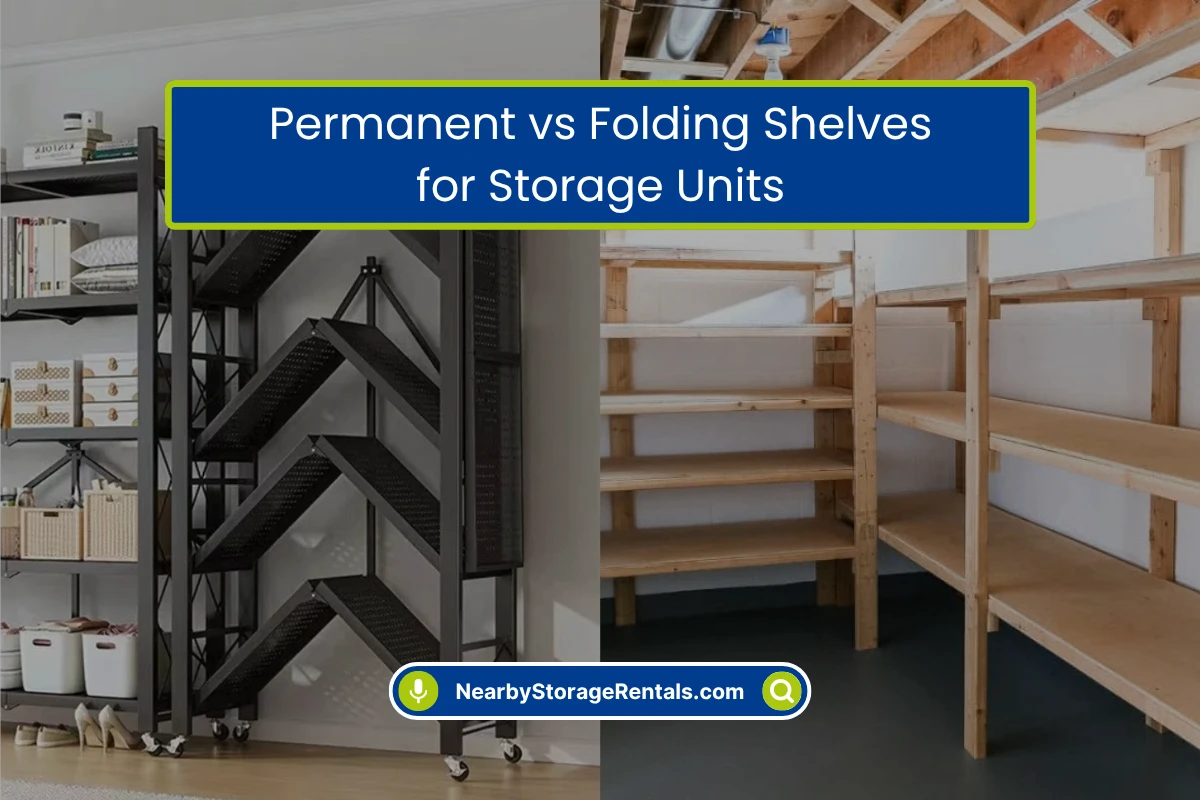
When I say permanent, I don’t mean you have to weld them to the floor. I’m talking about those heavy-duty steel racks you see in garages. The ones that weigh like fifty pounds before you even put a box on them.
These things are tanks. You put them in, and they aren’t moving until you take a wrench to them.
Here’s why you might love them:
For starters, they don’t wobble. If you’ve got a stack of old textbooks, power tools, or those massive Rubbermaid totes full of Christmas ornaments, this is your ride or die. You can load them up and forget about them. There’s no anxiety about waking up to a loud crash in the middle of the night.
Also, they force you to be organized. Because you can’t easily move them, you’re forced to think ahead. You decide the layout, you stick to it, and that actually makes it easier to remember where your stuff is.
But let me tell you about the downside, because there is one.
Putting these together is a workout. I’m serious. You’re going to be sweating, looking at a million bolts, and probably dropping a heavy metal shelf on your toe. If you’re moving in on a 90-degree day, the last thing you want to do is assemble industrial shelving.
And the biggest kicker? They are rigid. I’ve seen people set up their whole unit, lock the door, and come back the next day realizing they blocked their own access to the back. Now, you have to unload the shelf, dismantle it, and start over. It’s a pain in the neck.
Why Everyone Gets Sucked Into Buying Folding Shelves
Now, let’s talk about the other side of the coin. Folding shelves. These are those wire racks that snap together without tools. You’ve seen them at the big box stores. They’re usually cheaper and way lighter.
I get why people grab these. You can carry them into your unit with one hand. You snap the plastic clips in, and boom, you’ve got a shelf in five minutes.
Here’s the good stuff:
Flexibility. This is the whole reason to buy them. You know how when you start packing, you think you have a plan, but then you actually get into the unit and realize you were totally wrong? Folding shelves save you from that.
Need to wedge a couch in that you forgot about? Just fold the shelf down and push it out of the way. Need to create a workspace for a few hours? Move them. They let you change your mind, and trust me, in a storage unit, you’re going to change your mind a lot.
Now for the part nobody wants to hear:
These things are not meant for heavy stuff. I can’t tell you how many times I’ve seen these shelves buckle because someone loaded them up with heavy banker boxes. The clips that hold the wire shelves up? They’re plastic. Plastic warps under pressure.
Also, they are wobbly. You brush against them while you’re moving a box, and the whole unit shakes. It drives me nuts just watching it. If you’re clumsy (and I’m clumsy), you’re going to accidentally knock things off the top.
Here is What We Actually Tell Our Tenants
If you walk through our facility and look at the best units—the ones where people can actually walk in and find what they need—they almost never use just one type.
Look, we’re a storage place. We rent you the space, and we keep it secure and clean. But we can’t organize it for you. The one thing we can do is give you the advice we’ve seen work for hundreds of people before you.
- Go heavy in the back. Put a permanent, heavy-duty shelf against the back wall. This is for your “dead weight.” The boxes you know you aren’t going to touch for six months or a year. Stack them high, stack them deep, and lock it in.
- Go light in the front. Use a folding shelf near the entrance. This is where you put the stuff you grab every week. Sports gear, seasonal clothes, or tools you swap out. If you need to shuffle things around, you can fold it flat in seconds.
The “Reach” Factor That Everyone Ignores
You know what happens to 90% of the units I see? People buy shelves that are too tall. They see the high ceilings, and they think they’re getting a deal by using every inch of vertical space.
But when you put a heavy box on a shelf that’s above your head, you are just creating a hazard. You aren’t saving space, you’re creating a future injury.
If you can’t comfortably rest your chin on the top shelf, it’s too high. You shouldn’t need a ladder to get your Christmas lights down. And if you do have to use a ladder, make sure you leave room for it. Don’t put the shelf so close to the wall that you can’t fit your feet.
Don’t Trust the Weight Limits on the Box
Here’s a little secret. That folding shelf you bought that says it holds “800 pounds”? That’s a lie. Or, at least, it’s a marketing lie. They say that because they test it in a perfect lab with the weight perfectly distributed.
In real life, you’re throwing uneven boxes on it. You’re stacking things weird. You’re going to put 300 pounds of your grandma’s china on it and that plastic clip is going to give way.
Permanent shelves have realistic weight limits. Usually, it’s a “per shelf” limit, and they actually mean it.
My rule of thumb? If you are storing anything that costs you money (tools, electronics, furniture), put it on the permanent shelf. If you’re storing clothes, pillows, or holiday tinsel, the folding shelf is fine.
Let’s Talk About Your Time
Time is the thing we always forget to factor in.
When you buy a permanent shelf, you’re spending an hour assembling it and probably thirty minutes figuring out the layout. That’s an investment of your afternoon.
When you buy a folding shelf, you’re spending five minutes putting it together. But you’re going to spend more time later trying to Tetris your unit because you have to move things around to reach the back.
So, ask yourself: Do you want to sweat now or sweat later? Because you’re going to sweat either way.
The Biggest Mistake You Are Probably About to Make
You’re going to put the shelves on the floor and start stacking. Stop.
Leave a gap between the bottom shelf and the concrete floor.
Why? Because concrete sweats. Even in a dry building, moisture comes up from the ground. If your cardboard boxes are sitting directly on that floor, or on a shelf that is right on the floor, the bottom is going to get damp and ruin your stuff.
Put a pallet underneath, or get shelves with adjustable feet. It sounds like overkill, but I promise you, it saves your boxes from getting soggy and collapsing.
How We Fit Into This
We keep our facility dry, safe, and accessible. You rent the unit, you get the key, and you’ve got a blank canvas. Whether you walk in there with a truckload of pricey industrial shelves or a bunch of cheap wire racks from the hardware store, we want you to actually like using your unit.
A lot of people think storage is just “out of sight, out of mind.” But if you set it up right, it doesn’t feel like a chore to go there. It feels like you’re just walking into your own personal warehouse.
So, Permanent or Folding?
If you need me to pick a winner, I won’t. Because the winner is you, but only if you know your own stuff.
- Are you moving heavy tools? Permanent.
- Are you storing your kid’s off-season clothes? Folding.
- Are you just trying to get stuff out of your garage for the winter? Go cheap with the folding ones.
- Are you planning to store your stuff for more than a year? Spend the money on permanent and thank yourself later.
Don’t overthink it. Just don’t put heavy things on a flimsy rack. If you remember that one rule, you’re already ahead of half the people I see walking through our doors.
And if you make a mistake and it’s not working out? That’s fine. Just swap them. That’s the beauty of a storage unit. Nothing is permanent except that heavy shelf you bolted together. Even then, a little elbow grease will take it apart.
Go take a look at your pile of boxes, decide which ones weigh a ton, and start there. You’ve got this.









0 Comments