
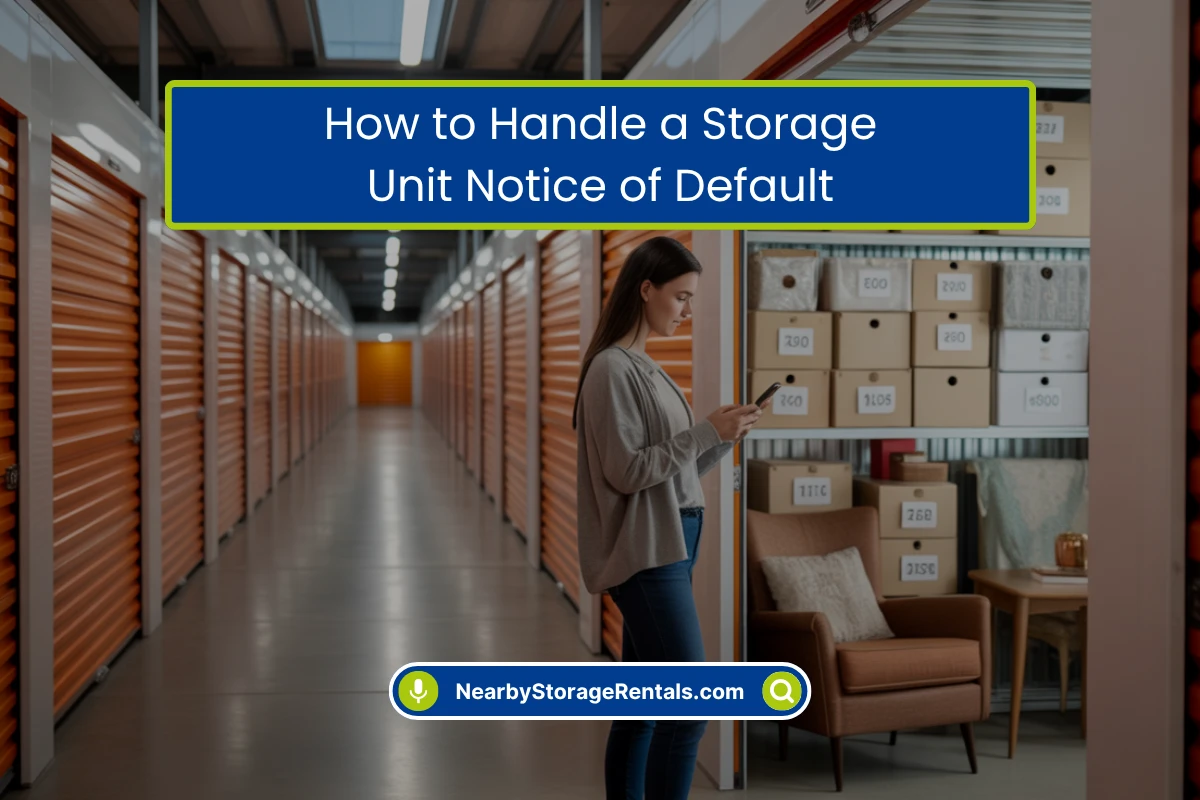
Let’s be real for a second. You’re busy, life gets chaotic, and sometimes that storage unit rental payment slips your mind. Maybe you changed bank accounts and forgot to update your autopay. Perhaps you’ve been dealing with a family emergency and paying for your storage unit simply wasn’t at the top of your priority list. Whatever the reason, it happens to the best of us.
But then you get that piece of mail—or worse, an email—with the words “Notice of Default” in bold letters at the top. Your heart probably sinks a little. What exactly does this mean? Are they going to auction off your grandmother’s antique furniture tomorrow? Are the storage cops going to show up and change the locks while you’re at work?
Take a deep breath. We’re going to walk through everything you need to know about what a storage unit notice of default actually means, what your rights are, and most importantly, how to handle the situation without panicking.
So, What Exactly Is a Notice of Default?
In simple terms, a Notice of Default is a formal document that your storage facility sends you when you’ve fallen behind on your rental payments. It’s the legal equivalent of a wake-up call—a “hey, we really need you to pay attention to this” kind of notification.
Every storage facility operates under something called a lien law. These laws give storage companies the right to place a claim (a “lien”) on the items inside your unit if you stop paying rent. The notice of default is the official first step in that legal process.
Think of it this way: you’ve entered into a contract with us when you rented that unit. We hold up our end of the bargain by keeping your stuff safe, secure, and climate-controlled (depending on the facility). Your end of the bargain is making sure your rent is paid on time. When that stops happening, the notice of default is our way of formally saying, “We need to resolve this, and here are the rules we both agreed to follow.”
What Does a Storage Unit Notice of Default Typically Include?
If you’ve received one of these notices (or you’re worried you might soon), here’s what you can expect to see on it. We want you to understand exactly what you’re looking at so nothing catches you off guard.
The Amount You Owe
This is pretty straightforward. The notice will clearly state how much you’re behind on your payments. It should include the base rental amount plus any late fees that have stacked up since your last payment.
A Deadline
Here’s where things get serious. State laws require that we give you a specific amount of time to bring your account current. This is usually between 14 and 30 days, depending on where you live. The notice will include a date by which you need to take action.
A Warning About What Happens Next
The notice will explain that if you don’t pay what you owe by the deadline, we have the legal right to take further steps. This can include:
- Putting a lock on your unit (we’ll add our own lock in addition to yours)
- Denying you access to your belongings until the situation is resolved
- Selling your belongings at a public auction to recover what you owe
We know that last one sounds terrifying. But here’s the thing—we don’t want to auction your stuff. We really, really don’t. Storage facilities aren’t in the business of selling other people’s property. We’re in the business of storing it. But we do have to follow the legal process that we’re both bound by.
Why Did You Get a Notice of Default in the First Place?
Let’s talk about the obvious question: how did you even get here? Understanding why can help you avoid this situation in the future.
You Missed a Payment
This is the most common reason. Maybe you forgot. Maybe you were out of town. Maybe you thought you had autopay set up but your card expired. Life happens, and we get that.
There Was a Billing Issue
Sometimes there’s confusion about billing cycles. Maybe you thought you paid for the month but the payment didn’t go through. Perhaps you paid late last month and now your payment schedule has shifted, and you didn’t realize it.
You Stopped Checking Your Mail
Some people receive their notice of default but don’t open it, especially if they don’t check their mail regularly. We try to reach out through multiple channels—email, phone calls, and physical mail—but sometimes folks just miss us.
Financial Hardship
We understand this one. Maybe you lost your job, had unexpected medical bills, or experienced some other financial setback. The rent on your storage unit suddenly became a luxury you couldn’t afford.
Here’s something important to remember: the notice of default isn’t personal. It’s a legal document. When you signed your rental agreement, you agreed to follow certain procedures, and we’re obligated to follow them too. We’re not trying to punish you; we’re just trying to operate within the law.
What Should You Do When You Receive a Notice of Default?
Now that you know what it is, let’s talk about what you actually need to do about it. The good news is that you almost always have options.
Step One: Don’t Panic and Don’t Ignore It
Ignoring the notice is genuinely the worst thing you can do. We’ve seen people who received a notice of default and just… ignored it. They hoped it would go away. It doesn’t go away. It just gets worse.
If you’re feeling stressed or embarrassed about falling behind, we understand those feelings. But hiding from the problem only makes it bigger. The notice has a deadline, and that deadline won’t extend itself.
Step Two: Open the Notice and Read It Carefully
We know we just said this, but please actually read it. Look at the date it was sent. Check the deadline date. Make a note of the total amount you owe. And most importantly, note whether the notice includes specific instructions about how to catch up.
Step Three: Contact Your Storage Facility
This is the most critical step. Call the facility, send an email, or walk into the office. But reach out. Here’s what you should say:
- “Hi, I received a notice of default, and I want to resolve this”
- “Can we talk about exactly what I owe?”
- “Do I have any options to avoid the auction?”
We can’t promise that every storage facility will offer you flexible terms. But we can tell you that many of them, including us, would much rather work out a solution with you than go through the hassle of an auction.
Step Four: Make a Plan
Depending on your situation, you might:
- Pay the balance in full – This is the easiest solution. You pay what you owe, the notice is cancelled, and everything goes back to normal. We remove the lock, you get your access back, and you don’t have to worry about your stuff being auctioned.
- Set up a payment plan – Some facilities are willing to let you catch up over time. This usually means making a partial payment now and agreeing to a schedule for the rest.
- Access your unit – If you know you can’t get caught up, you can ask to access your unit to remove some or all of your belongings. You’ll likely need to pay a portion of what you owe to get that access.
- Surrender the unit – This means you voluntarily give up the unit and its contents to the facility. It’s not ideal, and we’re not recommending it, but it’s an option if you genuinely can’t pay and don’t want your items to go to auction. This might allow you to avoid having a lien or collection action on your credit report.
What Happens If You Don’t Respond?
We need to be straight with you about this because it’s important.
If you don’t pay your balance or contact us by the deadline on your notice of default, the facility can move forward with the legal process. That typically means:
Your unit gets locked – We’ll put our own lock on your unit, and you won’t be able to access it. This is mostly to protect your belongings from theft or damage while the legal process plays out.
Your items may be sold at auction – After a certain period (again, this varies by state), we can sell your unit’s contents at a public auction. The money from that sale goes toward what you owe. If there’s any leftover, in many states, you might actually get that money back. But if your items don’t sell for enough to cover your debt, you could still owe the difference.
This can affect your credit – Depending on how your storage facility reports delinquent accounts, an unpaid debt could show up on your credit report. If the facility sends the debt to collections, that’s definitely going to ding your score.
You lose your stuff – This is the part that hurts. Once an auction happens, you have no claim to the items in your unit. They belong to whoever bought them. So all those sentimental items, important documents, and valuable belongings could be gone for good.
We’re telling you this not to scare you but to help you understand the stakes. The notice of default is the beginning of a legal process. It’s designed to give you a fair chance to catch up, but after that, there are real consequences.
How Can You Avoid Getting a Notice of Default in the First Place?
An ounce of prevention is worth a pound of cure, right? Here are some practical steps you can take to stay on top of your storage account:
Set up autopay – This is honestly the easiest way to avoid late payments. When we draft your payment automatically, you never have to remember to pay it.
Put a reminder on your calendar – If you prefer to pay manually, set a recurring calendar event for the day your payment is due. Set it for two days before, just to be safe.
Update your contact info with us – If we can’t reach you, we can’t help you. Make sure we have your current phone number, email address, and physical address on file.
Open your mail – We know we sound like your parents here, but seriously, open the communication we send you. If you get a notice, you want to know about it as soon as possible.
Reach out proactively – If you know you’re going to have trouble making a payment, call us before you miss a payment. We can sometimes work out a solution before a notice of default even gets sent.
At our storage facility, we genuinely want you to avoid this situation. We offer reminders before payments are due, multiple payment options, and we’ll work with you if you’re having a rough month. We believe in second chances, and we believe in treating people like people.
A Final Word About Notices of Default
Receiving a storage unit notice of default is stressful. There’s no way around that. But it’s not the end of the world, and it’s almost always a fixable problem. The key is to act quickly and communicate openly. We’ve seen countless situations where someone came to us, explained their situation, and we were able to find a path forward that worked for everyone.
At the end of the day, we all want the same thing: for you to have your belongings safely stored, and for the bills to be paid. A notice of default is just a tool to get both of us back on the same page.
If you’ve received a notice of default, contact us today. Let’s figure out the next steps together. And if you haven’t, take a moment to check your payment status. A quick review now could save you a major headache later.








0 Comments