
Quick Summary
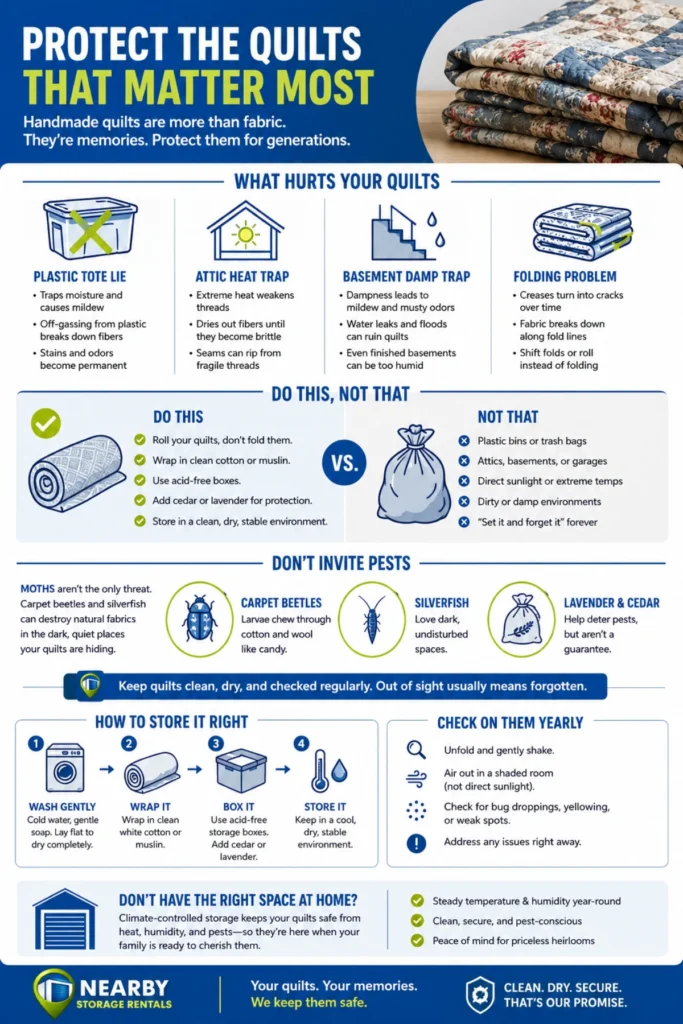
Handmade quilts should be stored clean, completely dry, wrapped in breathable cotton or muslin, and placed in an acid-free box somewhere with stable temperature and humidity. Avoid plastic totes, trash bags, attics, and damp basements because trapped moisture, heat, condensation, and pests can cause mildew, fabric damage, fading, and weakened seams. Rolling quilts instead of tightly folding them can also reduce permanent crease damage. If your home lacks a suitable space, a climate-controlled storage unit can provide a cleaner, more stable environment. Check stored quilts at least once a year for pests, stains, yellowing, or weak spots.
So you’ve got a handmade quilt or two stuffed in your house somewhere.
Maybe it was your great-aunt’s. Maybe you bought it off an artisan at a craft fair and paid way too much for it because you “just had to have it.” Or maybe—and this is the one that really gets me—you actually made the dang thing yourself. Hours and hours of stitching, sore fingers, squinting at fabric patterns until your eyes cross.
And now? It’s sitting in a pile. Or folded on a chair. Or shoved in a plastic tote under your bed.
I’m not judging. I’ve done it too.
We all know we should take better care of these things, but life gets loud, right? Kids need dinner. Work is crazy. The dog just threw up on the rug. Nobody has time to obsess over fabric fibers.
But here’s the thing. If you don’t pay attention to how you’re storing these quilts, you are going to pull them out one day and your heart is going to sink straight into your stomach. And I don’t want that for you.
The Plastic Tote Lie
Let me tell you about the biggest mistake people make.
Plastic bins.
I know, I know. They look so safe. They’re clear, so you can see what’s inside. They stack nicely. They keep the dust out. It makes total sense, right?
Wrong.
Here’s what happens. You fold that quilt up nice and tight. You snap the lid on that plastic tote. You slide it under the bed or into the closet. And then the seasons change. The weather gets humid. That airtight seal traps whatever moisture is already inside there.
And then? Mildew.
It doesn’t even have to be a lot of moisture. Just a little bit of humidity from the air. Now your quilt smells like a damp basement. And the worst part? That smell never fully comes out. Neither do the stains. Once mildew sets in, it eats the fabric. Literally eats it.
Nobody tells you that. The storage bin companies sure aren’t going to warn you.
Plastic is also weird with fabrics over the long haul. Off-gassing happens. That plastic smell? That’s chemicals. And those chemicals can break down natural fibers over twenty or thirty years. Your quilt could literally start falling apart because it was touching the side of a Rubbermaid bin.
The Attic and Basement Trap
Okay, so maybe you’re smarter than the plastic bin folks. Maybe you keep your quilts in a cedar chest.
Cedar is great. Bugs hate it. It smells amazing.
But where is that cedar chest sitting?
Be honest with me.
If it’s in your attic, you’re cooking your quilts. Attics get brutally hot in the summer. Heat weakens threads. It dries out fibers until they’re brittle. You go to unfold the quilt one day and rip—a seam just gives out because the thread turned to dust.
If it’s in your basement, you’re drowning them. Basements are damp. Even finished basements. Water seeps. Pipes drip. And if you live in a place that floods? Forget about it. I’ve seen entire heirloom collections ruined by three inches of water.
Your spare bedroom closet? That’s actually the best spot in the house. But you know what? Most of us don’t have a spare closet. We’ve got clothes, shoes, holiday decorations, and that box of random cables nobody will ever use again. There’s no room.
The Folding Problem Nobody Talks About
Let’s talk about folding.
You can’t just fold a quilt and leave it.
I know you do it. We all do it. You fold it into a nice square, stack it with the other blankets, and call it a day. But over time, those creases turn into cracks. The fabric breaks down right along that fold line.
Think about a piece of paper. Fold it once. Then fold it again. Then unfold it. You see that line? The fabric is doing the exact same thing. It’s just slower about it.
If you have to fold it, you need to change where you fold it every few months. Shift the folds around. Give those fibers a break.
Or better yet? Roll it.
Rolling a quilt is way better than folding. It eliminates those hard creases. Wrap it around a clean cardboard tube or even a pool noodle that’s been covered in a white sheet. It takes up more space, sure. But your quilt will last decades longer.
What About Pests?
Here’s a gross truth.
Moths are not the only thing coming for your quilts.
Carpet beetles are worse. They’re tiny little things that look like ladybugs but they are absolutely ruthless. Their larvae chew through natural fabrics like cotton and wool like it’s candy.
And silverfish? They love dark, quiet places. Exactly where you’re probably storing your quilts.
You can buy lavender sachets and cedar blocks. Those help. They really do. But they’re not a guarantee. The only real protection is keeping your quilts somewhere clean, somewhere dry, and somewhere you can actually check on them regularly.
Out of sight is not out of mind. Out of sight usually means “forgotten.” And forgotten quilts get eaten.
What We Tell Our Customers
I’ve got a storage facility, right?
People come in all the time asking about storing clothes, furniture, boxes. But the ones that break my heart are the ones lugging in trash bags full of quilts.
And I have to be the one to tell them, “Hey, that trash bag is going to suffocate that quilt.”
A lot of folks don’t know any better. They think a trash bag keeps the bugs out. And yeah, it does keep bugs out. But it also keeps moisture in. And it off-gasses. It’s bad news.
When people ask me where they should keep their quilts if they don’t have room at home, I tell them the same thing. Find a climate-controlled unit.
We offer those. And I’m not just saying that to sell you a unit.
Look, I’m in the storage business. But I’m also a human being who has seen too many people cry over ruined wedding dresses and baby blankets. I genuinely don’t want that to be you. A climate-controlled space keeps the temperature and humidity steady year-round. No summer heat spikes. No winter condensation. No basement dampness.
You park your quilts in one of our units, and you don’t have to worry about them. We handle the environment. You handle the memories.
What Actually Works
Alright, let’s cut the chatter and get practical.
If you want to store a quilt the right way, here’s what you actually need to do.
Wash it first. But wash it carefully. Cold water. Gentle soap. No wringing. No twisting. Lay it flat on towels to dry.
Once it’s completely dry—and I mean bone dry—wrap it in a clean white cotton sheet. Muslin is the best if you can get it. Plain old white bed sheets work fine too if they’re washed and unscented.
Then put that wrapped bundle in an acid-free box. You can order them online. They’re not that expensive. Regular cardboard has acid that leaches out and yellows your fabric. Acid-free is the way to go.
Toss in some cedar chips or lavender if you want. It smells nice and keeps the creepy crawlies away.
Then store that box somewhere that doesn’t get hot, doesn’t get cold, and doesn’t get wet.
If that somewhere is your house, great. If it’s not, we’ve got the space.
Check On Them Once In A While
Here’s one more thing.
You can’t just lock them away forever.
Once a year, pull them out. Unfold them. Give them a gentle shake. Air them out in a shaded room—not direct sunlight. Sunlight fades colors faster than anything.
Check for little black specks. That’s bug poop. Check for yellowing. That’s oxidation. Check for weak spots. That’s time catching up.
If you see any of that stuff, deal with it immediately. Don’t put it back and hope it gets better. It won’t.
So Here’s The Deal
Your handmade quilts are too important to treat like ordinary blankets. They’re pieces of art. They’re family heirlooms. They’re hours of somebody’s life stitched into fabric.
Don’t shove them in a plastic bin and forget about them. Don’t bake them in the attic. Don’t drown them in the basement.
Give them the respect they deserve. Clean them. Wrap them. Box them right. And if you don’t have a safe spot in your own house, that’s exactly why we exist. We’ve got clean, dry, temperature-controlled storage ready to go. You bring the quilts. We’ll keep them safe.
Because when your grandkids are old enough to appreciate them, you want those quilts to still be around. Trust me. You don’t want to be the one who has to explain why grandma’s quilt fell apart.
That’s a conversation nobody wants to have.










0 Comments