
Quick Summary
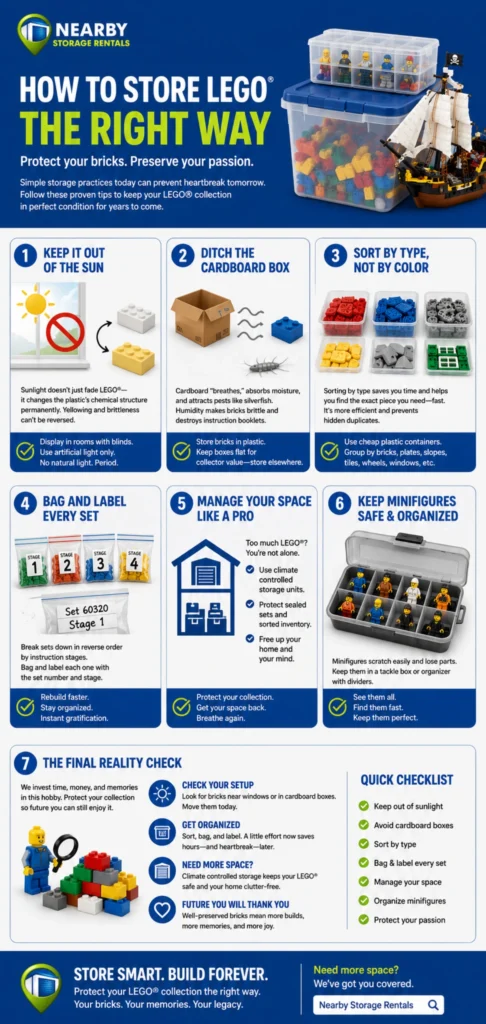
Proper LEGO storage means protecting bricks from sunlight, humidity, and temperature swings while keeping the collection organized. Keep LEGO away from direct sunlight, avoid storing bricks in cardboard, and use plastic containers sorted by piece type rather than color. Store dismantled sets in labeled Ziploc bags by building stage, keep minifigures separate in divided containers, and use climate-controlled storage if your home lacks enough safe space. These steps help prevent yellowing, brittleness, loose clutch power, scratches, lost pieces, and damage to valuable sets.
Look, I am going to be honest with you.
I used to be one of those people who thought Lego bricks were indestructible. I mean, they survive being stepped on by a bare foot at 2 AM, right? Surely they can survive sitting in a plastic tub in the garage.
Wrong. So wrong.
I learned this the hard way. A few years back, I pulled out my childhood Lego collection from my parents’ attic. I was so excited. I had this massive pirate ship set that I saved up allowance for months to buy. I opened that dusty plastic bin and my heart just sank.
The white sails were yellow. The grey castle walls felt… weird. Almost chalky. And some of the brown pieces literally snapped in my hands when I tried to click them together. I wanted to cry. I did not store them properly, and they were permanently degraded.
I don’t want that to happen to you. So let me save you the heartbreak.
Let’s Talk About the Elephant in the Room (The Sun)
You know what I am talking about. That gorgeous display shelf you have in front of the window because it looks so cool when the light hits your minifigures.
Stop it. Right now. Move them.
I don’t care if it is a little bit of sunlight or if it is only morning sun. Sunlight is a serial killer when it comes to Lego. And it doesn’t just fade the color. It actually changes the chemical structure of the plastic. That white snowspeeder you love? It will not be white in six months. It will be a weird, sad, milky yellow. And you cannot fix that. You can’t reverse it.
You can use all the hydrogen peroxide and retrobrighting tricks you see on YouTube, but honestly? That is just bleaching a damaged brick. It never looks the same. It is always a little brittle after that.
Here is my rule for my own collection: If I am displaying it, it goes in a room where I can close the blinds. If I want to show it off when people come over, I turn on the ceiling light. That is it. No natural light touches my bricks. Period.
The Cardboard Lie (And Why It Is Betraying You)
Let me ask you something. Do you keep your built sets in cardboard boxes? Maybe you break them down and put the pieces back in the original set box?
I used to do that. I thought it was clever. “I’ll just keep it in the box it came in, that is safe, right?”
Wrong again, my friend.
Cardboard breathes. I am serious. It absorbs moisture from the air. If you live in a place that gets humid in the summer, that cardboard is acting like a sponge. And what happens when cardboard gets damp? It holds that moisture right against your bricks.
Do you know what humidity does to plastic over a few years? It makes it brittle. It messes with the clutch power. Those bricks that used to click together with that satisfying snap? They are going to feel loose. They are going to fall apart if you even look at them wrong.
Plus, cardboard attracts bugs. Silverfish and cardboard are best friends. And silverfish love to eat the glue used in Lego instruction booklets. I have lost entire manual collections to those little creepy crawlies.
Ditch the boxes. If you want to keep the box for collector value, flatten it and store it somewhere else. But do not store your actual bricks in cardboard. Ever.
The Nightmare of the Giant Tub
I know you have one. We all have one.
That massive plastic tote bin that is just a swirling vortex of every piece you own. You dig through it for twenty minutes looking for one tiny 1×1 round tile, and you give up. You just buy another one on Bricklink.
That is a waste of your time and your money.
Here is what I do and it works so well I wish I had started it years ago. Get some cheap plastic shoeboxes. You can get them at the dollar store. Sort your pieces by type. Not by color. By type.
I know it looks less pretty. But if you sort by color, you are just hiding pieces from yourself. It is like looking for a black sock in a drawer full of black socks.
Separate your plates from your bricks. Separate your slopes from your tiles. Put all your wheels together. Put all your windows and doors together.
When you build, you are thinking “I need a blue 2×4 brick.” If you sort by color, you have to dig through a tub of all blue stuff. If you sort by shape, you just go to your brick drawer, find the 2×4 section, and grab the blue one. It saves you hours.
The One Thing I Refuse to Skip
Ziploc bags.
Every single set I take apart, I put into a Ziploc bag. But not just thrown in there. I do it section by section.
You know how the instructions have those numbered bags? Stage one, two, three, and four? When I take a set apart, I take it apart in reverse order. I separate stage four first, put those pieces in a bag and label it “Stage 4.” Then stage three, and so on.
I write the set number on the bag with a Sharpie.
Yeah, it is tedious. I know. But think about it. When you want to rebuild that set in two years, you do not want to be sitting there sorting through a thousand loose bricks trying to figure out where everything goes. You want to grab bag one and start building. It is instant gratification.
The Hard Truth About Space
Alright, here is the part where we get real.
You have too much Lego.
I say that with love, because I have too much too. You buy sets on sale. You get gifts. You find a deal on Facebook Marketplace. Before you know it, you have a backlog of unbuilt sets stacked up in your closet, and your wife or husband is giving you the side-eye every time they open that closet door.
You run out of room. It happens to all of us.
I had this problem badly. My spare bedroom looked like a warehouse. I could not even walk in there. And I realized, I was keeping sets in that room that I was not going to build for maybe a year or two. They were just sitting there, taking up valuable living space.
So I got smart. I looked into a new storage unit. Not for the garbage stuff. For the stuff I care about. My sealed sets, my extra sorted brick inventory, and the sets I have already built but want to keep safe.
I found a place near me that offers climate controlled units. That is the only kind you should ever use for Lego. No temperature swings. No humidity. It keeps your bricks exactly how you left them. And honestly, just getting that stuff out of my house made me feel like I could actually breathe again. My collection was safe, but I got my guest room back.
Look, you have to be realistic about your space. If you are tripping over tubs, you are one wrong step away from crushing a box or cracking a baseplate. Free up your floor and your shelves.
Don’t Forget About the Mini-Figures
This is a quick one but it is so important.
Keep your minifigures separate. Do not toss them into a bin with a bunch of bricks. They will get scratched. Their arms will pop off. You will lose their little hands.
I use a tackle box for mine. Those little adjustable dividers are perfect for keeping your Star Wars characters or your City people organized. You can see them all at a glance. You can pick the one you need without rummaging.
Final Reality Check
We spend so much money on this hobby. We are not just buying toys. We are buying experiences and memories. So we owe it to ourselves to take care of the plastic.
Do not wait until you have a bin of yellowed, brittle, loose bricks to realize you messed up. Start today. Go through your collection. Pull out the boxes that are against the wall and look at the color of the bricks near the windows. Move them if you need to.
And if you are completely swamped and you do not have the space to even start the sorting process, maybe look into a LEGO storage solution or rent a storage unit. Getting the clutter out of your home first gives you the space to breathe, sort your collection, and actually enjoy the hobby again.
Trust me on this one. Future you will be so grateful that present you actually did the work.










0 Comments