
Quick Summary
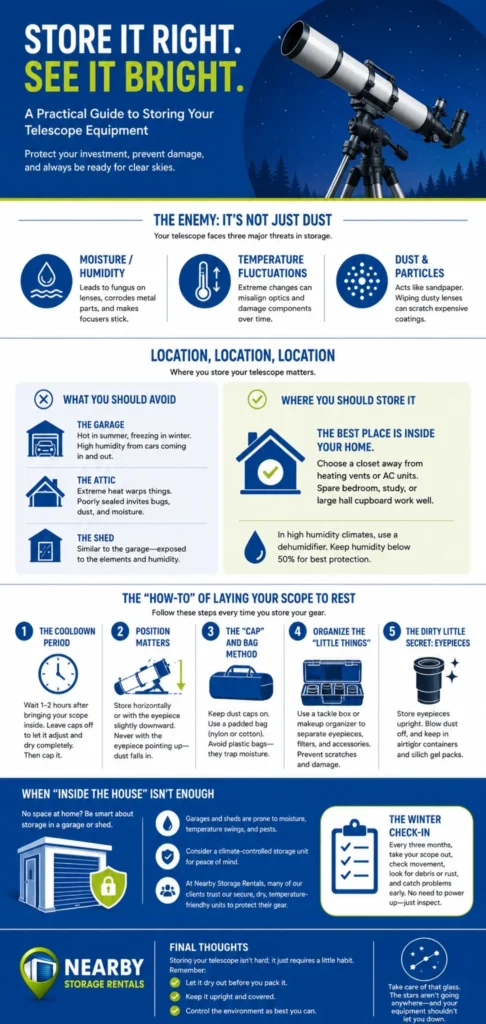
Proper telescope storage means controlling moisture, temperature, and dust before they damage your optics and metal parts. Store telescope equipment indoors in a stable, dry location whenever possible, ideally below 50% humidity, and avoid garages, attics, and sheds. After observing, let the telescope reach room temperature and dry for 1 to 2 hours before capping it. Store the scope horizontally, protect it with breathable padding, organize eyepieces separately with silica gel, and check the equipment every three months. If home storage is impractical, a climate-controlled storage unit can provide a safer alternative.
Let’s be honest for a second. You didn’t drop a chunk of your hard-earned cash on that beautiful telescope just to have it turn into a foggy, rusty paperweight in the back of your garage, did you? Of course not. You bought it to explore the cosmos, to show your kids the rings of Saturn, or maybe just to get a little peace and quiet in the backyard while pretending you’re an astronomer.
But here is the harsh reality that most stargazers don’t want to admit: We are terrible at storing our gear. I’ve seen it happen a thousand times. Someone spends months researching the perfect scope, they treat it like gold for the first few weeks, and then… life happens. The clouds roll in, work gets busy, and the next thing you know, that prized refractor is lying on its side in a dusty corner, collecting grime.
If that sounds familiar, don’t worry. I’m here to help you avoid that trap. Let’s talk about how to properly store your telescope equipment so that it’s ready to go the minute a clear night appears.
The Enemy: It’s Not Just Dust
When we think about “storage,” we usually just think about keeping things out of sight. But for a telescope, it’s a war zone out there. You’re fighting three specific enemies:
- Moisture/Humidity: This is the big one. Moisture is the enemy of optics. It can seep into your lenses, creating a breeding ground for fungus (yes, lens fungus is a real thing, and it’s gross). It will also corrode your metal parts and make your focuser stickier than honey.
- Temperature Fluctuations: Have you ever noticed how your scope needs time to “cool down” or “warm up” to match the outside air? That’s thermal equilibrium. If you store your scope in a place that changes temperature wildly (like an attic or a shed), the constant expanding and contracting of the materials can misalign your optics. Not good.
- Dust and Particles: Dust acts like sandpaper. If you wipe a dusty lens with a microfiber cloth, you are essentially rubbing tiny rocks across your expensive glass. It scratches the coatings.
Location, Location, Location
You wouldn’t store a bottle of fine wine next to a radiator, so why would you store your telescope in a place that isn’t climate-controlled?
What you should avoid:
- The Garage: Unless you live in a perfectly insulated bubble, your garage is a nightmare. It gets hot in summer, freezing in winter, and usually has a lot of humidity from cars driving in and out.
- The Attic: Attics are the worst. Extreme heat warps things, and most attics aren’t sealed well, meaning they invite bugs, dust, and moisture.
- The Shed: Similar to the garage, sheds are vulnerable to the elements.
Where you should store it:
The best place is actually inside your home. Find a closet that is away from heating vents or air conditioning units. A spare bedroom closet, a study, or even a large hall cupboard works perfectly. If you live in a climate with high humidity, consider investing in a dehumidifier for that room. It doesn’t have to be running 24/7, but keeping the ambient humidity below 50% will save you a world of hurt.
The “How-To” of Laying Your Scope to Rest
Okay, so you’ve found a good spot. Now, how do you put the gear away properly? It’s not just about throwing a cover over it.
- The Cooldown Period
This is the step everyone skips. If you just brought your telescope inside after a cold night of observing, and you immediately put the caps on and lock it in a case, you are trapping condensation inside the tube.
The Rule: Wait 1 to 2 hours. Leave the caps off and let the scope adjust to room temperature. This allows any moisture that accumulated on the glass to evaporate naturally. Once you’re sure it’s dry, then you cap it. - Position Matters
Never store a refractor or a Newtonian telescope with the eyepiece pointing straight up. Dust falls down. If the eyepiece hole is facing up, it’s a dust catcher. Instead, store them horizontally, or with the eyepiece pointing slightly downward (if you have the space). This way, gravity works with you and pulls any loose dust particles away from the sensitive optics. - The “Cap and Bag” Method
We always keep the dust caps on, obviously. But for extra protection, we love a good storage bag. You don’t need a “professional” bag; a simple padded duffel bag or a photography backpack works great. The goal is to keep the air circulation around the scope minimal.
Pro tip: Don’t store your scope in a plastic trash bag. Plastic traps moisture. Use breathable fabrics like cotton or nylon specifically designed for gear. - Organizing the “Little Things”
We often focus on the big tube and forget the accessories—the eyepieces, filters, finderscopes, and cables. These small items are fragile. Buy a small tackle box or a makeup organiser (seriously, the little dividers are perfect) to keep your eyepieces separated. If they clink together, they’ll get scratched.
When “Inside the House” Isn’t Enough
Look, I know not everyone has a spare closet. Maybe you live in a small apartment, or maybe your spouse has put a strict ban on “space junk” taking over the living room. We get it. That’s when you need to look for alternatives.
If you have to use a garage or a shed, you need to be smart. We’ve seen a lot of people rent a climate-controlled storage unit just for their hobby gear. It might sound extreme, but when you think about the cost of replacing a telescope, renting a small unit for $50-$100 a month suddenly looks like cheap insurance.
At Nearby Storage Rentals, we actually have a lot of clients who use our units specifically for this. They don’t want their heavy gear sitting in the damp garage, so they keep it in one of our secure, dry, temperature-friendly units. It gives them peace of mind knowing that when they drive over to grab their scope, it’s in exactly the same condition they left it in.
The “Dirty Little Secret” (Your Eyepieces)
We can’t talk about storage without talking about eyepieces. These little guys are the windows to the universe, and they are delicate. We have a rule: Never store an eyepiece with the barrel pointing down. Dust settles on the glass if it’s upright.
Also, do you clean your eyepieces? If you store them “dirty” in a dark box, the oils from your skin can actually etch the glass over time.
- Use a bulb blower to get the big dust off before you put them away.
- Keep them in airtight containers with a small silica gel packet to suck up any lingering moisture.
The Winter Check-In
Your gear isn’t like a car; you don’t have to start it up every month. But we do recommend a “check-in” about every three months.
Take your scope out of its bag. Turn the focus knobs, check the movement of the mount, and look through the tube (without the eyepiece) just to see if any debris has found its way inside. It’s better to catch a problem early—like a loose screw or a bit of rust—than to find it on a Friday night when the sky is perfectly clear.
Final Thoughts
Storing your telescope isn’t hard; it just requires a little habit. Remember:
- Let it dry out before you pack it.
- Keep it upright and covered.
- Control the environment as best you can.
If you treat your gear with respect, it will reward you with years of crisp, clear views of the universe. Don’t be the person who pulls out a dusty scope only to be disappointed. Be the person who is ready to go the moment the clouds part.
Take care of that glass. The stars aren’t going anywhere—and your equipment shouldn’t be either. And hey, if you need a safe spot to keep everything organized and out of the house, you know where to find us. Happy stargazing!










0 Comments