
Quick Summary
The best way to pack a storage unit is to sort your belongings first, clean everything, label boxes clearly, and leave a walkable path through the unit. Put frequently needed items near the front, stack heavy boxes below lighter ones, and protect fragile items by wrapping and storing them upright. Keep furniture off concrete, use breathable covers instead of plastic, and add moisture absorbers to help prevent mildew. Before locking up, take a photo of the unit so you have a quick visual map of where everything is stored.
Look, I’ll be honest with you. I’ve helped people move stuff easily into storage for years, and most of them do it wrong. Not because they’re lazy. Just because nobody ever told them there’s a better way.
You’ve probably got a storage unit already rented, or you’re thinking about it. And right now you’re looking at a living room full of boxes and furniture and wondering if you made a huge mistake. You didn’t. You just need a game plan.
Let me save you some regret.
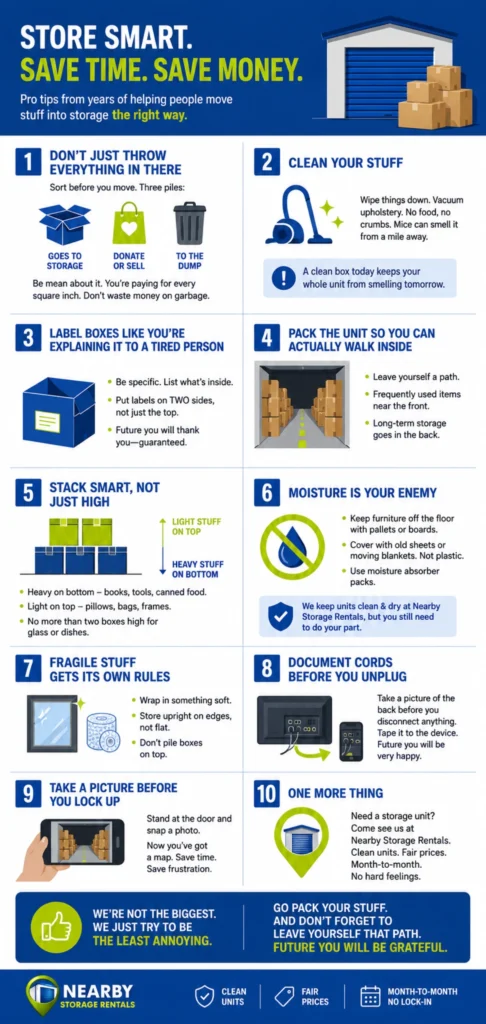
Don’t just throw everything in there
I know you’re tempted. I know you want to be done with this. But if you treat your storage place like a giant trash can, you will hate yourself later. I’ve seen people come back three weeks later looking for one specific thing – a winter coat, a tool, their kid’s baby pictures – and they have to unpack half the unit to find it. You may also find our post on belongings you cannot move helpful.
So here’s what you do instead.
Before anything goes into the truck, sort your stuff where it sits. Three piles:
- Goes to storage.
- Gets donated or sold.
- Goes to the dump.
Be mean about it. That broken lamp you swore you’d fix two years ago? Dump. Those jeans that haven’t fit since 2019? Donate. You’re paying monthly for every square inch of that unit. Don’t waste money on garbage.
Clean your stuff
I can’t tell you how many times someone has brought in a mattress with a stain they “didn’t notice” or a box of kitchen stuff that smells like last year’s spaghetti. That smell spreads. Then your holiday decorations smell like old meat. Not fun.
Wipe things down. Vacuum upholstery. Make sure there’s no food anywhere – not a single cracker crumb. Mice can smell that from a mile away, and once they’re in your unit, they’re not leaving.
Label boxes like you’re explaining it to a tired person
Because that tired person is future you.
Don’t just write “kitchen.” Write “kitchen – plates, cups, wine glasses – fragile.” Don’t just write “office.” Write “office – tax files 2019-2024, printer, old photos.”
And put the label on two sides of the box. Not just the top. Because boxes get stacked, and you won’t be able to see the top label once it’s under something else.
Pack the unit so you can actually walk inside
Here’s the mistake I see every single week. Someone packs their unit like a brick wall. Boxes from floor to ceiling, front to back. Then a month later they need something from the very back, and they have to move fifty boxes to get to it. Our guide on using AI to organize storage is a useful next read.
Leave yourself a path. Even a skinny one. Wide enough for you to walk sideways if you have to. Put the stuff you’ll need often near the front – camping gear, off-season clothes, whatever. The stuff you’re pretty sure you’ll never touch again? That goes in the back.
Stack smart, not just high
You’ve got vertical space. Use it. But don’t be an idiot about it.
Heavy stuff on the bottom – books, tools, canned food. Light stuff on top – pillows, sleeping bags, empty picture frames. If you put heavy boxes on top of light ones, something’s getting crushed. And if you’re storing glass or dishes, don’t stack more than two boxes high. I’ve seen too many people open their unit to find shattered heirlooms because they got greedy with stacking.
Moisture is your enemy
Even in a good storage unit, air gets in. Humidity happens. And moisture ruins things faster than almost anything else.
So here’s what you do:
- Put furniture up on pallets or old boards. Don’t let it sit right on the concrete floor.
- Cover stuff with old bedsheets or moving blankets. Not plastic. Plastic traps moisture and makes mildew.
- Throw in a few moisture absorber packs. They’re cheap.
We keep our units at Nearby Storage Rentals as dry and clean as we can. Climate control in some of them too. But you still need to do your part. Don’t make our job harder than it already is.
Fragile stuff gets its own rules
Mirrors, glass tabletops, framed art – don’t just toss these in. Wrap each piece in something soft – a towel, a blanket, bubble wrap if you have it. Then stand them up on their edges, not flat. And don’t pile boxes on top of them. That should be obvious but apparently it’s not.
For anything with cords – TV, stereo, computer – take a picture of the back before you unplug everything. Tape that picture to the device. When you pull it out of storage six months from now, you won’t have to guess which cord goes where.
Take a picture before you lock up
This takes five seconds and saves you hours later.
Stand at the door of your unit and snap a photo with your phone. Now you’ve got a map. Next time you’re looking for something, you can check the photo instead of guessing.
Frequently Asked Questions
Q1. How should I plan the order for loading a storage unit?
Plan loading around safe placement, large-item dimensions and what you will need to retrieve first.
Put the access route into the sketch before filling gaps.
We recommend labeling destinations and explaining the sequence to helpers so efficient unloading does not become a unit packed tightly without a usable way to reach the back.
Q2. Should belongings be cleaned before an efficient storage move-in?
Clean and appropriately dry belongings before move-in, even when you want to work quickly.
Follow material-specific guidance and check for residue or existing damage.
Nearby Storage Rentals suggests doing this ahead of loading day rather than trying to clean wet appliances or dirty equipment inside an already crowded unit.
Q3. How do I keep helpers from putting storage boxes in the wrong place?
Give helpers a simple unit map and clearly labeled categories before unloading begins.
Assign someone to coordinate placement and maintain the aisle.
Update the arrangement if large pieces require changes, rather than letting each person fill the nearest gap and discovering afterward that important boxes are trapped behind furniture.
Q4. Can efficient storage loading still leave room to walk?
Efficient loading should include the access you need rather than filling every available gap.
Plan an aisle and stable zones suited to your inventory.
We suggest treating retrieval space as part of the design, because a densely packed unit may use less floor area but require repeated heavy moving whenever you visit.
Q5. Should heavy boxes always go at the bottom of storage stacks?
Heavy boxes generally need a stable low position, but the containers and their contents must also tolerate the load above them.
Check strength and condition before stacking.
Do not place weight on fragile items simply because their box is already on the floor, and keep every stack manageable rather than unnecessarily tall.
Q6. How do I move fragile objects into storage without holding up the whole load?
Prepare fragile objects with appropriate packing and a clear placement plan before the main loading session.
Give them identified space and suitable handling help.
We recommend separating their requirements from ordinary cartons so working efficiently does not depend on rushing delicate pieces through a route crowded by heavier belongings.
Q7. What should I photograph after arranging my storage unit?
Photograph the overall layout, readable labels and significant condition details after arranging the unit.
Link images to your inventory and store copies outside the space.
Photos can help future retrieval, but we suggest checking them before leaving so a blurred doorway image is not your only record of where important belongings were placed.
Q8. How should I finish a storage move-in before locking up?
Finish move-in by checking stability, clear access, permitted contents and the door's normal operation.
Update the inventory and remove waste or temporary supplies.
Confirm the lock is used correctly under the facility's instructions rather than rushing away because the final box fits, leaving a problem for the next visit.
One more thing
If you don’t have a small storage unit yet, or you’re not happy with the one you’ve got, come see us at Nearby Storage Rentals. We’ve got clean units, fair prices, and we don’t lock you into some crazy year-long contract. Month to month. You leave when you want. No hard feelings.
We’re not the biggest storage company out there. We just try to be the least annoying. And in this business, that matters.
Alright. Go pack your stuff. And don’t forget to leave yourself that path. Future you will be grateful.








0 Comments