
Quick Summary
Before selling something to avoid storage costs, compare its current resale value with what it would cost to replace later and how much storage would cost in the meantime. Storage usually makes more sense for valuable, sentimental, temporary-use, or expensive-to-replace items, especially when you’ll need them again within a year or two. Sell low-value, unused, broken, or easily replaceable items instead. Factor in your time, emotional value, and the risk of buying back items at higher prices before deciding whether storing or selling is the better financial move.
Let me ask you something that’s probably been bouncing around your head for weeks. You’ve got a garage half-full of boxes you haven’t touched since that last move. Or maybe a spare bedroom that’s become a “storage unit” by accident. And you’re looking at that pile, thinking: Should I just sell all this stuff, or pay to keep it a little longer?
It’s a fair question. Nobody wants to throw money away. But here’s the thing most people get wrong – they look only at the monthly cost of a small storage unit and panic. They don’t look at the cost of replacing what they sold.
So let’s walk through this together. No fluff. Just real talk.
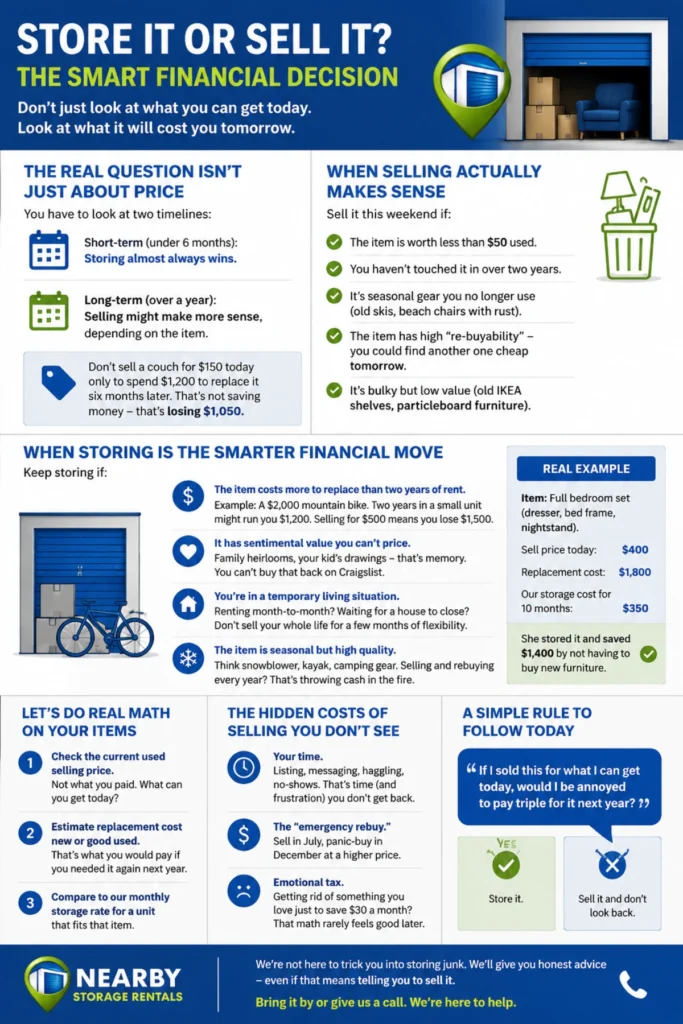
The Real Question Isn’t Just About Price
When you ask “is it cheaper to store or sell,” you have to look at two different timelines:
- Short-term (under 6 months): Storing almost always wins here.
- Long-term (over a year): Selling might make more sense, depending on the item.
But here’s where we see people mess up. They sell a leather couch for 150becausetheyneededitgonefast.Thensixmonthslater,theymoveintoabiggerplaceandspend1,200 to buy a similar couch. That’s not saving money – that’s losing $1,050.
Ouch, right?
When Selling Actually Makes Sense
Let’s be honest. Some stuff isn’t worth the square footage it takes up. You know the type – broken electronics, clothes that don’t fit, old textbooks, that treadmill you swore you’d use. Selling those? Absolutely. Do it this weekend.
Here’s a quick checklist for when selling beats storing:
- The item is worth less than $50 used.
- You haven’t touched it in over two years.
- It’s seasonal gear you no longer use (old skis, beach chairs with rust).
- The item has high “re-buyability” – meaning you could find another one cheap tomorrow on Facebook Marketplace.
- It’s bulky but low value (old IKEA shelves, particleboard furniture).
Sell that stuff. Don’t pay us to store your broken lamp. We’d rather have you show up with things you actually care about.
When Storing Is the Smarter Financial Move
Now here’s where we see people make the mistake of selling too fast. Storing isn’t just “paying to keep junk.” Sometimes it’s protecting future you from a much bigger bill.
Keep storing if:
- The item costs more to replace than two years of rent on a unit. Example: a 2,000mountainbike.Twoyearsinasmallunitmightrunyou1,200. Selling the bike for 500meansyoulose1,500 in value. Keep it.
- It has sentimental value you can’t price. Your grandmother’s dining table. Your kid’s first drawings. That’s not “stuff” – that’s memory. You can’t buy that back on Craigslist.
- You’re in a temporary living situation. Renting month-to-month? Waiting for a house to close? That’s exactly what we built our storage service for. Don’t sell your whole life because you need three months of flexibility.
- The item is seasonal but high quality. Think snowblower, kayak, camping gear. Selling and rebuying every year? That’s throwing cash in the fire.
Let’s Do Real Math on Your Items
Grab a coffee. Let me show you how we tell our customers to calculate this.
Step 1: Check the current used selling price. Not what you paid. What can you get today? Be honest with yourself – probably 30% of retail if you’re lucky.
Step 2: Estimate replacement cost new or good used. That’s what you would pay if you needed it again next year.
Step 3: Compare to our monthly storage rate for a unit that fits that item.
Here’s an example we ran for a customer last week:
- Item: Full bedroom set (dresser, bed frame, nightstand).
- Sell price today: $400.
- Replacement cost: $1,800.
- Our storage cost for 10 months: $350.
She stored it. Ten months later, she moved into her new house and saved $1,400 by not having to buy new furniture. That’s a win.
The Hidden Costs of Selling You Don’t See Coming
People always forget these when they rush to sell:
- Your time. Listing, messaging, haggling, no-shows. If you value your time at 20/hour,sellingtenitemsmightcostyou200 in frustration alone.
- The “emergency rebuy.” We’ve seen customers sell winter coats in July, then panic-buy overpriced ones in December.
- Emotional tax. Getting rid of something you love just to save $30 a month? That math rarely feels good later.
Where Our Storage Service Fits Your Decision
Look, we’re not here to trick you into storing junk. If you should sell it, we’ll tell you to sell it. But when you do decide that keeping your items makes more financial sense, that’s where we come in. Our storage units are clean, secure, and month-to-month – no pressure. You only pay for as long as you actually need. We’ve helped hundreds of people hold onto the things that matter without overthinking every single dollar.
A Simple Rule to Follow Today
Before you sell anything, ask yourself one question:
“If I sold this for what I can get today, would I be annoyed to pay triple for it next year?”
If yes – store it. If no – sell it and don’t look back.
And honestly? Most people sell too fast out of guilt. They feel like storage is “wasting money.” But rushing to sell your own stuff for pennies on the dollar? That’s the real waste. You worked hard for those things. It’s okay to keep them while you figure out your next move.
Got a specific item you’re unsure about? Bring it by or give us a call. We’ll give you an honest opinion – even if that means telling you to sell it somewhere else. That’s just how we do things.








0 Comments