
Quick Summary
Proper space heater storage starts with cleaning the heater, checking for damage, and keeping it somewhere dry and temperature-stable. Unplug and vacuum dust from the fan and coils, inspect the cord, plug, grill, and fan for wear, then loosely coil the cord and store the heater in a lidded plastic tote with light padding. Avoid damp garages and hot attics, and consider climate-controlled storage when your home lacks a suitable spot. If the heater is damaged, unstable, badly worn, or no longer useful, recycle it instead of storing a potential fire hazard.
Nobody thinks about their space heater in July. I get it. You wake up, it’s ninety degrees outside, and that dusty thing in the corner of your bedroom is the last thing on your mind. You just want it gone. Out of sight. You kick it under the bed, or you shove it into the back of your hall closet behind the board games, and you forget about it until the first frost hits in November.
But here is the thing—and I’m telling you this because I’ve made this mistake myself—you cannot just toss that thing anywhere. It’s not like storing a broom or a box of Christmas ornaments. A space heater has guts. It has coils, motors, and fans that can actually hold onto dust and debris for months. And when you pull it out next winter and plug it into the wall, all that gunk you ignored? It burns. And sometimes, it sparks.
I don’t want to scare you, but I do want you to think about it differently. You are not just “putting away an appliance.” You are basically parking a small fire hazard for six months. That’s why space heater storage deserves more attention than most people give it. How you park it matters.
That Burning Smell? That’s Your Warning
Let me guess. Last winter, the first time you turned your heater on, you smelled that weird burnt toast smell. You probably shrugged and thought, “It’s fine, it’ll go away.” And you were right, it usually does go away. But that smell is the dust that settled on the coils burning off.
Now, imagine that dust building up for years because you never clean the thing before you put it away. That’s like letting lint pile up in your dryer trap. Eventually, the heater has to work harder to push air through, the internal temperature spikes, and that little safety fuse inside just gives up. Or worse, it doesn’t give up, and you have a problem on your hands.
So, before you even look for a box, you and I need to talk about cleaning this thing properly. And no, I don’t mean just wiping the outside with a Swiffer.
The Right Way to Clean It (Without Breaking It)
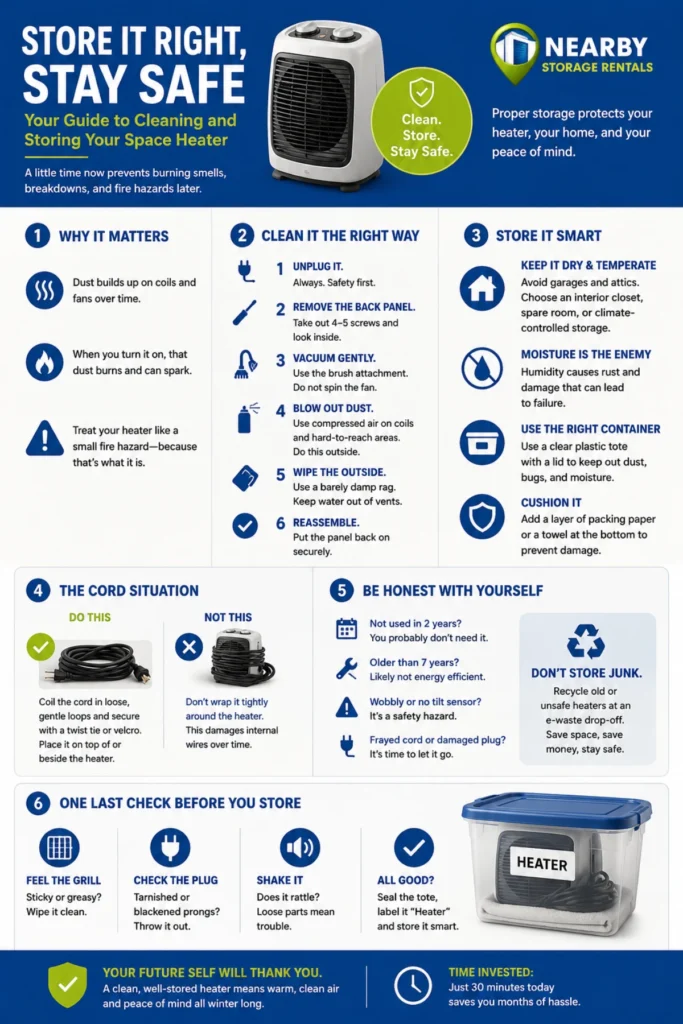
Grab a screwdriver and a vacuum cleaner. Yes, I’m serious.
First, unplug it. I know, obvious, but you would be amazed how many people try to clean stuff while it’s still live. Don’t be that person.
Now, look at the back of your heater. See that metal grill? That’s where the fan pulls in all the air—and all the pet hair, human hair, dust bunnies, and random crumbs that float around your house. You need to pop that back panel off. Most of them just have four or five screws. Take them out, gently pull the cover away, and just look inside.
It’s gross, right?
Take your vacuum with the brush attachment and gently go over the fan blades. Do not spin the fan with the vacuum; you can actually mess up the motor bearings if you force it to spin faster than it should. Just hover the brush over the blades and let the suction do the work.
Next, grab a can of compressed air—the same stuff you use for your computer keyboard. Spray it into the heating coils and any little nooks you can’t reach. Do this outside, by the way. You do not want to do this in your living room unless you enjoy inhaling a cloud of thirty-year-old dust.
When you put the panel back on, wipe the outside down with a barely damp rag. And I mean barely. You want the rag to be almost dry. If any water drips into those vents, you are asking for a short circuit next season.
Where Are You Actually Going to Put It?
This is where most people mess up.
You are probably thinking about your garage or your attic. And I’m here to tell you—please, don’t. Unless your garage is insulated and temperature controlled, that heater is going to suffer. Extreme heat in the summer warps the plastic casing. Extreme cold in the winter makes the wires brittle. And moisture? Moisture is the absolute enemy. If you live in a humid area, rust will form on the internal metal parts, and when you plug that heater in next year, it might just pop the breaker or hum loudly because the fan motor seized up from rust.
You want a dry, temperate spot. Think about a closet inside your actual house, or a spare room, or even under a bed if you keep it in a sealed container. If you don’t have that kind of space at home—and honestly, a lot of us don’t—this is exactly why we exist. We have spaces specifically for this kind of stuff. Climate-controlled units where the temperature doesn’t swing wildly. It keeps your heater (and your holiday decorations and your old furniture) safe from the elements.
I’m not trying to sell you here; I’m just saying, if your hallway closet is overflowing and you are literally tripping over stuff, you are better off moving the seasonal things to a dedicated spot rather than cramming a fragile appliance into a tight space where it might get knocked over by a falling suitcase.
The Cord Situation
Let’s talk about that thick power cord for a second.
People wrap cords like they are tying up a garden hose. You loop it around the heater and pull it tight. Stop doing that. That cord is the lifeline of the machine. When you bend it sharply or cinch it tight, the copper wires inside break down over time.
You want to loop the cord loosely—think big, gentle loops, like a slinky—and then use a twist tie or a velcro strap to hold it together. Don’t wrap it around the entire body of the heater. Just coil it up and set it on top of the heater or beside it in the box. If you see any fraying or cracking on the rubber coating, that heater needs to be thrown away. That is exposed wire waiting to arc. It’s not worth the risk to save a fifty-dollar heater.
The Box Question
I have a personal preference here. I hate cardboard boxes for long-term storage. Why? Roaches and silverfish love cardboard. They eat the glue, they nest in the flaps, and then they crawl into your heater and die in there.
Use a clear plastic tote with a lid. It seals out bugs and dust. Plus, it’s clear, so when you are looking for your heater next winter, you can spot it instantly without opening three different boxes.
Before you drop the heater in, put a layer of packing paper or an old towel at the bottom of the tote. That gives a little cushion if you drop the box. You don’t need bubble wrap or anything crazy—just enough so it isn’t rattling around.
Be Honest With Yourself
Here is the hard truth.
If you haven’t used that space heater in two years, and you are just moving it from one closet to another, why are you keeping it?
I have seen people rent storage units just to keep a broken space heater that they are “going to fix someday.” Stop paying money to store junk. If the heater is older than seven years, it’s probably not energy efficient anyway. And if it has any wobble to it—if it tips over easily—it’s a safety hazard. Modern heaters have tilt sensors that shut them off if they fall. Old ones don’t.
Be real with yourself. If it’s old and beat up, take it to an e-waste recycling drop-off and buy a new one this winter. You will save on your electric bill and you will sleep better knowing you aren’t storing a fire hazard.
A Quick Word About Your Living Space
Look, we use our own storage for this exact reason. We have a unit where we keep our seasonal fans, heaters, and heavy winter coats. It keeps our own homes uncluttered. You don’t need to be living in a cramped apartment where you can’t walk through the hallway because you have space heaters, fans, and humidifiers lined up against the wall.
Clear that space out. Give yourself room to breathe. If you are paying rent for a two-bedroom apartment but you can only use one bedroom because the other is full of storage bins, that doesn’t make sense. Move that stuff out. Keep the heater, by all means, just keep it somewhere smart.
One Last Check Before You Walk Away
Before you close that plastic tote and push it to the back of your closet or your storage unit, do one final check.
- Run your hand over the front grill. Does it feel sticky or greasy? Wipe it off.
- Look at the plug prongs. Are they tarnished or blackened? That’s a sign of arcing. Throw it out.
- Give the whole unit a shake. Does it rattle? If you hear something loose inside, that fan blade is probably cracked.
If everything passes, seal the tote. Label it “Heater” with a sharpie. And pat yourself on the back because you just did what ninety percent of people don’t do—you actually took care of your stuff.
When winter comes around again, you are going to pull that heater out, plug it in, and it will blow warm, clean air with zero burning smell. You are going to feel like a genius. And your house is going to be safer for it. So, take the time. It only takes thirty minutes, but it saves you so much grief down the road.
Stay safe out there, and seriously, check that cord before you put it away.









0 Comments