
Quick Summary
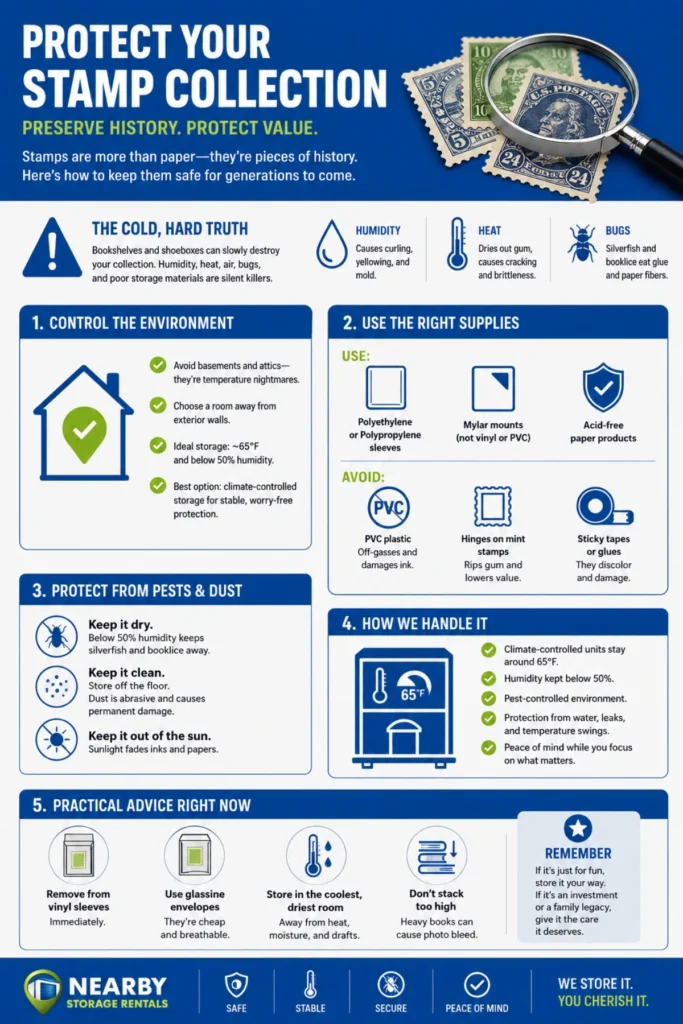
Proper stamp storage starts with controlling moisture, temperature, light, pests, and physical pressure. Keep valuable stamps in glassine envelopes or archival materials made from polyethylene, polypropylene, or Mylar, and avoid PVC sleeves and hinges on mint stamps. Store collections in a cool, dry, stable environment below 50% humidity, away from attics, basements, floors, and direct sunlight. For serious collections, a climate-controlled storage unit can provide more consistent conditions and protection from pests, leaks, and temperature swings.
Look, I’m going to be straight with you. If you are here, you’ve probably already made a mistake.
Maybe you bought a nice little album on Amazon, stuck your stamps in it, and shoved it on a bookshelf. Or maybe you inherited a shoebox from your grandpa and you just slid it under your bed.
Don’t feel bad. We all start there.
But here is the cold, hard truth: that bookshelf and that shoebox are slowly killing your collection.
I don’t say that to scare you. I say it because I have seen too many people show up at our storage facility with a box of stamps that look like potato chips—curled, brittle, and faded. And they always say the same thing: “I don’t know what happened.”
What happened is you treated paper like it was indestructible. It’s not.
Let’s Talk About the Air in Your House
You probably don’t think about your home’s humidity. Why would you? You aren’t a plant.
But your stamps are. Okay, they aren’t literally plants, but they are made of organic material. Cotton fibers. Wood pulp. They breathe. When the air in your living room gets humid in July, your stamps soak up that moisture like a sponge. When you crank the heat in December, they dry out and the gum on the back cracks.
You might not see it happening. It’s a slow death. But pull out a stamp you bought ten years ago and hold it next to a new one. You’ll see the yellowing. You’ll see the stiffness.
I’m not telling you to turn your house into a laboratory. But I am telling you to be honest with yourself. Do you have a basement? Don’t put stamps there. Do you have an attic? Absolutely not. Those places are temperature nightmares.
If you are serious, you have two choices: You either dedicate a specific closet in the center of your home (away from exterior walls) and run a dehumidifier 24/7, or you look for an off-site solution. We happen to offer climate-controlled units that hover right around 65 degrees. It’s boring. It’s stable. And boring and stable is exactly what your stamps need to survive.
The Truth About “Archival” Supplies
Let me save you some money here.
Walk into any craft store and you will see “Acid-Free” stamped on everything. You’ll think, “Great, I’m good to go.”
Wrong.
Just because the page is acid-free doesn’t mean the plastic covering it is safe. A lot of those cheap stockbooks use PVC plastic. You know that weird, sticky film that builds up on old shower curtains? That’s PVC breaking down. It off-gasses. That gas gets trapped in the plastic sleeve with your stamp, and it reacts with the ink. You will end up with a stamp that looks like it has a permanent greasy fingerprint on it.
Do yourself a favor. When you buy supplies, look for the words Polyethylene or Polypropylene. And if you are buying mounts (those little sleeves you slide the stamp into), make sure they are “Mylar.”
And please, please stop using hinges on mint stamps.
Hinges are those little folded strips of paper you lick and stick to the back of the stamp. If you have a used stamp, fine. Go nuts. But if you have an unused stamp with full, original gum on the back, a hinge will rip the gum right off and leave a thin spot. That thin spot just dropped your stamp’s value by 50%. I’m not exaggerating.
The Stuff Nobody Tells You About
Everyone tells you to keep stamps out of the sun. That’s obvious. Sun fades things.
But nobody tells you about the bugs.
Silverfish and booklice love stamps. They eat the glue and the paper fibers. You won’t even know they are there until you open your album and find little trails of destruction.
How do you stop them? You don’t use bug spray (obviously, that will ruin the paper). You keep the environment dry. Bugs need moisture to survive. If your storage space is below 50% humidity, bugs can’t live there. It’s that simple.
Also, don’t store your stamps on the floor. Even if you have a nice house, the floor is where dust settles. Dust is abrasive. You might think a little dust doesn’t matter, but when you close a heavy album on a speck of dust, that speck presses into the paper fibers. Forever.
How We Handle It at Our Facility
I’m not trying to sell you something you don’t need. If you have a climate-controlled office in your house, great. Keep them there.
But most of our clients who collect stamps are retirees living in Florida or Arizona. Or they are busy professionals in high-rises. They don’t have a “spare room” with perfect conditions.
They bring their collections to us because they want peace of mind. They know that our units don’t fluctuate. They know we are pest-controlled. They know they don’t have to worry about a pipe bursting in the wall behind their bookcase and soaking their albums while they are at work.
We literally see people walk in with a cart full of albums, sweating, looking terrified that they are going to drop them. And they walk out looking relieved.
My Practical Advice to You Right Now
If you are sitting there with a pile of stamps on your kitchen table, don’t panic.
- Take them out of any vinyl sleeves immediately.
- Put them in glassine envelopes (they are cheap and breathable).
- Find the coolest, driest room in your house.
- Don’t stack them too high. Heavy books on top of stamps can cause “photo bleed”—the ink transfers from one stamp to the back of the one in front of it.
If you plan on just keeping them for fun and you don’t care about resale value, ignore everything I said. Leave them in the shoebox. It doesn’t matter.
But if you are investing money, or you are holding onto your grandfather’s collection from the 1940s, you owe it to the paper to treat it right. Proper Stamp Storage helps protect your collection from moisture, light, and physical damage, preserving both its condition and value over time.
It’s just paper. But it’s history. And history deserves a stable place to sit.










0 Comments