
Quick Summary
Climate-controlled storage is worth the extra cost for wood furniture, electronics, important papers, leather, and sentimental items because regular storage can expose belongings to extreme temperatures, humidity, mold, pests, and damage. I learned that the hard way after losing $600 worth of vinyl records. Regular storage can work for durable items stored briefly, especially things that already handle garage conditions. Climate control typically adds about $30 a month, but that can be far cheaper than replacing damaged belongings. Use sealed bins, check the actual temperature, avoid food, visit monthly, and ask about pest control.
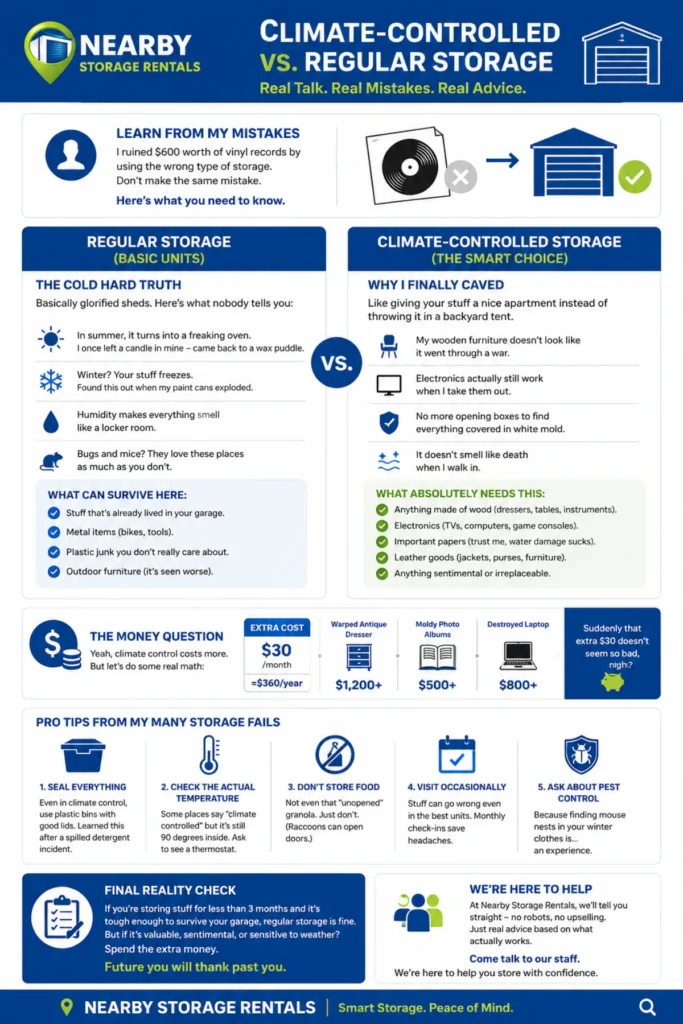
Look, I’m not some storage expert – just a person who’s messed up enough times to know what actually matters when choosing between a climate-controlled unit and regular storage. Last year, I ruined $600 worth of vinyl records by putting them in the wrong unit. Let me save you from making the same stupid mistakes I did.
Climate control vs regular storage at a glance
| Factor | Climate-controlled | Regular storage |
| Worth it for | Wood furniture, electronics, papers, leather, sentimental items | Durable items stored briefly |
| Risks avoided | Extreme temps, humidity, mold, pest/damage exposure | Still exposed to swings if not climate-controlled |
| Author note | Worth the extra cost after losing ~$600 in vinyl records (per post) | OK for things that already live outdoors or short stints |
The Cold Hard Truth About Regular Storage Facilities
Regular storage units are basically glorified sheds. Here’s what nobody tells you:
- In summer, it turns into a freaking oven. I once left a candle in mine – came back to a wax puddle.
- Winter? Your stuff freezes. Found this out when my paint cans exploded.
- Humidity makes everything smell like a locker room.
- Bugs and mice? They love these places as much as you don’t.
What can survive here:
- Stuff that’s already lived in your garage.
- Metal items (bikes, tools).
- Plastic junk you don’t really care about.
- Outdoor furniture (it’s seen worse).
Why I Finally Caved on Climate Control?
After my vinyl disaster, I wised up. Climate-controlled storage is like giving your stuff a nice apartment instead of throwing it in a backyard tent.
Real benefits I’ve noticed:
- My wooden furniture doesn’t look like it went through a war.
- Electronics actually still work when I take them out.
- No more opening boxes to find everything covered in white mold (true story).
- It doesn’t smell like death when I walk in.
What absolutely needs this:
- Anything made of wood (dressers, tables, instruments).
- Electronics (TVs, computers, game consoles).
- Important papers (trust me, water damage sucks).
- Leather goods (jackets, purses, furniture).
- Anything sentimental or irreplaceable.
The Money Question
Yeah, climate control costs more. But let’s do some real math:
- Extra $30/month for climate control = $360/year.
- Replacing a warped antique dresser = $1,200+.
- Restoring moldy photo albums = $500+.
- New laptop because yours cooked = $800+.
Suddenly that extra $30 doesn’t seem so bad, right?
Pro Tips from My Many Storage Fails
- Seal everything – Even in climate control, use plastic bins with good lids. Learned this after a spilled detergent incident.
- Check the actual temperature – Some places say “climate controlled” but it’s still 90 degrees inside. Ask to see a thermostat.
- Don’t store food – Not even that “unopened” granola. Just don’t. (Raccoons can open doors.)
- Visit occasionally – Stuff can go wrong even in the best units. Monthly check-ins save headaches.
- Ask about pest control – Because finding mouse nests in your winter clothes is… an experience.
Frequently Asked Questions
Q1. When is climate-controlled storage worth it?
Climate control is often worth it for wood furniture, electronics, documents and fabrics across humid or extreme seasons.
Compare contents risk.
Nearby Storage Rentals recommends matching protection to belongings rather than choosing only by rent difference carefully as needed when practical.
Q2. What does climate-controlled storage usually mean?
It generally means more stable temperature and humidity than untreated units, though exact ranges vary by facility.
Ask specifics.
We recommend clarifying maintained conditions instead of assuming every climate label is identical carefully as needed when practical for longer stays.
Q3. Can regular storage still work for some belongings?
Regular storage can suit sturdy items for shorter periods when packing is dry and conditions are acceptable.
Assess risk.
Nearby Storage Rentals suggests untreated units only when contents and timeline make that risk reasonable carefully as needed when practical for longer stays.
Q4. Do climate units prevent all moisture problems?
Climate control reduces swings but does not fix items packed damp.
Packing quality still matters.
We recommend dry preparation plus suitable unit type rather than treating climate control as a cure-all carefully as needed when practical for longer stays carefully.
Q5. How much more might climate control cost?
Costs vary by market and size; compare the premium against replacement risk for sensitive goods.
Total fees too.
Nearby Storage Rentals suggests value comparisons over the full rental length, not one month alone carefully as needed when practical for longer stays.
Q6. Should seasonal belongings prefer climate control?
Seasonal textiles, leather and instruments often benefit from stable conditions during long off-seasons.
Confirm options.
We recommend climate-aware storage for items that sit untouched through weather extremes carefully as needed when practical for longer stays carefully as needed when practical.
Q7. Can I switch from regular to climate-controlled later?
Transfers may be possible when space allows, with effort and possible fees.
Ask about the process.
Nearby Storage Rentals recommends planning climate needs early when belongings are clearly sensitive carefully as needed when practical for longer stays carefully as needed.
Q8. What questions should I ask about a climate unit?
Ask what ranges are targeted, how issues are monitored and whether the assigned unit is truly climate controlled.
Tour if possible.
We recommend specific answers rather than brochure phrases alone carefully as needed when practical for longer stays carefully as needed.
Final Reality Check
At Nearby Storage Rentals, we’ll tell you straight – if you’re storing stuff for less than 3 months and it’s tough enough to survive your garage, regular storage is fine. But if it’s valuable, sentimental, or sensitive to weather? Spend the extra money. Future you will thank past you.
Come talk to our staff – we’re not robots pushing expensive options. We’ll give you real advice based on what actually works. Because nobody should have to learn these lessons the hard way like I did.









0 Comments