
Quick Summary
Old maps need stable temperature and humidity, protection from sunlight, and careful handling to prevent fading, cracking, mold, and foxing. Store them in a dark, dry space away from attics, basements, garages, windows, and temperature swings. Flat storage is generally safer for long-term preservation, using acid-free tissue and archival materials, while archival polypropylene or polyethylene tubes are safer than PVC. Wash and dry your hands before handling maps, avoid heavy objects on them, and consider climate-controlled storage for valuable or sentimental collections.
So you have got some old maps. Maybe you inherited them from a grandparent. Maybe you are a history buff who cannot resist picking them up at estate sales. Maybe you just think they look cool and bought one on a whim. Whatever the reason, you are now the owner of a piece of paper that is probably older than your grandparents’ grandparents.
And you have no idea what to do with it.
I get it. I have been there. You want to keep it safe but you are not a museum curator. You do not have fancy equipment. You just want to make sure this thing does not turn into a crumbly mess in five years. The good news? It is not rocket science. The bad news? You are probably making at least one mistake right now without even realizing it.
Let me walk you through what actually matters.
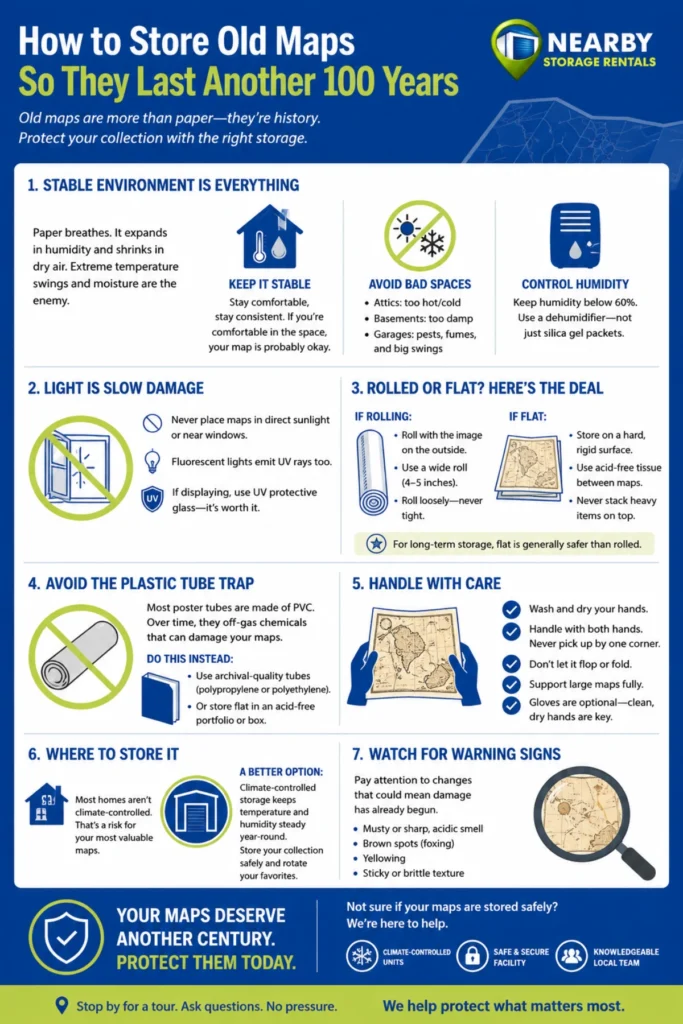
The first thing you need to understand is that paper breathes
I know that sounds weird. Paper is dead tree pulp. How does it breathe? But it does. Old paper especially. It absorbs moisture from the air and releases it. This means your map is constantly expanding and contracting based on the weather outside. In the summer when it is humid, the paper swells. In the winter when the heat is blasting and the air is dry, it shrinks.
Now imagine doing that expansion and contraction thing over and over for a hundred years. Something is going to give. Usually it is the edges. They start to crack. Or the ink starts to flake off because the paper underneath it is moving.
This is why you cannot just stick these things in the attic or the basement. I know that is where everybody wants to put them. It is out of the way. It is not cluttering up your living room. But those places are the absolute worst.
- Attics get scorching hot in the summer and freezing cold in the winter. That temperature swing wreaks havoc on paper fibers.
- Basements are damp nine times out of ten. Damp equals mold. Mold equals disaster.
- Garages are even worse. Temperature changes, humidity, pests, chemical fumes from cars. Do not even think about it.
You want a place where the temperature does not swing wildly. You want it to stay roughly the same day after day. If you are comfortable in that space, your map is probably okay. If you are sweating or shivering, your map is suffering.
Let me tell you about my own screw-up so you do not make the same one
A few years back I bought this beautiful map of London from the 1800s. It was not crazy expensive but it was not cheap either. I was so excited I framed it immediately and hung it on the wall across from my window. I thought I was being a good owner. I was showing it off. I was enjoying it.
Fast forward two years. I take it out of the frame to move and the colors are just… gone. Faded. Like somebody had washed it with bleach. That sunlight coming through the window? It had been slowly baking the ink that entire time.
I was devastated. And angry at myself because I knew better.
So listen to me on this one. If you value your map, do not put it in direct sunlight. Do not put it near a window. Do not even put it in a room that gets a lot of bright natural light. Indirect light is okay. But if you can see sunbeams hitting that glass, you are damaging your map every single day.
And if you have fluorescent lights in your house or your office, know that those also put out UV rays. Not as much as the sun but over years it adds up. If you absolutely have to display it, spend the extra money on UV protective glass. It is not cheap but it is cheaper than replacing a map that you cannot replace at all.
Rolled or flat? Here is the deal
This is one of those debates that map collectors love to argue about over beer. And honestly both sides have good points.
If you roll a map, you are putting stress on the paper. There is the outer side that is stretching and the inner side that is compressing. Over time the paper remembers that shape. It wants to stay rolled. Then when you unroll it to look at it, you are bending it the other way and that can cause cracking right along the crease.
But if you lay it flat, you need space. Not everybody has a giant flat file cabinet just sitting around. And if you stack things on top of it, even if they are just other maps, you can create pressure points that leave permanent indentations.
Here is my honest advice
- If you are going to roll it, roll it with the image on the outside. I know that seems backwards but trust me. The ink is on the inside if you roll image in and it gets compressed and cracked.
- If you are going to lay it flat, make sure it is on a hard surface. Not carpet. Not a soft mattress. Something rigid.
- Put acid free tissue paper between each map if you are stacking them. You can buy this at any art supply store. It is cheap.
- Never put heavy books or objects on top of a flat map. That compresses the paper fibers permanently.
- For long term storage, flat is generally safer than rolled. But it takes up space.
The plastic tube trap
I see this all the time. People buy a map, they do not have a place for it, so they stick it in a poster tube and forget about it for a decade.
Here is the problem. Most poster tubes are made of PVC. That plastic degrades over time. It off-gasses. This is a fancy way of saying it releases chemicals into the air and those chemicals land on your map. Over time your map starts to look sticky. It might even turn yellowish. That is the PVC breaking down and taking your map down with it.
If you are going to use a tube, buy an archival quality one made of polypropylene or polyethylene. They cost a few bucks more but they will not eat your map. Or just skip the tube entirely and use a flat acid free portfolio. They make huge ones that can hold maps up to four feet across.
Humidity and why it ruins everything
I touched on this already but I want to hammer it home because this is the number one thing that destroys old paper.
Mold spores are everywhere. They are in your house right now. They are floating around in the air. The only thing keeping them from growing on your map is the lack of moisture. The second the humidity in the room goes above sixty percent, those spores start looking at your map like a five star meal.
You do not need to live in a jungle for this to happen. A rainy week in spring can push your indoor humidity up high enough to start trouble. If you live anywhere near the coast, you have got an even bigger battle on your hands.
So what do you do? Get a dehumidifier. You can find one for under a hundred bucks on Amazon. Put it in the room where you are storing your maps. Empty the water out of it regularly. It sounds like a pain but it is better than pulling your map out one day and seeing those little brown spots that look like rust. That is foxing and once it starts it does not stop.
Some people will tell you to use silica gel packets. You know the little bags that come in shoe boxes. Those work okay for small spaces like a drawer. But for a whole room they are useless. You need something mechanical. You need air movement and water removal.
Handling the thing without wrecking it
You have got your map. You want to look at it. I understand. I want to look at all of mine constantly.
But before you touch it, wash your hands. And dry them thoroughly. I am not joking. The oils from your fingers are acidic. They transfer to the paper. You cannot see it happening but it is happening. Over time those fingerprints turn into brown patches because the oil oxidizes and attracts dirt.
Do you need to wear white cotton gloves? Some people will tell you absolutely yes. I think it depends on your hands. If your hands sweat a lot, the gloves trap that moisture against the paper and that can be bad. If you have very dry hands, the cotton can snag on brittle edges and cause tears.
I personally do not wear gloves. I wash my hands, dry them completely, and I handle the map with care. I support it with both hands. I never pick it up by one corner. I never let it flop around. You treat it like it is fragile because it is.
If you need to move a big map, roll it loosely. Do not crank it down tight. Use a wide roll, maybe four or five inches across. If you roll it too tight you are putting a lot of stress on that inner layer.
Where do you even keep all of this?
Here is the reality that we all have to face. Most of us do not have a climate controlled room in our house. Most of us do not have a spare bedroom that stays at sixty eight degrees year round. We have homes. We have families. The thermostat goes up and down. The windows get opened. The humidity fluctuates.
I am not telling you to turn your house into a museum. That is unrealistic.
But what I am telling you is that your precious maps might be better off somewhere else. Somewhere consistent. Somewhere where the temperature and humidity are controlled by professionals who know what they are doing.
At our storage facility, we have climate controlled units that are specifically designed for sensitive items like paper, art, and furniture. They stay cool and dry all year. You can rotate your collection. Keep your favorite map on the wall and store the rest with us. Then when you get bored of looking at the one on your wall, you come swap it out for another one from your collection. It is like having your own private archive.
I am not saying you have to store everything with us. But think about the ones that matter most. The ones that are expensive or sentimental. If they are sitting in your closet right now with no climate control, you are taking a risk. And I have seen enough ruined maps in my life to know that you do not want to take that risk.
One last thing
This might sound strange but hear me out.
Old maps have a smell. It is kind of musty but in a nice way. Like old books. If you notice that your map starts to smell different, sharper, more acidic, that could be a warning sign. Paper degrading often produces a specific odor. It is the smell of the paper breaking down.
Pay attention to that. It might save you from discovering damage that has already started.
So what now?
Take a look at your collection. Be honest with yourself. Are your maps in a safe place? Are they in the dark? Are they dry? Are they stable?
If you are not sure, we can help. We offer storage units that keep your things safe and we are happy to show you around. No pressure. Just come see the facility and ask us questions. We know maps. We know paper. We know what happens when things go wrong and we want to help you avoid that.
Your maps have survived for a long time already. They made it through wars and moves and different owners. They made it to you. Do not be the one who drops the ball. Keep them safe. Keep them dry. And keep them where they can be enjoyed for another hundred years.







0 Comments