
Quick Summary
For long-term storage, breathable cloth covers are usually safer than plastic wrap for wood, leather, fabric, paper, and cardboard because they allow moisture to escape and reduce condensation and mold risk. Plastic wrap can work for dry metal or glass over shorter periods, but it can trap moisture, leave residue, and cause damage when used on furniture or soft items for months. The best approach is to match the cover to the item, keep cardboard off the floor, use breathable mattress bags, and remember that a dry, stable storage environment matters as much as the cover itself.
Look, I’m just going to say it. Most people grab plastic wrap because it feels serious. It feels like you’re doing something professional. But half the time, you’re actually setting yourself up for a nasty surprise six months later.
I learned this the hard way. Not from some manual. From opening a unit and nearly gagging on the smell of something that used to be a leather jacket.
So let me walk you through what really happens with both. No fluff. No fake authority. Just what we’ve seen over and over.
Plastic wrap is a liar
You buy that big roll of stretch wrap. You go to town on your furniture. Everything looks tight and safe. You feel good about yourself.
People even start looking up things like how to cover a plastic container with fabric, because deep down they already know fabric breathes better than plastic in many situations.
Here’s what you don’t see.
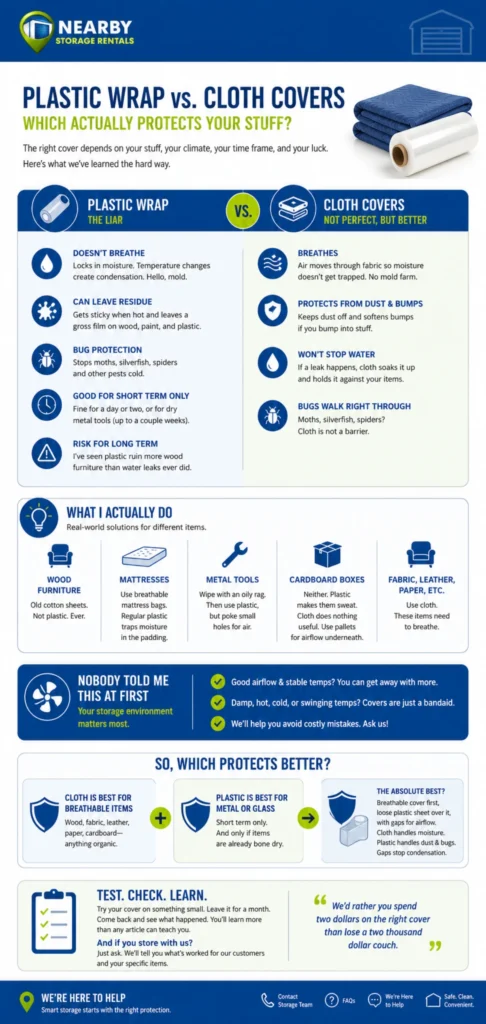
Plastic does not breathe at all. Zero. So any moisture that’s already in the air or in your item gets locked inside. Then the temperature changes overnight. That moisture turns into condensation. Now your couch is sitting inside a wet plastic bag.
You won’t know this happened until you come back. And by then? Mold has already had a party.
I’m not saying plastic is useless. If you’re moving something across town for one day? Fine. Wrap it. If you’re storing metal tools for two weeks in a dry climate? Maybe fine. But months? No. I’ve seen plastic ruin more wood furniture than water leaks ever did.
The other thing nobody mentions. Plastic gets sticky when it’s hot. Not like glue. But it leaves this weird residue on some surfaces. Wood. Painted stuff. Even some plastics. You peel it off and there’s this gross film. Now you’re scrubbing your own table with Goo Gone asking yourself why you bothered.
Cloth covers aren’t perfect either
Cloth covers don’t pretend to be armor. They’re just.. fabric. And that’s actually okay.
A heavy moving blanket or even a thick cotton sheet does a couple things right. It keeps dust off. It softens bumps if you bump into stuff. And most importantly, air moves through it.
That last part is huge. Air moving means moisture doesn’t get trapped. So your stuff dries out naturally. No mold farm hiding underneath.
But I have to tell you the bad part too.
Cloth won’t stop a leak. If water gets into your unit somehow, that blanket soaks it up and holds it against your stuff. Now you have a wet sponge sitting on your mattress. That’s worse than no cover at all.
Also bugs. Moths, silverfish, spiders? They just walk right through cloth like it’s not there. Plastic stops them cold.
So neither one wins every fight. You have to pick your enemy.
What I actually do with my own stuff
Here’s the honest truth. For anything I care about and plan to store longer than a month? I use cloth but I’m careful about it.
- For wood furniture? Old cotton sheets. Not plastic. Ever.
- For mattresses? There are special breathable mattress bags. Don’t use regular plastic. You’ll get mold in the padding and that mattress is done.
- For metal tools? I wipe them down with an oily rag first. Then I actually do use plastic because rust needs moisture and plastic keeps more moisture out than in if the tools are already dry. But I poke a couple small holes in the plastic so air can move a tiny bit. Works fine.
- For cardboard boxes? Neither. Plastic makes them sweat and get soft. Cloth does nothing useful. Just stack them on pallets so air goes underneath.
The thing nobody told me when I started
Your new storage environment matters more than your cover.
Seriously. If your unit has good air flow and stable temperature, you can get away with almost anything. If it’s damp or hot or cold and swinging around, your covers are just a bandaid.
We run our storage unit service with that in mind. When you rent from us, we don’t just hand you a key and disappear. We ask what you’re storing. We tell you if you’re about to do something dumb with plastic wrap. We’ve got extra cotton moving blankets at the front desk for like two bucks a day. Because we’d rather you spend two dollars than lose a two thousand dollar couch.
That’s not a sales pitch. That’s us not wanting to see you cry in our parking lot. Because we have. More than once.
So which one actually protects better?
Here’s my real answer. Not the blog answer. The real one.
Cloth protects better for anything that breathes. Wood. Fabric. Leather. Paper. Cardboard. Anything organic.
Plastic protects better for anything metal or glass, but only for short periods. And only if it’s already bone dry when you wrap it.
The absolute best? A breathable cover over the item. Then a loose plastic sheet over that, with gaps. The cloth handles moisture. The plastic handles dust and bugs. The gaps stop condensation.
But that’s extra work. Most of you won’t do that. And that’s fine. Just don’t use plastic alone on anything soft. I’m begging you.
One last thing
You’re going to read advice online that sounds very confident and very sure. Ignore that. Nobody who actually stores things for a living is that sure. We’ve all been surprised. We’ve all opened a unit and said “well I didn’t expect that.”
So test your covers on something small first. Leave it for a month. Come back and check. See what happened. Then you’ll know.
And if you’re storing with us, just ask. We’ll tell you what we’ve seen work for your specific stuff. Not what some article says. What actually happened in our units with our customers.
Because at the end of the day, the right cover depends on your stuff, your climate, your time frame, and your luck. And nobody can sell you that answer in a roll of stretch wrap.










0 Comments