
Quick Summary
Folding screens need protection from moisture, temperature swings, friction, and pressure, so the safest approach is to clean them gently, pad each panel, use breathable coverings, and store them upright in a stable indoor environment. Paper and fabric panels are especially sensitive to moisture, while wood frames can warp, crack, or damage their hinges when conditions change. Avoid plastic wrapping, garages, damp basements, and attics, and never stack items on the screen. When moving it, carry it upright and let it acclimate before unfolding.
So my sister called me last week in a total panic. She’d just pulled her folding screen out of storage and apparently it looked like something had been chewing on the bottom panels. She’s freaking out, sending me photos, asking what happened. And I’m sitting there looking at these pictures thinking, “yeah, I’ve been there.”
The thing is, I used to think storing a folding screen was the easiest thing in the world. Fold it up, stick it somewhere, done. Right?
Wrong. So wrong.
How I Ruined a Screen in Six Months
Let me tell you about my first screen. It was this gorgeous three-panel thing I picked up at an estate sale. Hand-painted, wooden frame, the works. I was so proud of it. Had it in my living room for like two years, loved looking at it every day.
Then I moved to a smaller apartment. No room for the screen. So I did what any reasonable person would do – I folded it up and put it in the corner of my closet. Figured it’d be fine there until I got a bigger place.
Eight months later I pulled it out. The bottom of one panel had this weird white fuzzy stuff growing on it. The paint on the frame was actually cracking in places. And the hinges? Stiff as hell. I tried to unfold it and one of the panels literally separated from the frame. Just… came off in my hands.
I was so mad at myself. That screen was beautiful and I’d basically killed it through sheer ignorance.
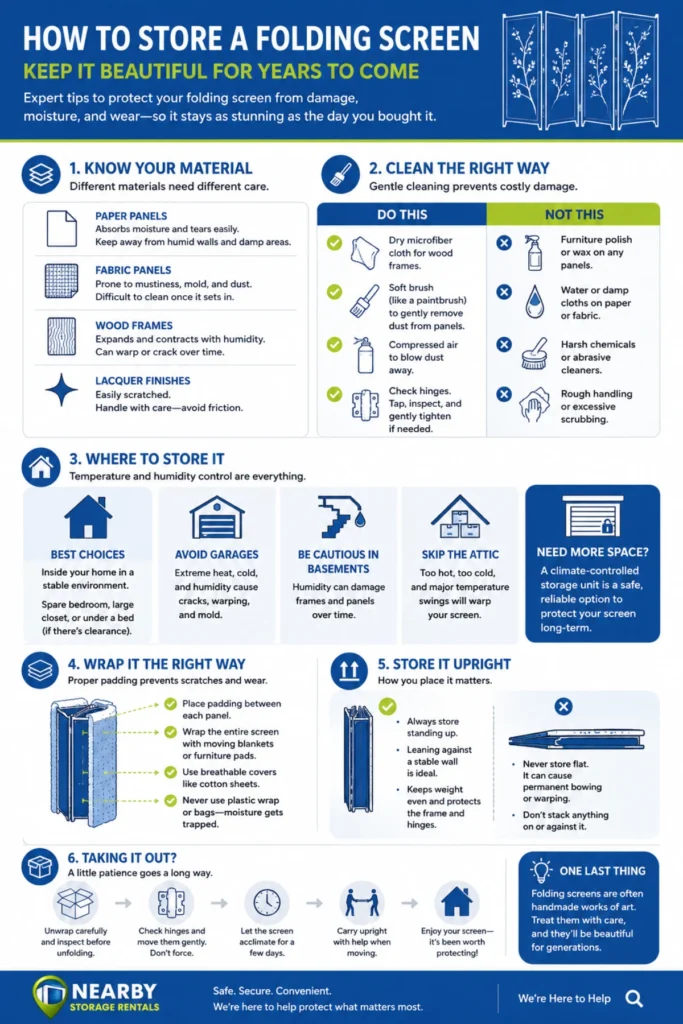
The Material Thing Nobody Warns You About
Okay so here’s the thing about folding screens. They’re all different, and you cannot treat them the same way. I learned this after my second screen started having issues too.
If your screen has paper panels, you gotta be extra careful. Paper absorbs moisture like crazy. It also tears if you look at it wrong. My friend has a screen with these delicate rice paper panels and she stored it touching a wall for a few months. The paper basically glued itself to the wall from humidity. She had to peel it off and it ripped. She cried. I don’t blame her.
Fabric panels? Same problem but different. They get musty. They get moldy. They attract dust and then that dust gets ground into the fabric fibers. It’s gross and it’s almost impossible to clean properly.
Wood frames are tricky too. Wood moves. It expands when it’s humid, contracts when it’s dry. Do that enough times and your frame starts looking like a pretzel. I’ve seen warped screens that’ll never be straight again.
Lacquer finishes scratch if you breathe on them. Okay slight exaggeration but seriously, the tiniest bit of friction leaves marks. I’ve got a screen right now with scratches on the bottom from where it dragged across the floor when I was moving it. Still mad about that one.
The Cleaning Mistake Almost Everyone Makes
Here’s something I see all the time. People try to clean their screens before storing them, and they make it worse.
My neighbor used some furniture polish on her screen’s panels. Like, the kind you use on wooden tables. On paper panels. The polish soaked right through, stained everything, and basically ruined the artwork on them. She was heartbroken.
Water is another one. People think a damp cloth is fine for everything. It’s not. If you’ve got paper or fabric, water will damage it. Period. Even if you’re just trying to dust it.
What actually works? For wood frames, use a dry microfiber cloth. That’s it. If something’s really stuck on there, maybe a barely damp cloth but wring it out until you think it’s dry. Then wring it again. For the panels, use a soft brush. I use a paintbrush. Just sweep the dust off gently. Or get a can of compressed air and blow the dust away. Works like a charm.
And check the hardware while you’re at it. Give the hinges a little tap. Are they loose? Tighten them. But gently. I overtightened once and stripped the screw hole. Then I had a whole new problem.
Where to Actually Put the Darn Thing
This is where people really mess up. They just shove screens wherever there’s space. Don’t do that.
Garages are the worst. I cannot tell you how many screens I’ve seen ruined in garages. The temperature changes are brutal. Summer heat dries everything out. Winter dampness invites mold. My mom stored a screen in her garage for one winter and the frame cracked in three places. Three! She didn’t even notice until she went to use it again.
Basements are risky too. If your basement is finished and stays dry, fine. But most basements get damp. Even if you don’t notice it, the humidity is there. And it’s slowly destroying your screen.
Attics? Forget about it. Too hot, too cold, too everything. The temperature swings alone will warp your frame.
You know what works best? Somewhere inside your actual house. A spare bedroom, a big closet, even under a bed if you’ve got the clearance. Somewhere that stays the same temperature year round.
But let’s be honest, not everyone has room in their house. I live in a tiny apartment. There’s no spare bedroom. There’s barely a closet. That’s actually why I started looking into storage units. You just need somewhere that’s not going to destroy your stuff. That’s what our storage unit service is for – giving people a safe place for the things they can’t keep at home.
Wrapping It Up the Right Way
Okay so you’ve found a good spot. Now you gotta wrap the screen properly.
Don’t just throw a sheet over it. That does nothing. You need actual padding. Moving blankets are great. Furniture pads work too.
Here’s the key thing. Put padding between each panel when you fold the screen. Those panels are gonna rub against each other every time you move it. Over time that rubbing causes wear. I’ve seen screens with permanent marks from this. It’s totally preventable.
Wrap the whole thing up nice and snug. But not too tight. You want protection, not compression.
And whatever you do, don’t use plastic wrap or bags. Plastic traps moisture. Moisture causes mold. Mold destroys screens. It’s a chain reaction you want no part of.
Use cotton sheets if you want to cover it. Something breathable.
How to Actually Place It in Storage
This seems simple but it’s important. Always store your screen standing up. Never flat.
I stored a screen flat once. Under my bed. For about a year. When I pulled it out, the frame had a permanent bow in it. It would never stand straight again. I was so annoyed with myself.
Standing up keeps the weight distributed properly. It doesn’t stress the hinges or the frame. Just lean it against a wall somewhere stable. Make sure it won’t fall over.
Also, don’t stack anything on it. I know, obvious right? But people do it. I’ve seen boxes stacked on screens, other furniture leaned against them. It’s crazy. These things aren’t tables or supports. They’re delicate.
The Big Move
When you eventually take your screen out of storage, take your time. Unwrap it carefully. Check everything before you try to unfold it. Sometimes hinges get stiff in storage and you don’t want to force anything.
If you’re moving it somewhere, always carry it upright. Get help if you can. These things are awkward. Trying to carry one by yourself is a recipe for disaster.
And here’s something most people don’t think about. When you bring your screen out of storage, let it sit for a few days before you do anything with it. If it’s been in a different environment, it needs time to adjust. Let it acclimate slowly.
One Last Thing
Look, I know this seems like a lot of fuss for a piece of furniture. But folding screens are special. They’re not like a bookshelf or a table. They’re delicate, they’re often handmade, and they’ve got character. They deserve better than being treated like an afterthought.
Take the time to store yours right. I wish I had with my first screen. I still think about that one sometimes. That hand-painted thing that I destroyed through sheer carelessness. Don’t be me. Learn from my mistakes.
Your screen will thank you. And when you pull it out years from now and it looks exactly like it did when you put it away, you’ll be glad you took the extra time.









0 Comments