
Quick Summary
Residential storage units are usually the better choice if you need flexible access, quieter surroundings, personal storage, and a lower monthly cost, while commercial storage makes more sense for businesses needing daytime access, wide driveways, or heavy-duty security. The biggest mistake is choosing based only on price or how nice a facility looks. Storage unit access hours matter most, especially if you work late or need your belongings on weekends. Before signing a lease, visit the facility at the time you actually expect to use it and check the lighting, security, parking, and overall feel.
I am going to be honest with you. Before I got into this business, I thought a storage unit was just a storage unit. You rent a box. You throw your stuff in. You leave. Done.
Man, was I wrong.
The location – and I mean the specific type of location – changes everything. And most persons don’t figure this out until after they have already signed a six-month lease and they are standing in front of their unit at 9 PM realizing they cannot even get in.
So let me save you that headache.
Residential vs commercial storage units at a glance
| Factor | Residential | Commercial |
| Best for | Personal storage; flexible access; quieter surroundings | Businesses needing daytime access, wide driveways, heavy-duty security |
| Cost | Usually lower monthly cost | Often priced for business use |
| Biggest mistake | Choosing on price or looks alone | Ignoring access hours that matter most for your schedule |
| Access hours | Often more flexible for personal schedules | May align with business daytime needs |
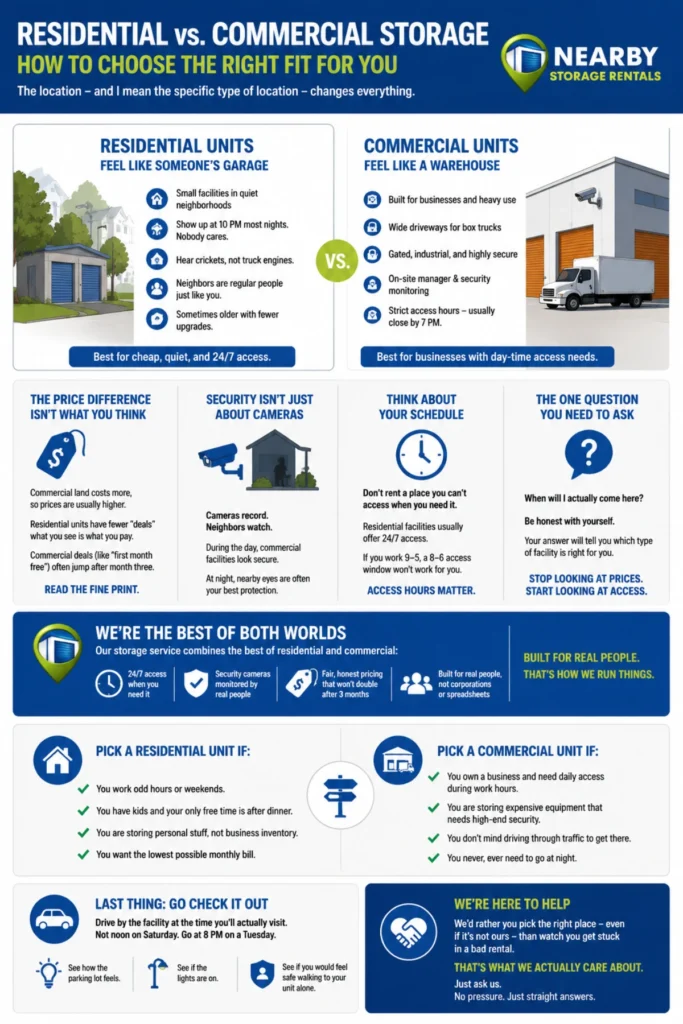
Residential units feel like someone’s garage
You know that feeling when you pull into a quiet neighborhood? Street lights. Trees. Maybe a kid riding a bike. That is the vibe of a residential storage facility.
These places are usually small. One building. Maybe two. Not flashy. Sometimes the sign is even a little faded.
You will find them behind a shopping plaza, or on a side street that dead ends into some woods. They are not trying to impress you. They are just there.
Here is what that means for you:
- You can show up at 10 PM most nights. Nobody cares.
- You will hear crickets, not truck engines.
- Your neighbors are regular people. Teachers. Retired couples. A dad storing his fishing boat for winter.
The downside? These places sometimes get lazy with upgrades. Old lights. A gate that breaks once a month. Nothing dangerous, just… tired.
But if you want cheap and quiet? This is your spot.
Commercial units feel like a warehouse
Now drive five miles toward the highway. You know those big orange and white buildings with the giant roll-up doors? The ones where every single light works and there is a camera on every corner?
That is commercial storage.
These facilities are built for businesses. A plumber storing pipes. A boutique owner keeping extra inventory. A contractor with three job sites worth of tools.
You will notice the difference immediately when you pull in.
- The driveway is wide enough for a box truck. Not a minivan. A full box truck.
- The gate is heavy. Industrial.
- There is probably an office with a manager sitting there right now, watching a bank of security monitors.
Here is what nobody tells you though. Commercial units are a pain if you are just a regular person. Because they assume you run a business. So they close at 7 PM. Every single day. Sundays? Forget it. Half day if you are lucky.
You work late? Too bad. You need to grab your camping gear for a last minute trip at 9 PM? Not happening.
The price difference is not what you think
Everyone assumes commercial units cost more. And yeah, usually they do. But not for the reason you think.
Commercial land is expensive. The facility pays higher property taxes. They pass that to you.
But here is the sneaky part. Residential units often have fewer “deals.” The price you see is the price you pay. Month after month. No gimmicks.
Commercial units? They will hit you with “first month free” or “50% off for three months.” Sounds great. Until month four when your bill jumps eighty bucks. And now you are stuck because moving all that stuff again is a nightmare.
I have watched people fall for that so many times.
Security is not about cameras. It is about eyes
Walk through a commercial facility during the day. Cameras everywhere. Keypads. Motion lights.
Now walk through that same facility at 2 AM. Guess what? Those cameras are still there. But who is watching? Nobody. Just a recording.
Residential facilities often have something better. Actual neighbors. Apartments, houses, small businesses nearby. People who notice when a stranger is messing around at midnight.
Do not get me wrong. Cameras are good. But a retired guy smoking a cigarette on his porch at 11 PM? That is the best privacy system you will ever find.
You need to think about your own schedule
Here is where most people mess up.
They rent a commercial unit because the facility looks nice and professional. Brand new. Clean. Great website.
Then they realize they can only get in there between 8 AM and 6 PM Monday through Friday. And they work 9 to 5. So they literally cannot access their own stuff unless they take a day off work.
Read that again. Slowly.
You just paid money to store your things in a place you cannot reach.
Residential facilities usually have 24/7 access. Not always. But usually. Because they know their customers are normal humans with weird schedules. People who think “I will move that couch at 9 PM” and actually mean it.
The one question you need to ask before renting
Stop looking at prices. Stop looking at pictures online.
Ask this question instead: When will I actually come here?
Be honest with yourself.
If you are storing Christmas decorations and you only need them once a year? Then access hours do not matter. Go with the cheapest option. Residential or commercial. Does not matter.
But if you are storing tools you need every weekend? Or winter clothes you might grab on a random Tuesday night? Then access hours are everything.
I have seen a guy rent a beautiful commercial unit for his mountain bike. Paid extra for the climate control. Nice wide hallway. Loved it. Except he could only get his bike out on Saturday mornings. Every single time he wanted to ride after work? Could not do it. He broke the lease after two months.
Let me tell you what we do different
Our storage service sits right smack in the middle of this whole debate. We are not purely residential. We are not purely commercial. We picked locations where you get the good parts of both without the headaches.
You want to show up at 9 PM? Our gates are open. You want security cameras that actually get checked by a human? We do that too. You want a price that does not magically double after three months? That is how we run things.
We built this for real people. Not corporations. Not spreadsheets. Just folks who need a place to put their stuff without jumping through hoops.
So which one should you pick?
Let me make this simple.
Pick a residential unit if:
- You work odd hours or weekends.
- You have kids and your only free time is after dinner.
- You are storing personal stuff, not business inventory.
- You want the lowest possible monthly bill.
Pick a commercial unit if:
- You own a business and you need daily access during work hours.
- You are storing expensive equipment that needs high end security.
- You do not mind driving through traffic to get there.
- You never, ever need to go at night.
That is really it. The rest is just noise.
Frequently Asked Questions
Q1. Are residential and commercial storage labels enough to choose a unit?
Residential and commercial labels are not enough to choose a suitable unit.
Operators may use those terms differently, while actual access, permitted uses and equipment vary.
We recommend comparing the agreement and specific site features rather than assuming either label guarantees a particular price, security standard or level of business support.
Q2. Can a business use a unit marketed for household storage?
A business may use a household-marketed unit only when its intended use is permitted by the rental and applicable rules.
Ask about inventory, deliveries and visit patterns explicitly.
Storing business belongings is different from operating a staffed workplace, receiving customers or carrying out activities the site has not authorized.
Q3. Is commercial storage always more expensive than personal storage?
Commercial storage is not always more expensive than personal storage.
Prices depend on the particular unit, location, terms and included services.
Compare suitable available options using their actual charges rather than treating the marketing category as proof that one rental will cost less or provide better value for your use.
Q4. What should home-based businesses ask before renting storage?
Home-based businesses should explain the intended goods, visit frequency and delivery requirements before renting.
Confirm permitted activity and any relevant coverage conditions in writing.
Nearby Storage Rentals recommends resolving practical limits early instead of assuming that permission to store boxes also authorizes order packing, charging equipment or regular customer collections on-site.
Q5. Does residential storage guarantee quieter visits?
A residential storage label does not guarantee quieter visits.
Activity depends on the site's users, layout and operating patterns.
Check the environment when you would normally visit, while recognizing that a short tour cannot promise future conditions or establish that a commercial-marketed alternative will necessarily be busier.
Q6. How should I compare security across commercial and residential storage?
Compare the actual security arrangements across both types rather than ranking labels.
Ask about access controls, maintenance and reporting procedures while reviewing your own coverage responsibilities.
No category guarantees protection, and a marketing description should not replace checking whether the specific site and rental terms suit the belongings you plan to store.
Q7. Can a personal storage rental receive business deliveries?
Receiving business deliveries depends on the operator's policy and your agreement, even if the stored goods themselves are allowed.
Confirm acceptance, access and handling arrangements before using the address.
Do not assume staff will receive parcels, sign for freight or move stock into the unit as part of an ordinary rental.
Q8. When should I choose specialist business storage instead of an ordinary unit?
Consider specialist business storage when ordinary rental terms or access arrangements do not support your actual stock and workflow.
Identify the unmet requirement before comparing alternatives.
We suggest choosing a service that explicitly accommodates it rather than attempting to turn a convenient personal unit into a workplace or delivery hub without permission.
Last thing
Go drive by the facility before you sign anything. Do it at the time you will actually visit. Not noon on a Saturday when everything looks great. Go at 8 PM on a Tuesday. See how the parking lot feels. See if the lights are on. See if you would feel safe walking to your unit alone.
Trust your gut. Not the website photos. Not the Google reviews.
Your gut knows.
And if you want help figuring this out without the sales pitch? Just ask us. We would rather you pick the right place – even if it is not ours – than watch you get stuck in a bad rental for six months.
That is what we actually care about.









0 Comments