
Quick Summary
You generally need just a few things to rent a storage unit: a government-issued photo ID, proof of your current address if your ID is outdated, and a credit or debit card for payment. You may also need proof of insurance, a second ID for certain situations, or a notarized power of attorney if you’re renting for someone else. Most facilities provide the rental agreement, and many accept digital documents, but bringing physical IDs is still smart. Before you go, have your ID, address proof, payment method, and insurance information ready.
So, you’ve finally decided to clear out that spare bedroom or get your garage back from the pile of boxes that’s been multiplying since last year. Good for you. Renting a storage unit is one of those “why didn’t I do this sooner?” decisions, especially when you start wondering what documents need long term business storage for organizing important files properly.
But then comes the practical part. You show up ready to sign on the dotted line, and suddenly you’re worried you forgot some obscure piece of paper.
Let me put your mind at ease. I’ve been around this business long enough to know exactly what trips people up and what you actually need to bring. Spoiler alert: it’s usually less than you think.
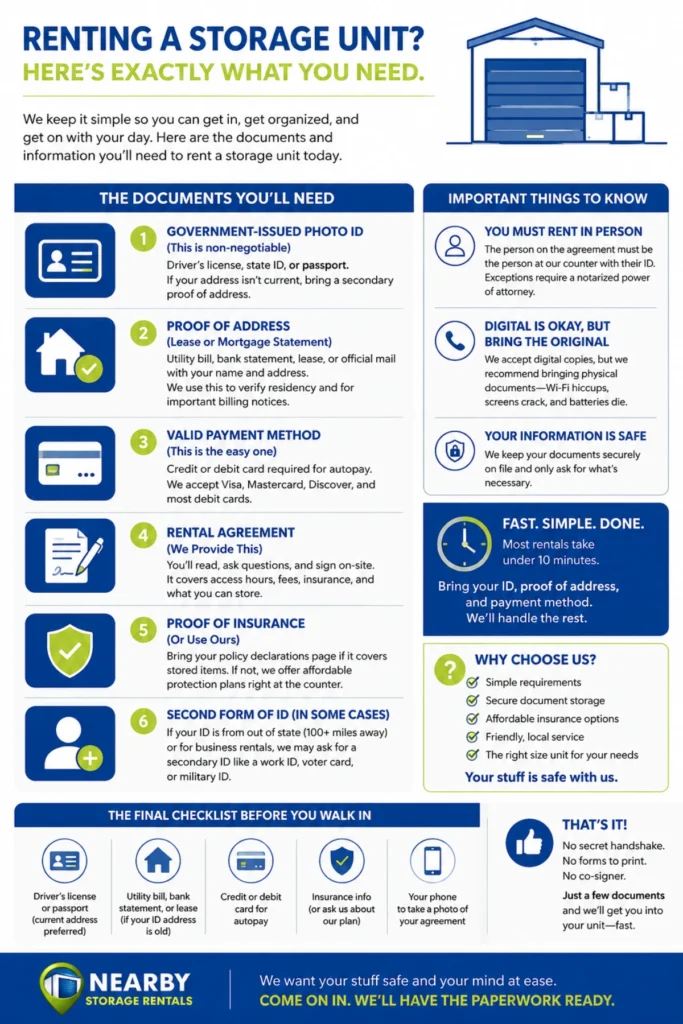
Here’s the straightforward, no-nonsense list of documents you’ll need to rent a storage unit today.
Your Government-Issued Photo ID (This is non-negotiable)
Think driver’s license, state ID, or a passport. We need to know who you are. It’s not that we don’t trust you—it’s that we have to protect you. If someone else ever tried to access your unit, that ID is the first thing we check.
Make sure the address on your ID is current. Is it not? No worries. Just bring a secondary proof of address along with it (more on that in a second).
Your Lease or Mortgage Statement (Wait, really?)
This one surprises a lot of you, and I get it. You’re thinking, “Why does a storage space care where I live?”
Here’s the honest answer: storage units are prime targets for fraud if a facility isn’t careful. We ask for proof of your home address for two simple reasons. First, to confirm you live nearby (or have a legitimate reason to rent from us). Second, for billing and legal notices. If we ever need to reach you about your unit, we need to know you’re getting your mail.
A utility bill, a bank statement, or even a piece of official mail with your name and address on it works perfectly. It doesn’t have to be fancy.
A Valid Payment Method (This is the easy one)
You’d be shocked how many people show up with a pocket full of cash and no card. We love cash as much as you do. But almost every storage facility—including ours—needs a credit or debit card on file for the autopay system.
Why? Because we don’t want to auction off your stuff. Ever. That’s the worst day for us and for you. Autopay ensures you don’t accidentally miss a payment while you’re on vacation or buried in a work project. Bring your Visa, Mastercard, Discover, or a debit card linked to your bank account.
The Rental Agreement (We Provide This, Don’t Stress)
You won’t need to print anything out before you arrive. We handle that part. You just need to read it, ask questions if something looks weird, and sign it. And please—actually read it. I’m serious.
The agreement tells you everything: access hours, late fee policies, insurance requirements, and whether you can store a classic car or just grandma’s china. Take your five minutes to scan it. Your future self will thank you.
Proof of Insurance (Or Use Ours)
Here’s where a lot of you get confused. Many people think their homeowner’s or renter’s insurance covers items in a storage unit. Sometimes it does. Sometimes it doesn’t. You need to check.
If your policy covers stored belongings, bring that declarations page to us. If not, don’t panic. At our storage unit service, we offer affordable protection plans right at the counter. It adds pennies to your monthly bill and covers you if something wild happens—like a pipe burst or a roof leak (rare, but we’re being honest here).
A Second Form of ID (In Some Cases)
This isn’t always required, but I’m telling you now so you’re not caught off guard. If your driver’s license is from out of state (more than 100 miles away), or if you’re renting the unit for a business, we might ask for a secondary ID.
That could be a work ID, a voter registration card, or even a military ID. It just helps us verify you’re a real person, not a ghost.
What About Renting for Someone Else?
You can’t. Well, you shouldn’t try. The person whose name is on the agreement must be the person standing at our counter with their ID. The only exception is if you have a notarized power of attorney document. That’s rare, but it happens.
If you’re a parent renting for a college kid, just have your son or daughter sign. It protects them, and it protects us.
A Quick Word on Digital Documents
We live in a digital world. I know that. Most of our facilities accept digital copies of your documents right on your phone. But here’s my advice: bring the physical card anyway. Wi-Fi hiccups. Screens crack. Batteries die. A physical driver’s license never runs out of battery.
Why We Make This So Simple (And Why You Should Choose Us)
Look, I’ve rented from places that made me feel like I was applying for a mortgage just to store a few boxes of winter coats. That’s not how we run things.
Our storage unit service keeps your documents on file securely, asks only what’s necessary, and gets you into your unit in under ten minutes. You bring your ID, a proof of address, and a payment method. We’ll handle the rest—including walking you through the insurance part and showing you exactly which size unit fits your stuff.
Frequently Asked Questions
Q1. What documents should I confirm before arriving to rent a storage unit?
Ask the facility which documents apply to your rental before arriving.
Identity, billing, coverage and authorization requirements can vary by situation and storage type.
We recommend using a confirmed checklist rather than assuming every facility follows the same rules or that a general online list establishes what your booking requires.
Q2. Can an expired identity document delay a storage rental?
An expired identity document can delay a rental if the facility requires current identification.
Ask which documents it accepts before traveling with a load.
Do not assume an alternative will be accepted on the spot, and use the facility's approved process rather than sending unnecessary personal information through an informal channel.
Q3. Will digital copies of rental documents always be accepted?
Digital copies of rental documents are not always accepted for every purpose.
Ask the facility what format and verification method it requires, especially for identity or legal authorization.
Nearby Storage Rentals suggests confirming this before arrival rather than relying on a phone photograph where an original or a particular submission process is necessary.
Q4. Do I need different paperwork to rent storage for a business?
Business storage may require additional paperwork or account arrangements depending on the facility and your authority to sign.
Ask what applies to the specific business and intended use before booking.
Do not assume a personal rental checklist automatically establishes permission to store company property or act on an organization's behalf.
Q5. What should I check before signing a storage rental agreement?
Check the assigned unit, charges, rate-change terms, access, coverage responsibilities and move-out requirements before signing.
Ask for clarification of anything uncertain and keep a copy.
A quick signing process should still allow you to understand the agreement rather than treating the document as a formality after choosing the space.
Q6. Can I rent storage on someone else’s behalf with their verbal permission?
Verbal permission may not satisfy a facility's requirements for renting on someone else's behalf.
Ask what authorization and account structure apply before signing or moving belongings.
Appropriate legal advice may be needed for some circumstances, so do not assume a family connection or helpful intention replaces the necessary authority.
Q7. Should proof of insurance be checked before I move into storage?
Check any proof-of-insurance requirement before moving in and confirm your coverage actually applies to the stored belongings.
The facility's acceptance of paperwork does not itself define every policy term.
We recommend asking the insurer about limits and exclusions rather than treating a document submission as a guarantee of full protection.
Q8. How should I protect personal documents during the rental process?
Use the facility's approved secure process for required documents and share only what is necessary.
Ask how verification works if unsure, and keep your own copies appropriately protected.
Do not send sensitive records to an unverified contact merely because a storage listing or informal message claims additional paperwork is urgently needed.
The Final Checklist Before You Walk In
Before you drive over, run through this quick list:
- Driver’s license or passport (current address preferred).
- Utility bill, bank statement, or lease (if your ID address is old).
- Credit or debit card for autopay.
- Insurance info (or just ask us about our plan).
- Your phone (to take a photo of your agreement for your records).
That’s it. No secret handshake. No forms you need to print at home. No third cousin to co-sign.
We want your stuff safe and your mind at ease. And the only thing standing between you and an empty closet at home is about four pieces of paper and a five-minute conversation with us.
Come on in. We’ll have the paperwork ready.









0 Comments