
So you’ve decided you need some extra space. Maybe your garage is overflowing, you’re between homes, or your small business inventory has taken over your living room. You found a storage unit nearby — possibly even ours — and now you’re ready to grab that unit and be done with it. But wait.
Did you actually read the contract? I mean really read it, not just scroll to the bottom and tap “agree.”
I get it. Contract storage agreements look boring. They’re full of legal words and fine print that make your eyes glaze over. But here’s the truth — skipping the details before you sign a contract storage agreement can cost you time, money, and frustration later. Let me walk you through what actually matters, so you know exactly what you’re getting into.
The one thing most people ignore (but shouldn’t)
The biggest surprise for most people? The monthly rate isn’t always locked in.
Yes, you’ll see a nice low price on the website or the big sign out front. But many simple storage contracts include something called a “rate adjustment” or “promotional period” clause. That means after 30, 60, or 90 days, your rent can go up — sometimes without any warning other than a small line buried on page three.
When you look at your contract, scan for phrases like:
- “Introductory rate”
- “Subject to change with 30 days’ notice”
- “Market rate adjustment”
We believe in being clear from day one. That’s why when you rent a unit through our service, we highlight any promotional pricing in bold and tell you exactly when — and by how much — your rate could change. No hide-and-seek.
Late fees: small print, big hit
Let’s talk about late fees. Nobody plans to pay rent late, but life happens. Your card expires, you forget the due date changed, or you’re simply traveling.
Here’s what you need to check before signing:
- Grace period — How many days after the due date do you have before a late fee applies? Some places give 5 days, some give none.
- Fee amount — Is it a flat $15 or $20, or is it a percentage of your rent (which can be much worse)?
- Recurring fees — Does the late fee hit every week the payment is late, or just once?
I once had a customer tell me they owed almost double their original rent just from two months of small late fees stacking up. Don’t be that person. Read the late fee section like it’s a bank statement.
Access hours sound simple — until they’re not
You assume you can get your stuff whenever you want, right? Not always.
Some storage facilities have restricted gate hours. You might think you can grab your winter coats at 10 PM before a sudden cold snap, but if the contract says access is only 6 AM to 9 PM, you’re out of luck.
Also check:
- Is there 24/7 access? If yes, is that included in your base rent or an extra fee?
- Do you need a special code or keycard, and what’s the replacement cost if you lose it?
- Are there holidays where the entire facility closes?
We keep access simple for you — 24/7 access is standard with our units, no extra charge. But even then, the contract spells out the one or two days a year (like Christmas) when the whole lot is locked. Just so you know ahead of time.
What happens if you stop paying?
This sounds scary, but it’s practical. Every storage space contract has a section about lien sales or auctions. Basically, if you stop paying rent long enough, the storage company can sell your stuff to recover the money you owe.
What you want to know before signing:
- How many days past due before they lock you out of your unit? (Usually 10–30 days)
- How many days before they auction your belongings? (Often 30–90 days)
- Do they have to send you written notice, or just email? (Written notice is better for you)
- Can you get your stuff back after lockout by paying everything you owe?
Make sure the contract clearly says how and where they will contact you. If they only send a letter to an old address, you might never see the warning. We always send a text, email, and letter — because we want you to keep your things, not lose them in an auction.
Auto-pay is convenient, but read the cancel terms
A lot of storage places push auto-pay hard. And honestly, it’s handy — one less bill to remember. But here’s what people miss: how do you turn it off?
I’ve seen contracts where you have to send a written letter or fill out a physical form to stop auto-pay. No phone call allowed. No online button.
Before you sign, find the cancellation or auto-pay section and look for:
- Can you cancel auto-pay online?
- Do you need to give 30 days’ notice even if you move out sooner?
- Is there a fee to switch from auto-pay to manual pay?
Our system lets you turn auto-pay on or off in two clicks from your phone. But even if you use our service, the contract still clearly states you can cancel auto-pay at any time without penalty. That’s how it should be.
Rent due dates and prorated rent
You move in on the 15th of the month. Does your contract charge you for the full month anyway? Or do they prorate it — meaning you only pay for the days you actually use?
Some contracts automatically charge full months regardless of move-in date. Others give you a prorated first month but not a prorated final month when you leave.
Look for:
- “First month prorated” or “Full month required”
- “Final month automatically prorated” or “Final month billed as full month regardless of move-out date”
A good contract won’t hide this. It should be right there near the top. We put our prorated policy in the very first paragraph of the rental terms, because nobody likes overpaying for days they didn’t use.
Your responsibility vs. their responsibility
Here’s a hard truth: most storage contracts say the facility is not responsible for damage to your stuff from things like:
- Leaky roofs (unless they knew about the leak and ignored it).
- Pests (mice, bugs, etc.).
- Flooding from heavy rain.
- Vandalism if the gate logs show you let someone in.
That doesn’t mean you have no protection. It just means you usually need renter’s insurance or storage insurance. Some facilities require proof of insurance. Others sell you a cheap policy at move-in.
Before you sign, check:
- Does the facility require insurance? If yes, what’s the minimum coverage?
- If they offer insurance, how much per month and what does it cover (fire, flood, theft)?
- Are you allowed to use your own homeowner’s or renter’s insurance instead?
We offer affordable insurance options through our service, but you’re always welcome to use your own. Just show us the proof, and we’re good. But don’t skip this — I’ve seen too many people lose everything to a pipe burst and assume the storage company would pay. They won’t. It’s in the contract.
Moving out: notice period is everything
This one catches people off guard constantly. You show up on the 1st with your truck, empty your unit, hand in the lock, and expect to be done. Then you get a bill for next month.
Why? Because your contract said you need to give written notice 15 or 30 days before moving out — even if you’re fully moved out.
Check for:
- How many days’ notice required (often 15, 30, or even 45 days)
- Does notice have to be in writing, or can it be by phone/email?
- If you don’t give notice, will they auto-renew your lease for another month (or longer)?
We keep it simple: 10 days’ written notice (email or in-person) and you’re done. No extra month charges. But we still put it in the contract in plain English because every customer deserves to know before they sign.
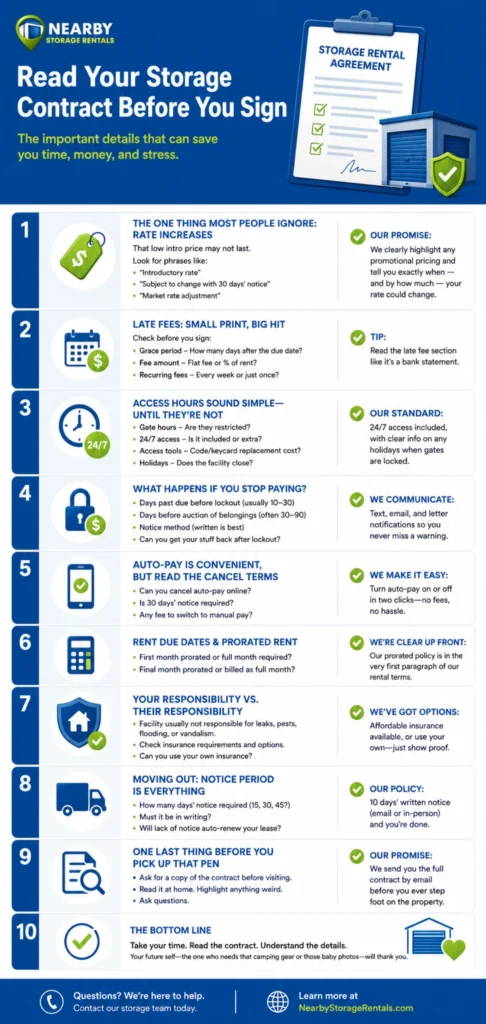
One last thing before you pick up that pen
I’m not trying to scare you away from renting a storage unit. Most people have a totally fine experience — especially if they understand the contract first. The problem happens when you assume something, the contract says something else, and suddenly you’re frustrated over a $50 late fee or a lost weekend trying to get your stuff out.
So here’s my honest advice: ask for a copy of the contract before you go to the facility. Read it at home with a cup of coffee. Highlight anything that seems weird. Then call and ask questions.
If a storage company won’t give you a contract to review in advance, that’s a red flag. Walk away.
When you rent with us, we send you the full contract by email before you ever step foot on the property. No surprises. No fine-print tricks. You should expect the same from any good storage service.
Take your time. Read the contract. Your future self — the one who needs that camping gear or those baby photos — will thank you.








0 Comments