
Quick Summary
Proper RV and motorcycle storage starts with choosing the right location and preparing the vehicle before you park it. Indoor storage offers the best protection, while covered storage works for shorter periods and outdoor storage needs extra protection. For motorcycles, clean and wax the bike, change fluids, protect the battery, and prevent tire damage. For RVs, remove food, winterize the water system, protect the tires, and seal openings against pests. Long-term storage also gives you better security, access, and less wear than leaving your vehicle outside or in a driveway.
Let’s be real – your bike or RV isn’t just some random vehicle. It’s your ticket to freedom, your weekend escape pod, maybe even your second home. So when it’s time to park it for a while, you want to do it right. No shortcuts, no “it’ll be fine” excuses.
I’ve seen too many people skip the basics and pay for it later – dead batteries, cracked tires, even mice nesting in the air filter (true story). Don’t let that be you. Here’s everything I’ve learned over the years to protect my own rides and help others do the same.
Where You Store Matters More Than You Think?
Parking in your buddy’s backyard might seem easy now, but wait until you see what happens after three months of rain, snow, or blistering sun. Here’s the breakdown:
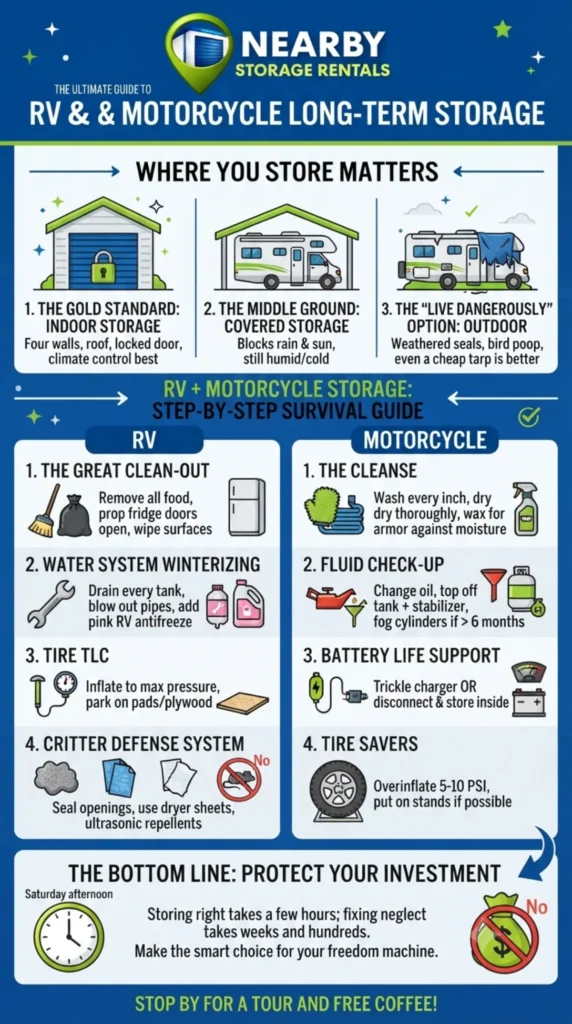
The Gold Standard: Indoor Storage
- What you get: Four walls, a roof, and usually a locked door between your baby and the outside world.
- Best for: Classic bikes, luxury RVs, or anything you really care about.
- Pro tip: Look for climate control if you’re in extreme hot/cold areas.
The Middle Ground: Covered Storage
- Good: Blocks rain and sun.
- Bad: Still gets humid, still gets cold.
- Works for: Short-term (think a month or two).
The “I Like to Live Dangerously” Option: Outdoor
- Only do this if: You enjoy replacing weathered seals and cleaning bird poop off your paint.
- Seriously: Even a cheap tarp is better than nothing.
RV Motorcycle Storage: A Step-by-Step Survival Guide
The Cleanse (No, Not Just a Quick Rinse)
- Wash every inch – brake dust eats through coatings over time.
- Dry thoroughly – water spots become permanent marks.
- Wax like you’re prepping for a show – this is armor against moisture.
Fluid Check-Up
- Change the oil (old oil turns acidic sitting in your engine).
- Top off the tank + add stabilizer (empty tanks collect condensation = rust city).
- Fog the cylinders if storing more than 6 months (ask your mechanic how).
Battery Life Support
- Option A: Trickle charger (the set-it-and-forget-it method).
- Option B: Disconnect and store inside (but check voltage monthly).
Tire Savers
- Overinflate by 5-10 PSI (combats slow leaks).
- Put it on stands if possible (no flat spots = no vibration at 70mph later).
The Final Wrap
- Breathable cover ONLY (plastic traps moisture = mold party).
- Stuff exhaust pipes with steel wool (trust me, you don’t want mice in there).
RV Storage: Protecting Your Rolling Castle
The Great Clean-Out
- Remove ALL food (even crumbs attract ants in minutes).
- Prop open fridge/freezer doors (prevents that death smell).
- Wipe down every surface (sticky spills turn into science experiments).
Water System Winterizing (Non-Negotiable)
- Drain every tank (fresh, gray, black – all of it).
- Blow out pipes with compressed air.
- Pour RV antifreeze in drains (the pink stuff – not car antifreeze!).
Tire TLC
- Inflate to max sidewall pressure (weight + time = sidewall cracks).
- Park on plywood or tire pads (concrete “sweats” and causes dry rot).
Critter Defense System
- Seal any openings bigger than a dime (mice can squeeze through crazy small spaces).
- Place dryer sheets everywhere (they hate the smell).
- Consider ultrasonic repellents (works for some, not all).
“But Do I Really Need to…” (FAQ Section)
Q: Can I just start it once a month instead of all this?
A: Sure, if you enjoy:
- Wearing out your starter motor.
- Never fully warming up the oil.
- Still getting a dead battery when you forget to visit.
Q: My uncle says he just parks his RV outside with a tarp – why can’t I?
A: Ask him how often he replaces:
- Faded upholstery.
- Cracked window seals.
- Chewed wiring harnesses.
Why Our Storage Beats Your Garage Facility?
Look, I get it – long term storage units seem like an extra expense. Until you factor in:
- No more tripping over your bike all winter.
- Not having to explain oil stains on your driveway.
- Actual security (versus “hoping” nobody messes with your RV).
We have:
- Drive-up access (no narrow hallways).
- On-site managers (real humans, not just cameras).
- Flexible leases (because life happens).
Frequently Asked Questions
Q1. How should I store an RV the right way?
Follow manufacturer guidance, confirm facility vehicle rules, and prepare fluids, batteries and covers as appropriate for the climate.
Choose a suitable outdoor or covered option.
Nearby Storage Rentals recommends verifying dimensions and access routes before arriving with a large RV that may not fit the assigned space.
Q2. What matters most when storing a motorcycle?
Stabilize the bike, protect it from weather and theft according to facility options, and address fuel and battery guidance for the storage length.
Use quality covers.
We recommend climate and security features matched to your bike rather than leaving it unprotected in an untreated outdoor spot.
Q3. Should RVs use covered or uncovered storage?
Covered storage can reduce sun and weather exposure, while uncovered may cost less depending on the site.
Compare protection needs.
Nearby Storage Rentals suggests weighing paint, seal and interior sensitivity against budget instead of assuming any outdoor parking is equivalent.
Q4. How do I prepare an RV battery for storage?
Battery prep depends on type and manufacturer guidance; some owners disconnect or maintain charge with approved methods.
Confirm facility power rules.
We recommend following equipment instructions rather than guessing a one-size approach for every battery chemistry carefully as needed when practical.
Q5. Can I store an RV with personal belongings inside?
Some personal items may stay inside if facility rules allow and weight distribution remains safe, but valuables may be better in a locked unit.
Ask about policies.
Nearby Storage Rentals recommends clarifying what may remain in vehicles versus what should move into a storage unit.
Q6. How often should I check a stored RV or motorcycle?
Check on a schedule suited to weather extremes, looking for cover damage, pests, tire conditions and leaks.
Keep visits practical.
We recommend planned inspections rather than leaving vehicles untouched for an entire off-season without any review carefully as needed when practical.
Q7. Do motorcycle covers replace secure parking?
Covers help with weather and dust but do not replace locks, lighting and site security.
Use both layers.
Nearby Storage Rentals suggests evaluating the facility security package rather than treating a cover as complete theft protection for a stored motorcycle.
Q8. What access features help RV and motorcycle storage?
Wide lanes, adequate turning space and clear entry hours matter for large or two-wheeled vehicles.
Tour the route.
We recommend testing access with your actual vehicle dimensions in mind instead of judging from a car-sized visit alone carefully as needed.
The Bottom Line
Storing right takes a Saturday afternoon. Fixing neglect takes weeks and hundreds of dollars. Your choice.
Next time stop by and we’ll show you the perfect spot for your ride. First coffee’s on us – because proper storage talk goes better with caffeine.
Got a storage horror story or pro tip? Hit the comments – let’s swap war stories.





0 Comments